Co-supervisor: Geir Olve Storvik
Background
We are getting data from a cooling system, where cooling water is circulating in a closed loop. The system is cooling a frequency converter, and is leaking continuously. Cooling water is refilled at irregular intervals, we do not know when the refill occurs.
The different systems are leaking at various rates, and a repair or replacement eventually has to be performed if the system is leaking too much.
We can get data from about 100 systems, on about 50 ships, and about 5 years of data from each.
Targets of research
- Estimate the rate of leakage
- Predict the optimal time of the next refill (given some criteria) with confidence levels
- Detect abnormal/ too high leakages
- Detect/estimate the degree of presence of a second fault mode (broken expansion vessel) where an increase in system temperature leads to an increase in system pressure.
Data
There are 6/7 streams of measurements that are relevant for the estimation. Sampling time is typically 10 minutes or less.
- Input pressure
- Output pressure
- Differential pressure
- Conductivity
- Temperature
- Power
- Running cooling pump
Examples:
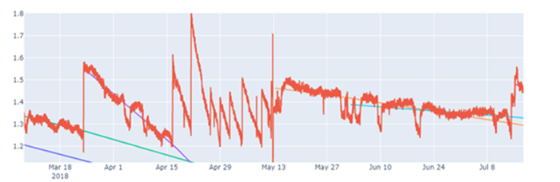
- A data sample showing the system input pressure vs time, with various leakage rates. Repair occurring at May 13th
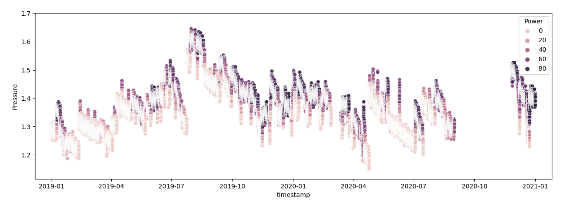
- Data sample showing a system with a strong correlation between power (and hence temperature) and input pressure. Indicating some presence of the second fault mode
This project provides an opportunity to apply a wide selection of statistical and machine learning methods to a real world problem. Any proposed method can be trained and validated on a large operational dataset.