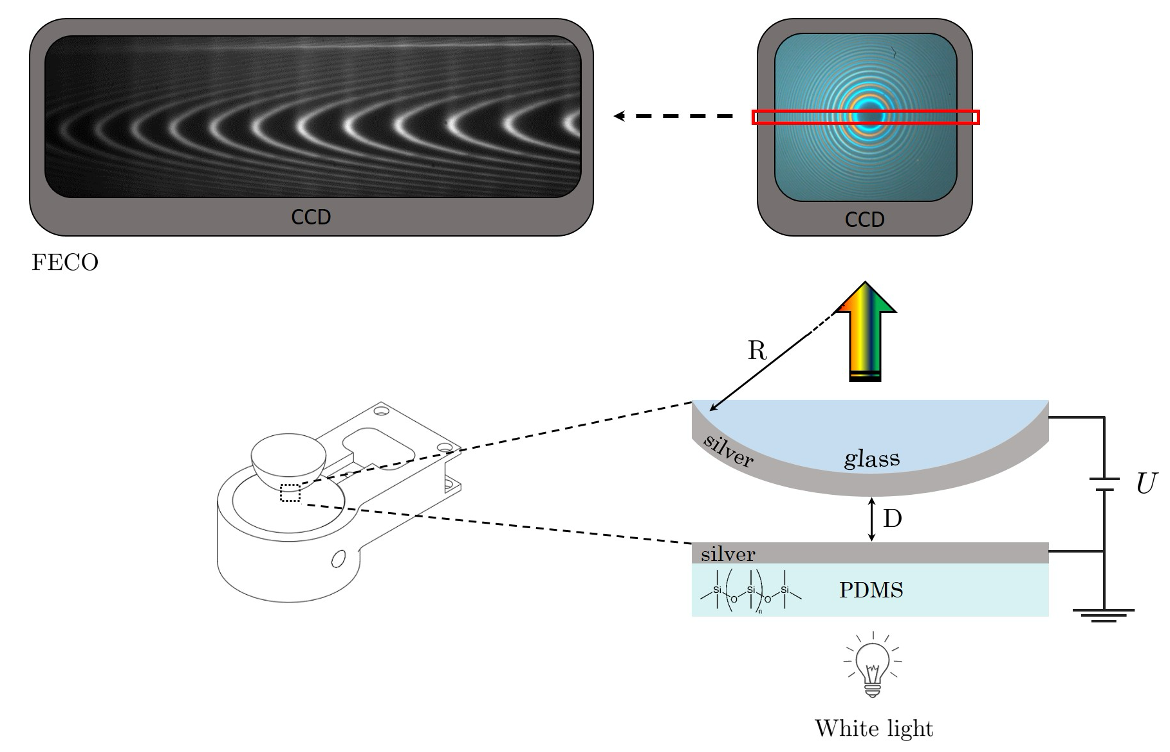
Compliant walls play a significant role in many systems of interest; deformable interfaces abound in systems of biological significance. To understand surface properties of gels (like wetting or adhesion), long-range deformations must be considered. Mammalian synovial joints display remarkable lubrication properties; however, the working mechanisms responsible for that performance, linking charged macromolecules and compliant boundaries, are still not well understood. In that sense, new exploring tools are needed for the precise exploration of the response to external perturbations of compliant boundaries. The main objective of this project is to develop a surface stress sensor (surface membrane sensor, SMS) based on precise determination of the deformation of a compliant membrane exposed to a changing environment, by using multiple beam interferometry. We also aim to build the necessary theoretical/numerical tools to rationalize the novel information gathered. Using this new tool, a combined theoretical-experimental approach will be implemented to investigate important topics in soft matter. First, the electrical double layer2 at a metal-solution interface and its behavior when it is pushed out of equilibrium, by measuring the compliant membrane deformation1 to determine the pressure field on the metal-liquid boundary. Then, we will study the elastohydrodynamic3 (EHD) coupling emerging when a solid object moves near an elastic membrane.
[1] Sajadi B, Goosen H,van Keulen F, International Journal of Mechanical Sciences, (2018), 210-218, 138-139
[2] Richter Ł, Zuk P, Szymczak P, et al., Physical Review Letters, (2020), 125(5)
[3] Vincent Bertin, Yacine Amarouchene, Elie Raphaël and Thomas Salez, J. Fluid Mech. (2022), vol.933,A23