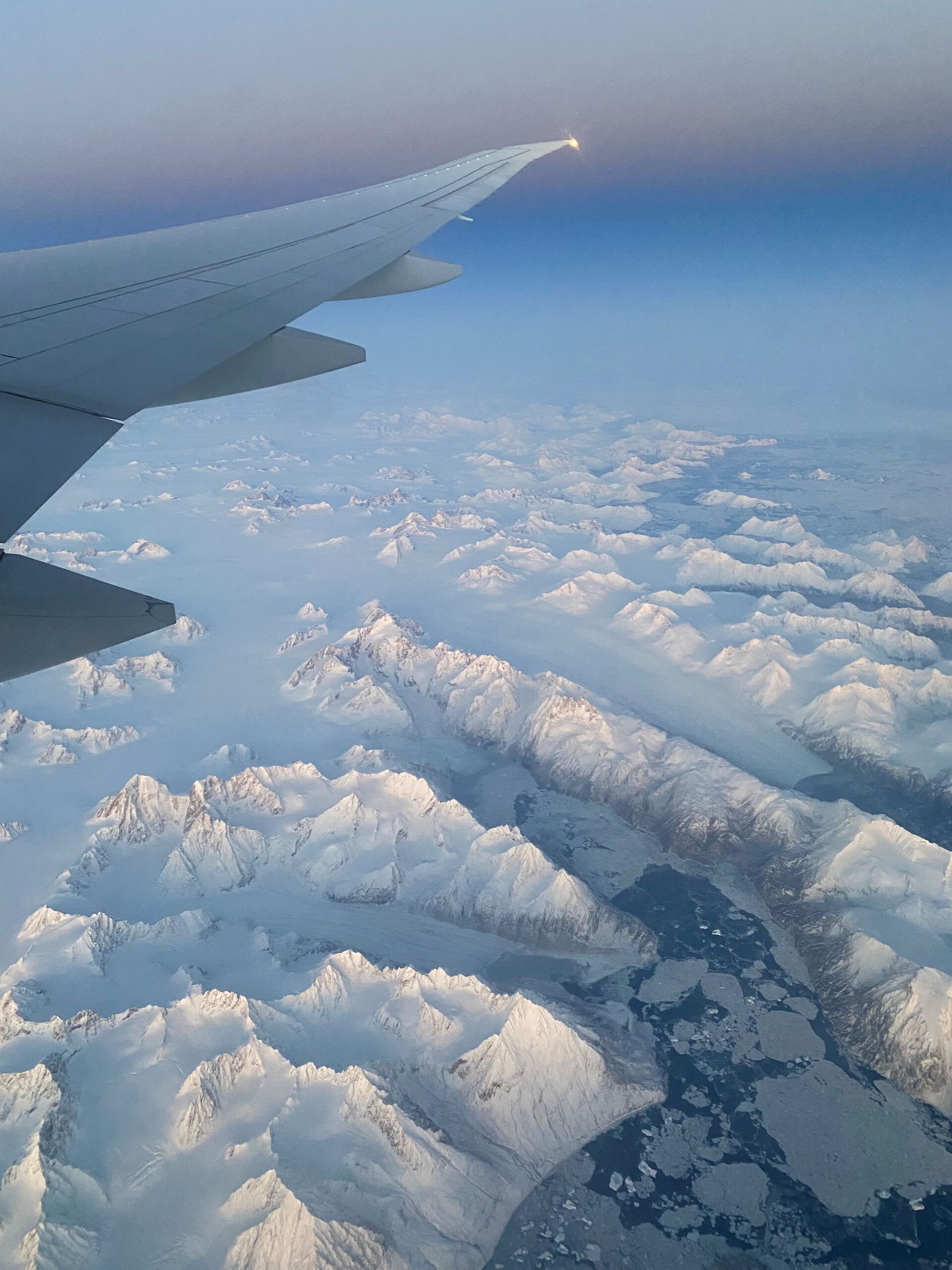
Satellite observations of ground movement show that the entire coastline of Greenland is uplifting. This uplift is caused by the ongoing deglaciation of the Greenland ice sheet. As Greenland loses ice mass, the earth beneath the ice decompresses and rises at rates of a few mm/yr. The southeast coast of Greenland, however, is uplifting unusually rapidly, at rates of more than 10 mm/yr. Numerical models of glacial isostatic adjustment (GIA), which compute the solid Earth’s response to deglaciation, have not been able to explain this rapid uplift.
Uplift rates depend not only on the deglaciation history, but also on the properties of the mantle beneath the melting ice. Of these properties, viscosity is particularly important, because it controls the rate at which rocks deform. Previous GIA models have mostly considered only depth-variations in viscosity, but Weerdesteijn and Conrad used a new GIA code that can also handle lateral variations in viscosity.
Before 40 million years ago, Greenland passed over the Iceland Plume. Weerdesteijn and Conrad thought that heat from the Iceland plume may have weakened the rocks beneath Greenland. Using their new GIA model, they assigned reduced viscosities to the upper mantle rocks along the track of the Iceland plume crossing Greenland. These models show that uplift rates are considerably amplified along the plume track: Uplift that would have occurred over the span of thousands of years instead happens in only hundreds of years above this weakened mantle. Southeast Greenland in particular uplifts rapidly in these models, as it is the part of Greenland that is closest to Iceland.
A similar uplift event may have occurred about 10000 years ago. Sea level indicators from the Early Holocene show that the ground surface of southeast Greenland rose above sea level quite rapidly following extensive deglaciation of Greenland at the end of the last ice age. Uplift rates during this period may have been nearly double the rates we see today, which indicates the potential for even faster ground uplift in the future as deglaciation accelerates. Such uplift is important because it affects the slope of the glacier beds, and thus affects the rates of future discharge from the ice sheet.
You can read the full article here.
Citation: Weerdesteijn, M. F. M., and C. P. Conrad (2024), Recent ice melt above a mantle plume track is accelerating the uplift of Southeast Greenland, Communications Earth & Environment, 5(1), 791, doi:10.1038/s43247-024-01968-6.