
Yixiao Zhou joined RoCS - Rosseland Centre for Solar Physics in April 2025, bringing valuable expertise from his previous roles in astrophysics.
From Beijing to the southern hemisphere
Originally from Beijing, China, Yixiao’s educational journey began there, culminating in an undergraduate degree in physics from Wuhan University. He continued his studies at the Australian National University in Canberra, where he pursued a PhD in astrophysics.

His prior research has been centered on computer simulations of near-surface regions of solar-type stars using the Stagger code—a magnetohydrodynamic tool closely related to the Bifrost code used at RoCS. His PhD dissertation explored significant questions in asteroseismology, focusing on internal stellar structures through the interpretation of oscillation frequencies.
Deepening the understanding of solar interiors
At RoCS, Yixiao will shift his focus from the stars’ surface to the deeper interior of the Sun using the DISPATCH code, an advanced successor to Stagger: - I’m particularly interested in studying the tachocline, an intricate region influencing stellar dynamics, he explains. - My main question revolves around understanding the extent of overshooting beneath the convective envelope.
A novel approach to stellar physics
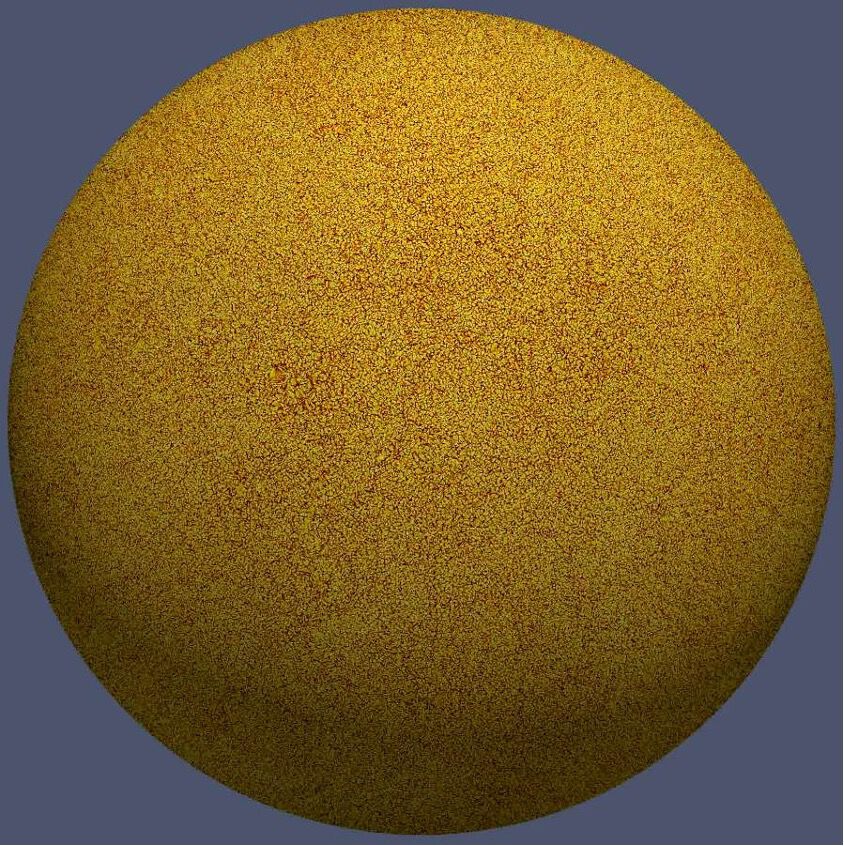
To tackle his research question, Yixiao plans to conduct extensive simulations that span from the Sun’s radiative interior to its surface, utilizing the state-of-the-art DISPATCH code.
By including elements like rotation, magnetic fields, and realistic input physics, we aim to create one of the most ambitious models in stellar astrophysics
he shares, emphasizing the project’s potential to provide deep insights into physical processes within the solar interior.
Finding inspiration at RoCS
Yixiao was drawn to RoCS after a visit in 2023, where he was captivated by the groundbreaking research conducted by the team. - The opportunity to work on cutting-edge science and contribute to important projects, such as the global solar convection simulations, motivated me to join RoCS, he reflects.
Looking ahead, Yixiao is eager to deepen his knowledge of the DISPATCH code and to contribute to prominent research outcomes at RoCS. - I hope to publish impactful results and further understand the physics of solar phenomena where RoCS excels globally, he expresses.
Settling into a new home
Yixiao describes his transition from Christchurch, New Zealand, to Oslo as both challenging and rewarding. - The academic mobility can be difficult, but it has enriched my understanding of diverse cultures and the beauty of our planet, he notes.
Beyond the lab
In his spare time, Yixiao is an avid sports enthusiast who enjoys football, table tennis, and hiking in Norway’s scenic landscapes, taking full advantage of easy access to the outdoors.
We are thrilled to welcome Yixiao Zhou to RoCS and look forward to his contributions to the field of solar physics.
Welcome aboard, Yixiao!