The frenchman Quentin Noraz has come to Oslo to work on the WholeSun ERC project; an European collaboration to better understand the functioning of the Sun.
By
Eyrun Thune
PublishedJune 8, 2023
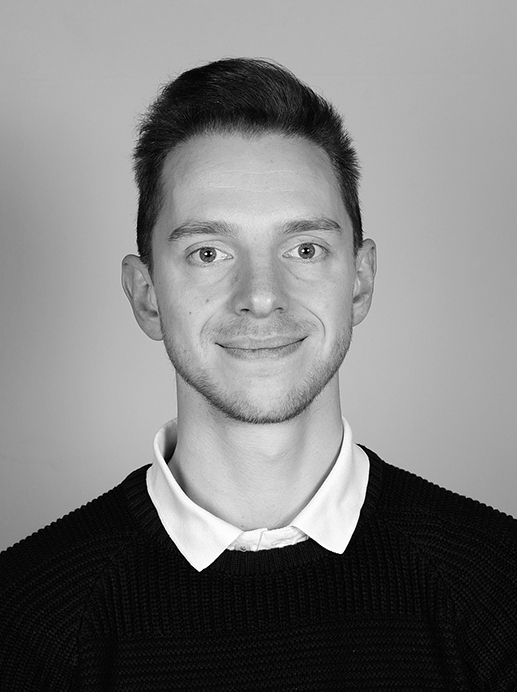
Quentin Noraz comes from the mountain village, Saint-Jean-de-Maurienne, Savoie, in the french Alps. He has worked as a Postdoctor at RoCS - Rosseland Centre for Solar Physics since November 2022. Photo: UiO
The RoCS - Rosseland Centre for Solar Physics team members are experts on the outer solar atmosphere (chromosphere and corona).The ultimate goal of the project is to develop a code capable of carrying out global simulations of the Sun.
Indeed, mechanisms responsible for its magnetic cycle, sunspots, and hot atmosphere remain incompletely understood, and the project seeks to shed new light on these phenomena.
- Where have you studied and worked before and in what field?
- Before joining RoCS, I studied at Paris Saclay & Paris Cité universities, and then worked at the LDE3 laboratory of the French Alternative and Atomic Energy Commission for my PhD.
I focused on the dynamics and magnetism of solar-type stars, using global numerical simulations to better understand their functioning and life.
The goal was to put the Sun back in its stellar context and to use it as a Rosetta stone to gain insight into the fundamental mechanisms taking place on both the Sun and other stars with similar properties.
This experience prepared me well for my current project at RoCS, which involves studying the origin of solar wind formation and the coupling of local and global MHD models using local simulations of the solar surface.
- What are you going to study?
- My role at RoCS is to leverage my experience in global simulations of solar-type stars to investigate smaller-scale dynamics and magnetism, with this time local simulations of the solar surface, an area in which RoCS expertise is recognized worldwide.
My primary research goal is to study the origin of atmospheric heating that leads to the formation of the solar wind and explore how this process applies to other solar-type stars.
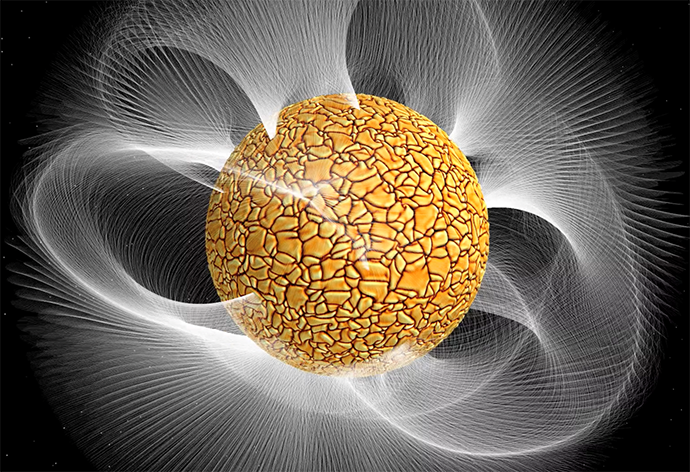
Figure 1: 3D simulation with the ASH code of the convection and dynamo of a solar-type star : convective radial velocity are represented in yellow/brown (rise/fall), beneath white magnetic field lines.
- How do you plan to answer to the main question?
- To conduct these investigations, various codes developed at RoCS will be used to simulate stellar surfaces and synthesize radiative emissions, which will then be compared to observations. My plan is to focus on studying the mechanisms taking place in the chromosphere and to bring new magnetic constraints through the coupling of local and global MHD models.
- What brought you to Oslo?
- I came to Oslo to be part of the WholeSun project at RoCS, being respectively a front-line project and a world leading team in the study of the Sun. As a young scientist, having the opportunity to work alongside pioneering experts in an international collaboration is an excellent chance for me to both contribute my experience and knowledge while further improving it.
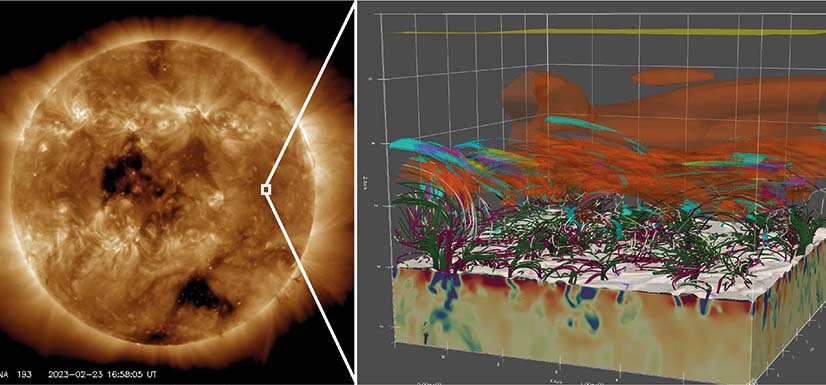
Figure 2: Comparison of UV solar observations (left) with Bifrost simulations (right).
The 3D visualization shows the simulated surface (white), which is above deeper convection (red/blue for rising/sinking cells) and below the small-scale magnetic field, represented with green, cyan and magenta surfaces highlight dissipations created by magnetized flows, which increase the temperature illustrated by orange and yellow surfaces.
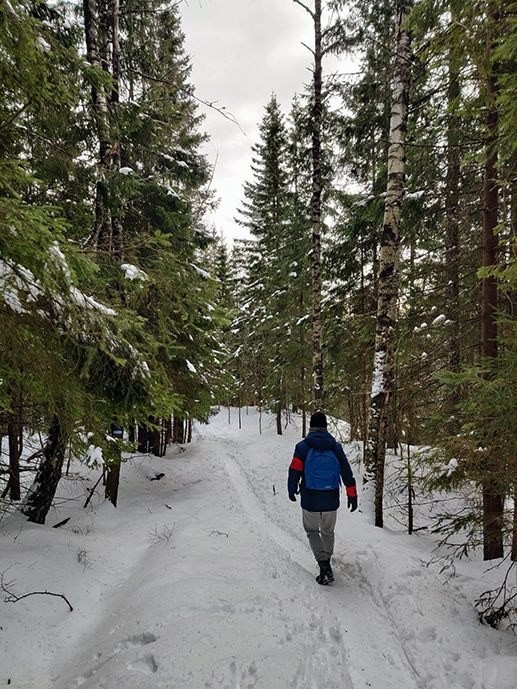
When I am not studying the Sun, I enjoy it during activities like biking, hiking, skiing, or simply spending time with family and friends. Norway offers some of the best opportunities for outdoor activities, and I feel grateful to be living in such a stunning environment.
Walking in the winter woods of Oslo. Photo: Private
- How can you describe your experience here at ITA and in Oslo so far?
- I have had a fantastic experience so far. The environment is stimulating, supportive, welcoming, and I am learning something new every day, which is exactly what I was aiming for.
- What do you expect from this experience?
- I have high expectations for my experience at ITA and in Norway. I hope to contribute to research and learn as much as possible from the experts at RoCS, and I am excited to explore Norway and its natural beauty.
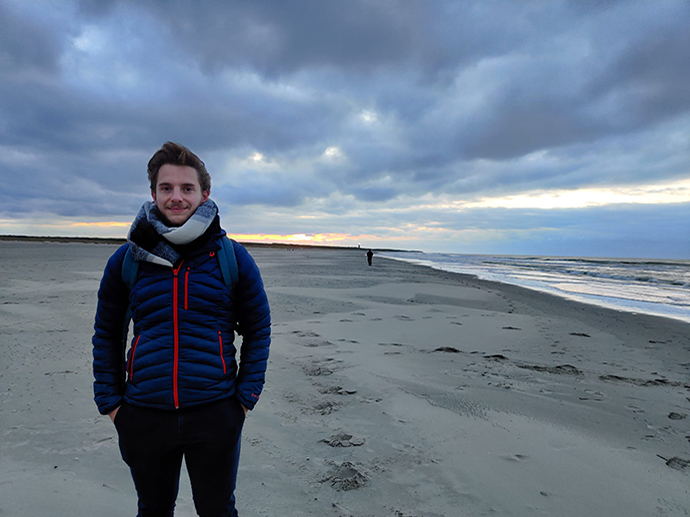
Quentin enjoys being outside in nature. Here seen on a beach in the Netherlands. Photo: Private
PublishedJune 8, 2023 7:33 AM - Last modifiedOct. 19, 2023 9:45 AM