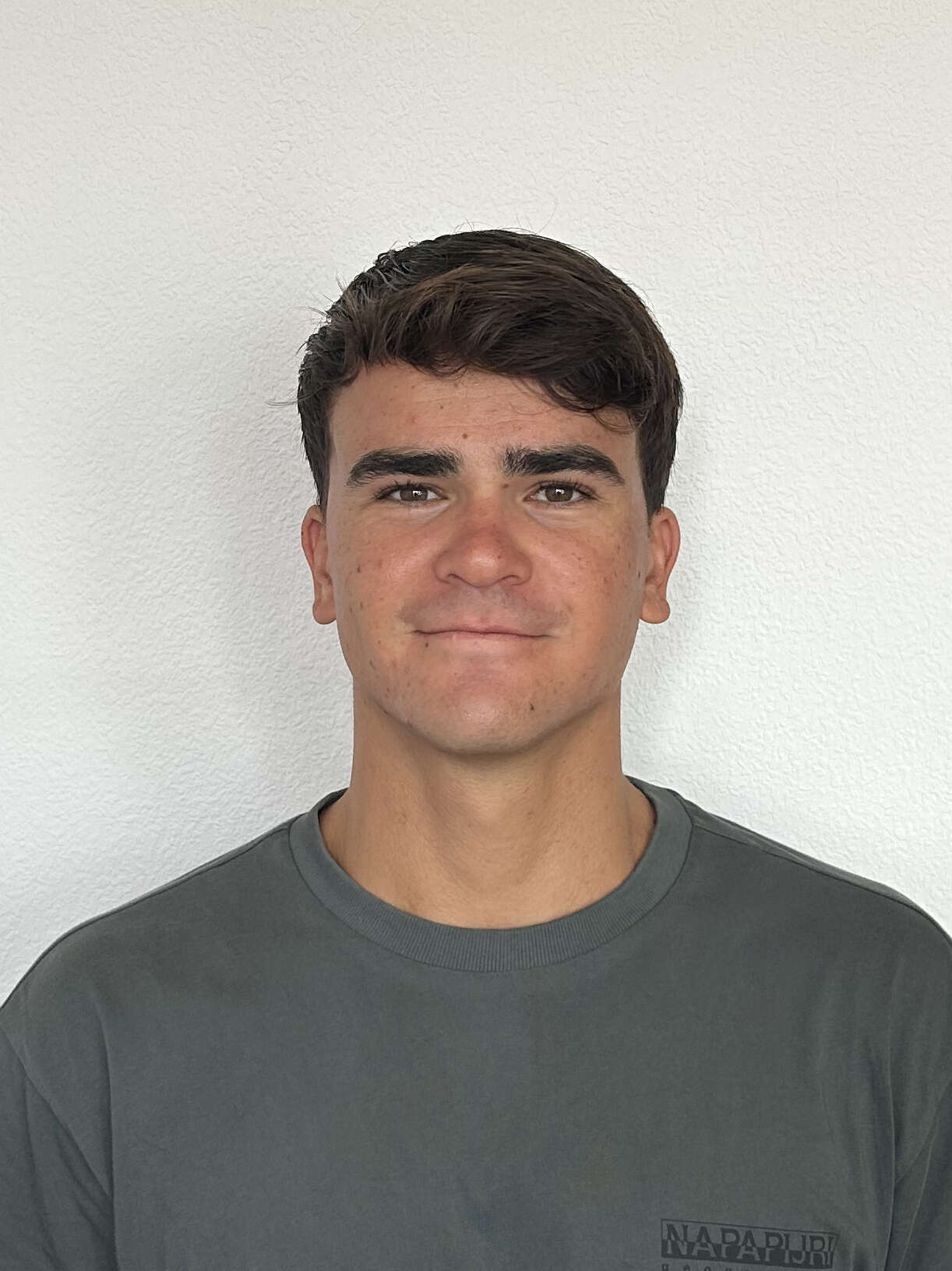
Moving from Tenerife to Norway is quite a transition. But for Oscar Soler, the move represents an exciting opportunity to immerse himself in both Norwegian culture and cutting-edge solar research. As a new Doctoral Research Fellow at the Rosseland Centre for Solar Physics, he will investigate some of the Sun’s most complex and energetic phenomena.
Oscar’s academic background is closely connected to his home island of Tenerife. He completed a bachelor’s degree in physics at the Universidad de La Laguna before continuing with a master’s degree in astrophysics.
This was a natural choice: the university has close links to the Instituto de Astrofísica de Canarias (IAC), internationally recognised for its research in astrophysics and for operating major observatories in the Canary Islands. Alongside his studies in physics and astrophysics, he also completed a master’s degree in education.
The road to solar physics
I have been interested in solar physics for a while now
His interest developed through a combination of theoretical work, numerical modelling and observations. For his bachelor’s thesis, he studied numerical methods for modelling magnetosonic shocks. During his master’s degree, he spent a summer internship at the IAC, where he analysed solar observations to probe umbral magnetoconvection—the dynamic processes occurring in the dark central regions of sunspots.
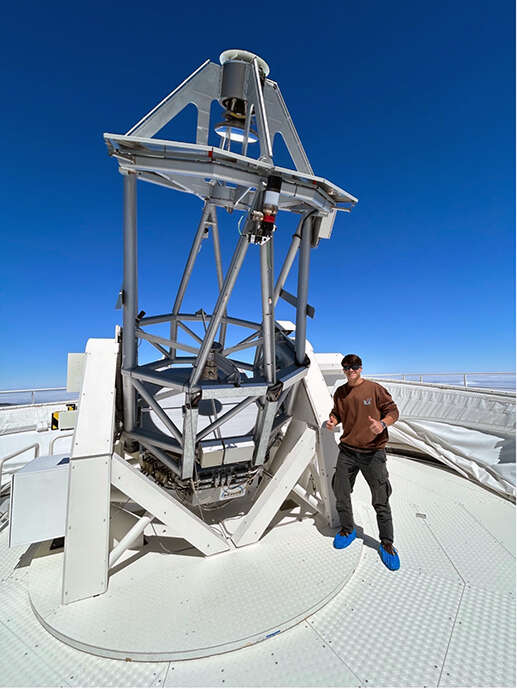
For his master’s thesis, Oscar returned to simulations, studying how solar flares affect prominences in the Sun’s atmosphere. He later spent six months on a research project at the University of San Francisco, collaborating with a Spanish company to study gravitational lensing using the Two-metre Twin Telescope in Tenerife.
Now I am finally back to solar physics simulations
Simulating solar flares across scales
The central aim of Oscar’s PhD project is to develop flare simulations that can capture both large- and small-scale processes at the same time.
To achieve this, he will contribute to integrating particle-in-cell (PIC) solvers adaptively into radiative magnetohydrodynamic (rMHD) simulations within the DISPATCH framework. This combination of methods may help researchers study the complex physics of solar flares in greater detail than before.
I am very excited about this opportunity to develop novel methods that can help us understand the complex processes of the Sun

A new home in Oslo
Oscar chose Oslo primarily because of the PhD project and its strong focus on numerical methods and simulations.
– I have always been interested in numerical methods and simulations, both the technical and physical aspects, he explains. – I thought this project would be an excellent opportunity to focus on that.
However, research was not the only reason he was drawn to Norway. The country’s landscapes, outdoor culture and winter season were equally appealing.
Besides the academic reasons, I was also attracted by Norway’s nature and all the possibilities to explore the outdoors—and the winter!
So far, his experience in Oslo has been overwhelmingly positive.
– I have been extremely pleased with the warm welcome that I have received, he says. – Everyone at RoCS and ITA has been friendly, accessible and open to helping with whatever they can. It almost feels like home already.

Looking ahead
Through his PhD, Oscar hopes to gain the skills needed to become an independent researcher and to contribute to a better understanding of solar physics.
I expect to gain all the relevant skills that will allow me to become a good researcher and to contribute to improving our knowledge of the physics of the Sun
Outside the office, he is eager to make the most of Norway’s outdoor opportunities. He enjoys sports and spends as much time outside as possible, whether running, cycling or hiking. Although he also loves surfing—something that may be more challenging in Oslo—he is especially looking forward to a new winter sport.
I am very, very, very excited about cross-country skiing this winter!