
About the project
Solar eruptions, including solar flares and jets, are among the most energetic events in the solar system, driven by the complex interplay of magnetic fields in the solar atmosphere. Their origin lies in the long-term evolution of the magnetic field, where energy is gradually stored through flux emergence, cancellation, and shear motions in the photosphere before being released via magnetic reconnection.Understanding the mechanisms leading to these eruptions is crucial for predicting space weather and its impact on Earth's space environment.
Objectives
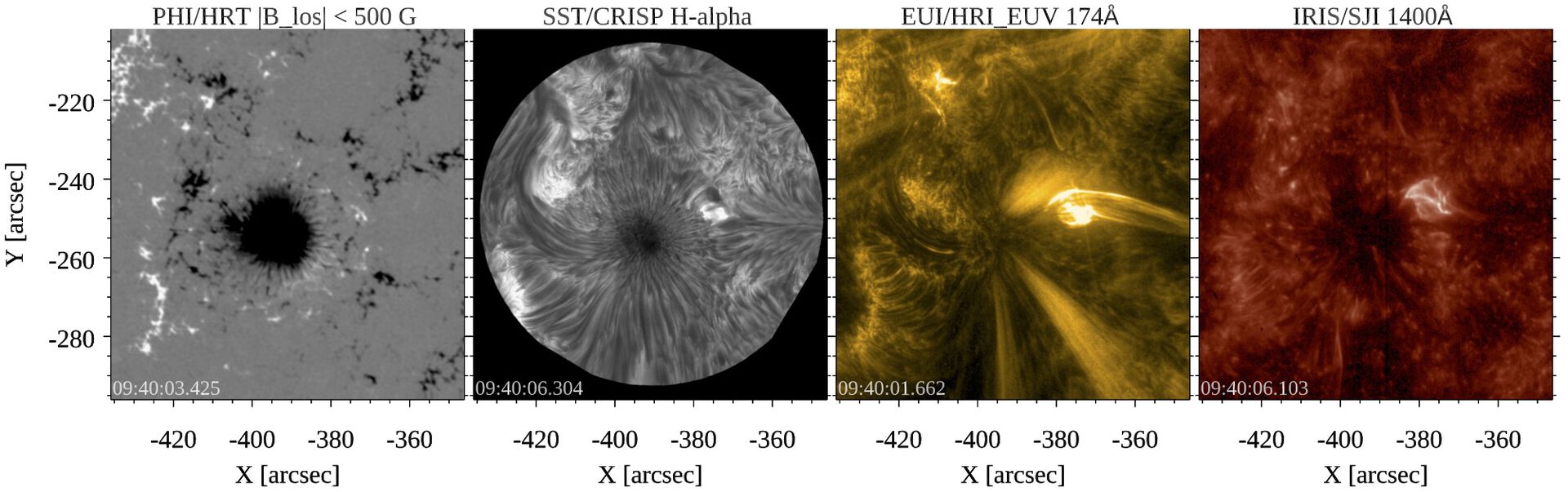
The OESE project will investigate the origin and evolution of solar eruptions by combining high-resolution observations from space- and ground-based telescopes: ESAʼs Solar Orbiter, the Swedish 1-m Solar Telescope (SST) on La Palma, NASAʼs Interface Region Imaging Spectrograph (IRIS), and the upcoming Multi-slit Solar Explorer (MUSE) mission. The EUI instrument onboard Solar Orbiter is imaging the hot coronal component of jet eruptions at unprecedented spatial and temporal resolution.
Magnetic field extrapolations using vector magnetograms from the SST will help identify key magnetic structures, such as flux ropes and null points, that play a role in eruption onset. Additionally, advanced numerical simulations using the Bifrost radiative MHD code will be employed to model the pre-eruptive magnetic environment and compare it with observations using synthetic observables.
Competences and tools
The project will fund one researcher for three years and one PhD student. The project further provides support for hardware needed for data processing and storage.