New Code Developments
The Sun is, in a sense, impossible to study directly. We cannot fly into it, and even satellites can only look at its surface and outer edges. So we build the Sun instead — in code, on supercomputers — and watch what happens.
That is harder than it sounds. Deep inside the Sun, matter behaves like a slow-moving fluid, and a single computational cell might represent thousands of kilometres. Near the surface, in the eruptive tangle of a solar flare, the same physics breaks down completely: things move too fast, and the particles are too spread out, for a "fluid" description to make sense at all. Modelling the whole Sun — from the calm depths to the violence of a flare — means running two very different kinds of physics side by side, and getting them to talk to each other. Here is where that work stands today.
A framework built to grow
Good science software needs a solid foundation, much like a building. Ours is built on continuous testing, so new code can be added without quietly breaking old code — which lets us move fast without things falling apart behind us.
On top of that foundation, our established solar-atmosphere code, Bifrost, is being integrated into a newer, more flexible framework called DISPATCH. Bifrost running inside DISPATCH reproduces the same physics as before, but faster — and that extra speed can be spent on bigger simulations, sharper detail, or more realistic physics, whichever a given question needs. DISPATCH can also automatically add resolution exactly where it is needed, for instance around a sharp, flare-like feature, rather than everywhere at once.
We also put real effort into running efficiently on the newest supercomputers. Modern machines, like the LUMI supercomputer in Finland — one of the fastest in the world — get their power from GPUs, chips built very differently from a normal computer processor. Adapting existing scientific code to that kind of hardware takes real specialist skill, and our work on this was influential enough to be built into LUMI's own official guide for other scientists.
From the whole Sun to a single spark
We can simulate the Sun's entire convection zone — the roiling outer third of the Sun where heat rises, cools, and sinks again, driving almost everything we see on the surface. Rather than force the Sun's round shape onto an awkward grid, we tile it with many small, flat, overlapping boxes — a bit like the panels on a football — each one simple and fast to solve on its own, together forming the whole star.
Having the whole Sun in a box, so to speak, is only the start. We can zoom into any interesting spot — a place where a flare might be forming, say — and run a far more detailed simulation of just that region, then convert the result into a simulated observation that can be compared directly with real telescopes. Very few research groups anywhere can do all of this themselves, start to finish.

At the smallest scales, we are also closing in on the violent core of a flare directly. Ordinary fluid physics cannot capture what happens there, so we track groups of charged particles instead, along with the electric and magnetic fields they create as they move — a computationally demanding but far more faithful description.
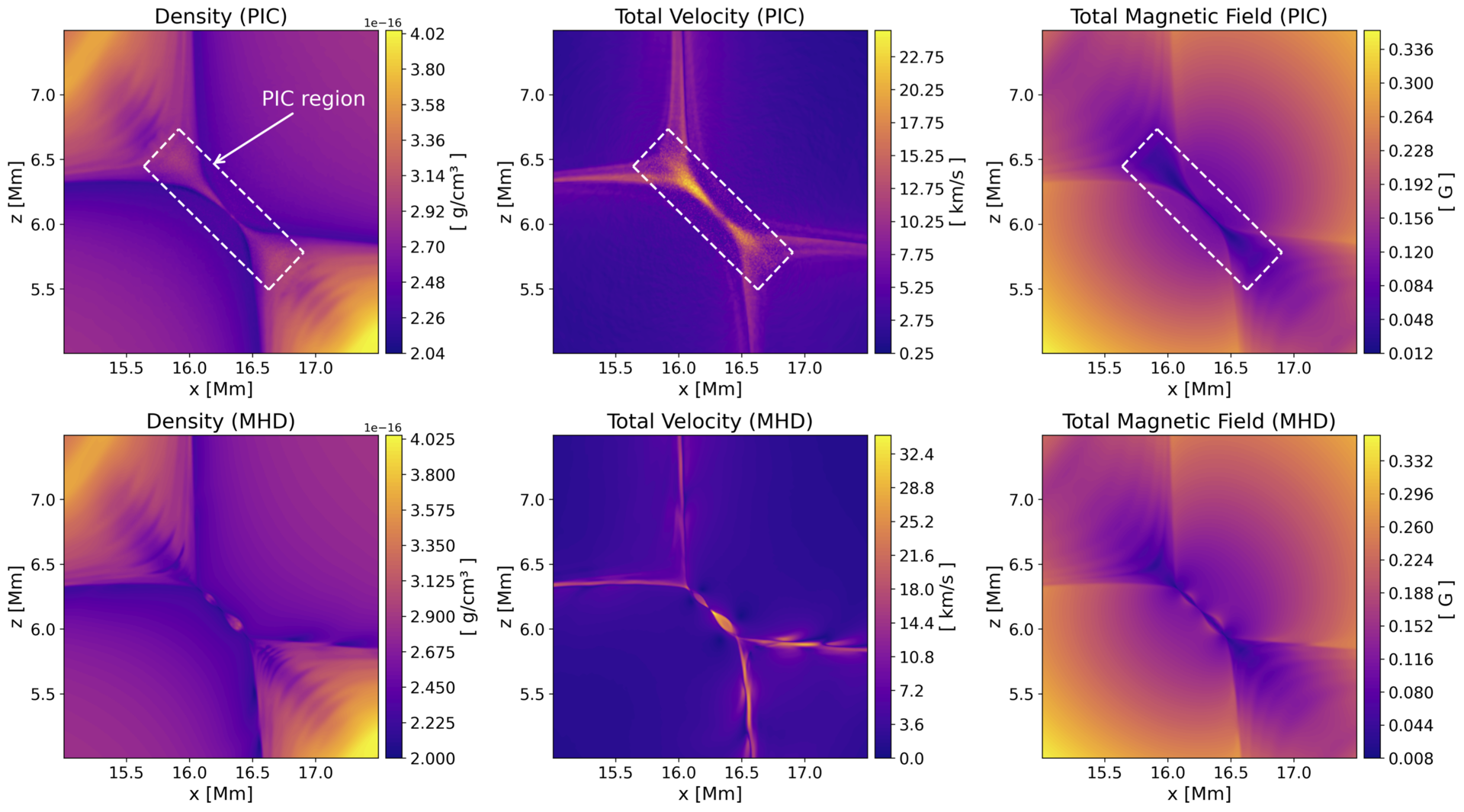
In the future the adaptive DISPATCH code will allow ud to change the simulation from following groups of particles or use a fluid description adaptively. A complementary tool is built specifically to follow rare particles a flare accelerates. Because the particles are rare, they are not represented in the groups of particles treated in the simulation but they can carry a significant amount of energy away from the flare site and deposit it in other locations where they collide with the ambient plasma.

Alongside it, a separate toolkit traces the paths of millions of individual particles through simulations we have already run, revealing where and how they are likely to be accelerated, and the distribution of their energies.
Joining the deep Sun to its surface
The deep interior of the Sun and its visible surface are, physically speaking, almost different worlds — different timescales, different physics, different assumptions. Within a European research collaboration called WholeSun, we are building a careful "handshake" between codes that specialise in each: matching flows, temperatures and magnetic fields across a shared boundary region, and making sure nothing is lost or duplicated in the process. The method has passed a thorough series of tests, and the first genuinely useful combined simulations — deep interior and atmosphere, working together — are close at hand.
Keeping track of it all
A less visible but increasingly important task is organisation. As the number of simulations grows, so does the risk of losing track of what already exists. We have built common tools — working across several programming languages — that can read the different kinds of data our various codes produce, and are building an automatic system that catalogues every completed simulation: what physics it included, how big it was, what it produced. The goal is a catalogue of roughly 70 simulations and 1300 terabytes of data — allowing us, and eventually other researchers, to find and reuse existing simulations instead of re-running expensive ones from scratch.
Listening to the Sun
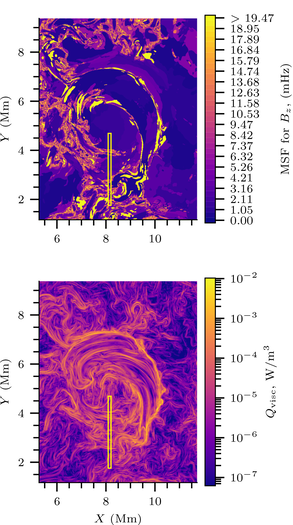 Energy from the Sun's surface travels upward as waves — not unlike sound, but far more complex, since they move through a magnetised, constantly shifting medium. Telling a genuine, travelling wave apart from background noise, in both real observations and simulated data, is surprisingly difficult. New analysis methods can do exactly that, measuring how much wave energy reaches a given height in the atmosphere and under what conditions. The method is described in two published scientific papers, and a version intended for wider community use is being prepared.
We are also preparing our main workhorse code, Bifrost, for public release — trimming it down and updating its documentation, so that other research groups can eventually use it too.
What comes next
Priorities ahead include bringing the simulation catalogue fully online, extending our testing of DISPATCH to more demanding physical scenarios, running the first combined fluid-and-particle simulations of priority target regions, training more researchers to use these new tools, and tying all of this more closely to real telescope observations.