Action of ingredients
TI prime
The TI PRIME adhesion promoter improves resist adhesion on substrates like Si or glass. Read the technical data sheet for how to apply.
PolyStyrene (PS)
Polystyrene comes as solid pellets (data sheet) that need to be dissolved before spin coating the liquid over the TI prime covered surface.
We dissolve in toluene that is very toxic, read the safety datasheet.
- Perform all steps in a fume hood to avoid inhalation of toluene vapors.
- Wear appropriate PPE: gloves, lab coat, and safety goggles.
- Desired amount: xx ml per cover glass
- Desired concentration: 0.5 weight %
- Toluene density: 0.8623 g/mL, V=1.16 ml/g
- => 0.5*0.8623/100 g/ml= 4.31 (mg PS / ml toluene)
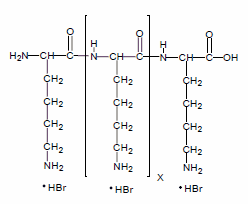
PLL-g-PEG' is a random graft co-polymer with a poly(L-lysine) backbone and poly(ethylene glycol)side-chains. The PLL backbone interacts electrostatically with the substrate, while the side-chains extend from the surface to form a densely packed polymeric brush. PLL-g-PEG Spontaneously assembles a monomolecular coating. Coated substrates have low non-specific binding of proteins (typically less than 10 ng/cm2 from full human serum). Coated substrates become cell resistant and blocks cell adhesion.
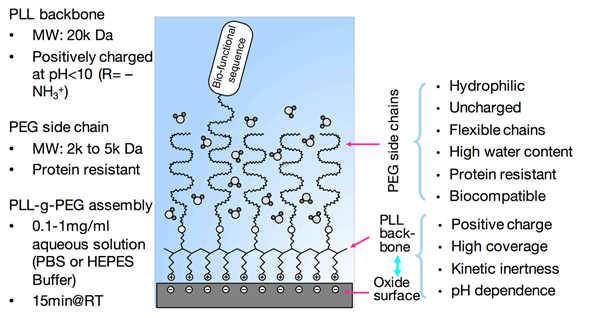
- Poly(ethylene glycol) (PEG) is a synthetic, hydrophilic, biocompatible polymer with widespread use in biomedical and other applications.
- Poly-L-lysine (PLL) is a charge enhancer; therefore, it can be used for coating many surfaces.