HEAs are a novel class of materials made by mixing relatively large proportions of several elements, unlike traditional alloys that typically have one or two main components. Due to their complex composition, HEAs exhibit remarkable properties, including high strength, fracture resistance, and excellent corrosion and oxidation resistance. These characteristics make HEAs highly promising for various industrial applications, such as aerospace, automotive, and energy sectors.
Methods for Producing High-Entropy Alloys
HEAs can be synthesized, using a variety of methods. Each with its unique advantages and limitations. Common techniques include:
- Vacuum Arc Melting: Melts the constituent elements in a controlled atmosphere, forming bulk HEAs.
- Induction Melting: Uses electromagnetic induction to heat and melt the elements, also for bulk production.
- Powder Metallurgy: Involves mixing elemental powders, compacting them, and sintering to form solid HEA pieces. This method is suitable for complex shapes and fine microstructures.
- Mechanical Alloying: High-energy ball milling combines elemental powders, forming homogeneous alloys, especially useful for high-melting-point HEAs.
- Additive Manufacturing: Techniques like selective laser melting (SLM) allow for precise control over HEA composition and microstructure.
- Coating Deposition: Methods like sputtering or laser cladding produce HEA coatings on substrates, ideal for surface modifications.
Completed his PhD in Materials Science and Engineering
Hessel Silva completed his undergraduate degree in Materials Engineering at the Federal University of São Carlos (UFSCar) in 2018. He then pursued a master’s degree in the same field, graduating in 2019, followed by a PhD in Materials Science and Engineering at UFSCar, before entering the position as a Postdoctoral Researcher at the Department of Technology Systems (ITS) at the University of Oslo (UiO).
- My work also involves developing design methodologies, using thermodynamic computational tools to model and synthesize multicomponent alloys for hydrogen storage, says the researcher.
-This includes exploring the relationship between the composition and structure of these alloys and their hydrogen storage behavior.
Focuses on the design and synthesis of metal hydrides
Hessel Silva’s research at UiO continues to focus on the design and synthesis of metal hydrides, using high-entropy or multicomponent systems. His current interest is in multi-phase systems, which can improve both the thermodynamic and kinetic behavior of hydrogen absorption and desorption reactions. He employs CALPHAD (Calculation of Phase Diagrams) methods to predict promising compositions, with a focus on using scrap materials instead of high-purity elements.
Daily, typical activites at UiO
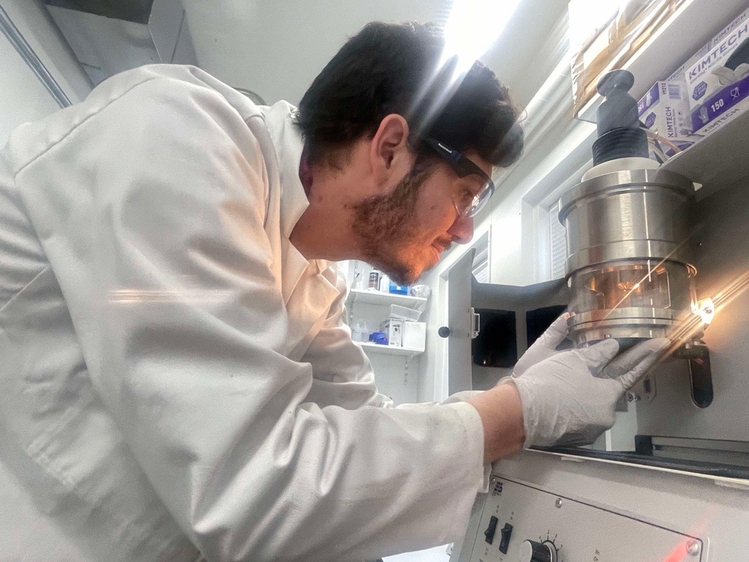
At UiO, Kjeller, Silva’s typical activities involve synthesizing alloy ingots using electric arc melting, preparing samples for analysis, and characterizing the alloys using X-ray diffraction and scanning electron microscopy. For hydrogen storage analyses, he uses a volumetric Sieverts apparatus to measure the kinetic performance of hydrogen absorption and desorption and to determine the equilibrium pressure for these processes under varying temperature conditions. The Hydrogen Lab at The Department of Technology Systems (ITS) is frequently used during his research work at his workplace.
Master’s Supervision Experience
However, research does not occupy his total everyday life at Kjeller.
- Supervising students is one of my favourite activities, says Hessel Silva. He recently co-supervised Federico Mandrioli, a master's student from the University of Torino, who spent three months at ITS as part of an Erasmus traineeship. The collaboration was highly productive, with daily discussions and problem-solving sessions that advanced both the student’s and Silva's research projects.
On a daily basis, the Postdoctoral Researcher works closely with Professor Sabrina Sartori' s "Hydrogen Group" at UiO, as well as researchers from the University of Pavia (Italy), University of Torino (Italy), and University of Campinas (Brazil). He is also part of a global network of collaborators in the field. These collaborations has led him to hold presentations nationwide - and internationally.
Active part in conferences worldvide
- I have participated in several conferences, since my start at UiO, including a national Materials Science and Technology conference in Trondheim, where I presented my work on Nb-rich alloys for hydrogen absorption at room temperature. I have also had the pleasure of attending the HYDROGENi consortium meeting in Norway, which focuses on hydrogen and ammonia projects. Just before Christmas, I presented at the Material Research Society (MRS) Fall meeting in Boston,US, discussing the challenges in designing multi-phase multicomponent alloys for hydrogen storage.
He feels lucky to have experienced all this in a relatively short amount of time as an UiO-employee.
Goals for the next years
During his postdoctoral tenure at UiO, Silva aims to develop his own research projects, contribute to student supervision, and continue advancing his work on hydrogen storage materials. He also hopes to improve his teaching skills and collaborate with other researchers.
- On a personal level, I look forward to further integrating into Norwegian society by learning the language and understanding the culture, he says. The researcher moved to the city of Lillestrøm for its strategic location, proximity to nature, and easy access to Oslo. He enjoys the walks through the city, taking in the natural beauty, especially during the winter months when the landscape is covered in snow and ice.
He aspires to become a professor one day, and continue helping others improve their lives through his work.
- I am committed to my current research and responsibilities, remaining open to the opportunities that may arise.
Thank you for joining us, Bruno Hessel Silva! We are happy to have you on board!
This text is partly generated by AI