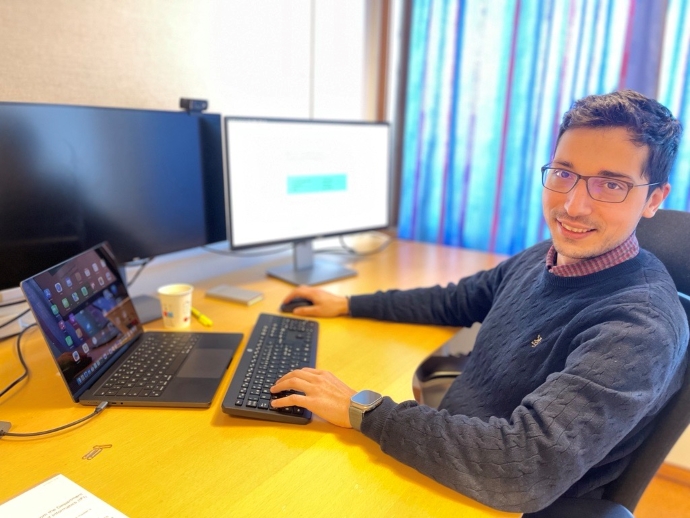
A month into his new job at Kjeller, he says “It allows me to help and support the program, but also requires adaptability as we establish processes, goals, and new learning objectives”.
Georgios Kavallieratos was awarded his Ph.D. in Information Security and Communication Technology by the Norwegian University of Science and Technology (NTNU) in 2021. Moreover, he received the B.Sc. degree in computer science and the M.Sc. degree in digital systems security in 2016 and 2018, respectively, from the University of Piraeus, Piraeus, Greece.
- My impression of my new job and job environment so far is very good. The role is engaging, the team is supportive, and the work environment fosters collaboration and growth. I am excited about the opportunities ahead! The job environment at the department is excellent. It is collaborative and supportive, making it a great place to work and grow professionally.
We are happy to hear those words, Mr. Kavallieratos.
Security of cyber physical systems in a number of application domains
The Associate Professors LinkedIn profile tells us that Kavallieratos is a certified ISO 27001:2013 lead auditor for information security management systems. His main line of research concerns topics related to Critical Infrastructure Protection and Maritime cyber-security, and particularly, those associated with the security of cyber-physical systems, risk management, and cyber threat intelligence. Τhe areas of interest are related to the security of cyber physical systems, in a number of application domains that include inter alia the energy, health, and maritime sectors.
Technology and problem-solving from early age
Can you tell the readers why you chose to go into cyber security in the first place?
- I have been interested in technology and problem-solving from an early age. Cyber security stood out as a field where I could combine those to protect systems and make a real impact in an increasingly digital world.
Why should, in your opinion, students choose the master program in Cyber-Physical Systems Security?
-The Cyber-Physical Systems Security master's program Security in Cyber-Physical Systems – Informatics: Information Security (master's two years) – University of Oslo offers novel knowledge at the intersection of cybersecurity and emerging technologies, preparing them for in-demand careers protecting critical systems in the increasingly interconnected infrastructures. The program enables students to take a holistic view of security and understand how security challenges can impact both information technology and the physical world.
Coordinates, teaches and supervise
You now coordinate a new course in the program. Challenges and advantages so far?
- Coordinating a new course offers the advantage of developing the course to meet current needs, but it also comes with challenges like developing content from scratch and aligning it with program goals and learning objectives. So far, it has been a rewarding experience.
During the spring semester, you will be teaching the students here at Kjeller. Can you tell us a bit about the main focus of the content in the course?
-The course Basic Security in Cyber-Physical Systems (TEK 4560) will introduce students to the cybersecurity challenges of CPSs and to systematic approaches to improve the security and resilience of such systems, says Kavallieratos.
Will you also be supervising students in the future?
-Yes, I will. And I look forward to this work, helping the students explore their interests, and guiding them through their academic and research journeys in cyber security.
You have lived in Norway for a long time. Some might wonder if someone from Greece can ever get used to the cold winters here?
- Having lived in Norway for a while, I have adapted to the cold, but it’s always a bit of a challenge.
Where do you see yourself 10 years from now?
-Ten years from now, I see myself continuing to grow as a scholar in academia, contributing to both research and teaching. I hope to have expanded my expertise, mentored many students, and collaborated on impactful research projects.
Again, a warm welcome to the UiO-team, Georgious Kavallieratos! We are so pleased to have you on board.