Events
Previous
Pardon recently established a type of "cohomology ring of enumeration problems" that all reasonable curve counting theories pair with to produce their invariants. A technical regularization procedure then allows him to prove that, for 3-folds, this ring is generated by local curve elements in the relevant degrees, from which the MNOP correspondence (for primary insertions) between different curve counting theories follows, since it was previously proven in the local curve case. Our work extends this framework to the CY4-fold case, which allows us to prove several curve counting conjectures in the CY4 case. Among the additional technical difficulties in this case is that a more complicated virtual dimension formula leads to more generators than just local curves. In this talk, I will give an overview of this framework and explain the main techniques involved. This is joint work in progress with Ivan Karpov, and partially based on separate work with Jim Bryan.
A primitive element of a Galois field F is a generator of the group of units F*. Finding such elements is entirely non-trivial and this search has given rise to many interesting results in number theory. If one is willing to assume the generalised Riemann hypothesis, then every (non-silly) integer is primitive to infinitely many prime order fields. Moreover, the least primitive element in such fields is less than the square root of the order. I will present an effective method for finding primitive elements in Galois fields with prime-power order. This method is an amalgamation of my hybrid bound on prime divisors and joint work with J. Punch on prime sieves. I will also discuss some of my recent work on least primitive elements.

Nordfjordeid Summer School 2026
The Bernstein–Khovanskii–Kushnirenko (BKK) theorem gives a way to count the non-zero solutions of a system of polynomial equations using geometric objects called Newton polytopes. It can be seen as a refinement of Bézout’s theorem. One particularly nice proof of this result uses ideas from tropical geometry, where complicated algebraic problems can be translated into simpler, combinatorial ones. In this talk, I will explain the BKK theorem and sketch its proof using tropical geometry. I will also describe joint work with Andrés Jaramillo Puentes, where we extend this result to more general base fields, not just algebraically closed ones. This leads to a meaningful way to count solutions in a broader setting, again using tropical methods.
A numerical semigroup is said to be Weierstrass if it is the semigroup of pole orders of rational functions that are regular at all but one point of some compact Riemann surface or smooth algebraic curve. Hurwitz asked in 1892 whether all numerical semigroups can occur. Buchweitz in 1980 gave the first examples of Non-Weierstrass semigroups. In this paper we give a new method, using syzygies, to show that certain semigroups are not Weierstrass, including the first one of multiplicity 6 (the lowest possible) and genus 13 (the lowest known). We give many other examples to which the method applies.
Around 1970, Gruson and Raynaud proved that one may render a morphism of finite presentation flat by blowing up an ideal in the target, with rather mild restrictions on the involved schemes. New proofs, entirely different from the one of Gruson and Raynaud, have been found by Fujiwara and Kato and by Guignard. The two proofs are basically the same, both using Temkin's relative Zariski–Riemann spaces, the limits of all interesting blow-ups. These spaces are quasi compact locally ringed spaces whose local rings are close to being valuation rings, so that almost anything is flat, and due to their quasi compactness, one may descend flatness to a genuine blow-up.
Notes for the talk here.
References
Quentin Guignard: A New Proof of Raynaud–Gruson’s Flattening Theorem (arXiv:1801.01188v3)
Kazuhiro Fujiwara and Fumiharu Kato: Rigid Geometry and Applications, in Advanced Studies in Pure Mathematics 45 (2006), Moduli Spaces and Arithmetic Geometry (Kyoto, 2004), pp. 327–386.
The goal is to understand "Birational Invariants from Hodge Structures and Quantum Multiplication" by Katzarkov-Kontsevich-Pantev-YU. KKPY introduce new birational invariants called Hodge atoms. These are constructed by combining classical Hodge theory with quantum cohomology. They use it to prove that a very general cubic fourfold is not rational.
Let X be a variety, and (F_n) a sequence of coherent sheaves on the n-th symmetric products Sym^n X. Following Okounkov, we consider the notion of (F_n) being factorisable. Roughly speaking, this means that over points of Sym^(m+n) X corresponding to the union of disjoint configurations in Sym^m X and Sym^n X, the sheaf F_{m+n} is the tensor product of F_m and F_n. Completing a partial argument by Okounkov, we show that if (F_n) is factorisable, then the generating function of Euler characteristics of F_n is the plethystic exponential of a generating function of Euler characteristics of sheaves on X. I'll explain why this is true and why it's useful.
The distance matrix of a tree appears in a range of contexts, from phylogenetics to physical chemistry. I will describe a new result about the spectrum of this matrix, one that gives affirmative answer to two questions about matroid positivity properties. These are both strengthenings of Mason's conjectures about the log-concavity of sequence of numbers of independent sets of a matroid, proposed by Igor Pak and by Giansiracusa, Rincón, Schleis, Ulirsch, respectively.
At the heart is a characterization of the gross substitutes property from economics in terms of the Lorentzian property of a generating function.
This is joint work with Federico Ardila-Mantilla, Sergio Cristancho, Chris Eur, June Huh, and Botong Wang.
Since Ellingsrud and Peskine showed that there is an upper bound on the degree of smooth surfaces not of general type in P^4, there have been efforts to find them. I will give a survey of different methods of construction, and a list of the kind of surfaces known so far, reporting also on joint work with Hirotachi Abo and Frank-Olaf Schreyer to write a Macaulay2 package that produces equations of examples of each kind.
To each matroid we associate a class in the Chow ring of the Grassmannian. We develop a new combinatorial approach for computing these Chow classes, by first focusing on snake matroids and then extending our results via valuativity to Lattice path matroids, and further to any matroid. Our main contribution identifies the Poincaré dual of the Chow class of a snake matroid with a specific ribbon Schur function, providing an explicit formula for its coefficients in the Schubert basis as the number of standard Young tableaux of a given shape with a prescribed descent set. As consequences, we recover and simplify classical results such as Gessel--Viennot’s enumeration of permutations with fixed descent sets, and formulas for the volume of lattice path matroids. Furthermore, we use our results to show that certain Schubert coefficients are positive for all connected paving matroids.
The derived category of a Fano variety will often have a semiorthogonal decomposition consisting of a sequence of exceptional line bundles and a remaining subcategory, which we will call the Kuznetsov category. The categorical Torelli problem asks whether knowing this category up to exact equivalence is enough to determine the variety up to isomorphism. We will explain how a technique based on a computation of the Hochschild-Serre algebra of the category shows that the answer is yes in many cases, including many weighted hypersurface and a Veronese double cone. This is joint work with Xun Lin and Shizhuo Zhang.
Virasoro constraints were recently formulated for moduli of sheaves. The main difference compared to Gromov-Witten theory lies in the linearity of the former which allowed us (B.-Lim-Moreira) to derive sheaf-theoretic constraints from the geometric vertex algebras of Joyce. Our approach applies to more general linear categories. For both sheaves and representations of quivers, I will explain that Virasoro costraints determine primary states of the vertex algebra. This is already sufficient to illustrate the formulation for any linear theory, and it leads to the proof of many results via wall-crossing.
Nordfjordeid Summer School 2025
In this talk, I will present a joint work with Matilde Manzaroli. I will introduce real tori (in the greater generality) as well as real equivariant torus embeddings. Then I will describe the structure of the torus orbits. It will allow us to easily compute the Betti numbers of the real loci of smooth real equivariant torus embeddings, provided that those real loci are compact. Then I will present a canonical "foliation" of their real loci by equivariant embeddings of split tori. I will express a necessary and sufficient condition for this foliation to be given by the fibre of a fibre bundle, and explain how to reduce to this case by performing toric blow-ups.

There are several approaches to studying configuration spaces of points on curves. Examples are the Deligne-Mumford and Hassett spaces or, in the case of points on a projective line, a straightforward GIT construction. Deligne and Mostow further investigated the situation where moduli spaces of weighted points on the projective line have ball quotient models. This leads to a finite set of configuration spaces of ordered or partially ordered points on P^1. In all of these cases, the GIT compactification and the Baily-Borel compactification of the ball quotient are isomorphic. These spaces have natural (partial) desingularizations, namely the Kirwan blow-up and the toroidal compactification. It follows from results of Gallardo-Kerr-Schaffler and Kiem-Moon that, in the case of ordered configurations, the Deligne-Mostow map lifts to an isomorphism of these compactifications. This can fail for only partially ordered configurations. The main result of this talk is to explain a criterion exactly when these two compactifications coincide. This is also related to the Log Minimal Model Program. This is joint work with Yota Maeda.
I will explain how to use the motivic volume formula and toric degenerations to study the rationality problem for complete intersections in Grassmannians, in particular Gr(2,5).
We study rationality questions for the Fano schemes of non-maximal linear spaces on a smooth complete intersection X of two quadrics, especially over non-closed fields. We start by showing that they are all geometrically rational. We then ask their rationality over k and analyze in details the case of second maximal linear spaces. In particular, we generalize results of Hassett-Tschinkel and Benoist-Wittenberg when X has odd dimension, and extend work of Hassett-Kollár-Tschinkel when X has even dimension and k = R. This is joint work with Lena Ji.
Based on the preprint Bhatt, Iyengar, Ma - Regular rings and perfectoid algebras. Notes for the lecture here.
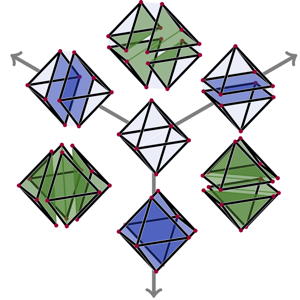
Positive geometry is a recent branch of mathematical physics which present exciting connections with real, complex and tropical algebraic geometry.
In this talk, we introduce the topic by developing the positive geometry of del Pezzo surfaces and their moduli spaces.
We will analyze their connected components, likelihood equations and scattering amplitudes.
The talk is based on joint work with Early, Geiger, Sturmfels and Yun.