Events - Page 2
Abstract: I will introduce a certain configuration space associated with a graph, and compute its cohomology ring. It turns out to be related to internal zonotopal algebras, which were introduced in the context of approximation theory and show up in many different contexts.
This is joint work with Colin Crowley, Galen Dorpalen-Barry, and Andre Henriques.

Positroids are a class of matroids that were introduced by Postnikov in 2006 that index a certain stratification of the totally non-negative Grassmannian. These matroids are famously in bijection with a “zoo” of combinatorial objects including Grassmann necklaces and plabic graphs. We introduce a new family of positroids called rook matroids that arise from restricted rook placements on a skew shaped board and discuss it in terms of this zoo. We highlight the transversal structure of rook matroids and the slightly mysterious relationship they share with lattice path matroids. This is joint work with Per Alexandersson and ongoing work with Irem Portakal and Akiyoshi Tsuchiya.
Chebyshev varieties are algebraic varieties parametrized by Chebyshev polynomials or their multivariate generalizations. We determine the dimension, degree, singular locus and defining equations of these varieties. We explain how they play the role of toric varieties in sparse polynomial root finding, when monomials are replaced by Chebyshev polynomials. We present numerical root finding algorithms that exploit our results. Joint work with Zaïneb Bel-Afia and Chiara Meroni.
The amplituhedron is a semi-algebraic set given as the image of the positive Grassmannian under a linear map subject to a choice of additional parameters. We define the Infinituhedron as the limit of amplituhedra by sending one of the parameters to infinity. We derive its algebraic boundary in terms of Chow varieties and explain its geometric interpretation from the point of view of Positive Geometry in terms of secants of the rational normal curve. This discussion shows that the Infinituhedron is a positive geometry with a unique differential form. Joint work with Rainer Sinn.
Note the non-standard time!
In the first part of the talk, I will give an introductory talk to o-minimality, giving the definitions and some of intuition through understanding which Lie groups are amenable to being understood in o-minimal contexts.
In the second part I will state the two theorems which have had the most important applications to algebra and give some intuition of how (at least one of them) has been used.
In 2008, looking to bound the face vectors of tropical linear spaces, Speyer introduced the g-invariant of a matroid. He proved its coefficients nonnegative for matroids representable in characteristic zero and conjectured this in general. Later, Shaw and Speyer and I reduced the question to positivity of the top coefficient. This talk will overview work being written up with Andy Berget (Western Washington) that proves the conjecture. The first half will be introductory, aiming to define the g-invariant, state the theorem, and compare to other recent work in matroid theory. The second half will look at the proof techniques.
Geometrically, the main ingredient in the proof is a Kempf collapsing constructed from the matroid tautological vector bundles of Berget--Eur--Spink--Tseng, and an initial degeneration thereof. Combinatorially, it is an extension of the definition of external activity to a pair of matroids and a way to compute it using the fan displacement rule on tropical Chern classes. The work of Ardila and Boocher on the closure of a linear space in (P^1)^n is a special case.
Based on J. Kollár and C. Voisin. Flat pushforwards of Chern classes and the smoothability of cycles below the middle dimension. Ann. of Math. (2), 200(2):771–797, 2024.
Based on preprints https://arxiv.org/abs/2006.07213 and https://arxiv.org/abs/2406.05382.
Mirror symmetry predicts that the symplectic geometry of a manifold is equivalent to the complex geometry of the mirror manifold. In particular, enumerative mirror symmetry relates quantum cohomology (Gromov-Witten invariants) of a manifold with period integrals of the mirror. A fundamental question in mirror symmetry is to construct mirrors. I will explain Gross-Siebert's intrinsic mirror symmetry which gives a mirror construction using relative quantum cohomology. More precisely, one considers a maximally unipotent monodromy degeneration of a Calabi—Yau manifold and take proj of the degree zero part of a relative quantum cohomology ring associated with the degeneration. Theta functions form a canonical basis of the degree zero part of the relative quantum cohomology ring. Theta functions can be defined in terms of punctured Gromov-Witten invariants of the broken line type. I will explain a variant of intrinsic mirror symmetry using orbifold Gromov-Witten invariants of root stacks, theta functions for general snc pairs and possible applications to questions in mirror symmetry.
The 5th Scandinavian Gathering Around Remarkable Discrete Mathematics
I will talk about how one can relate intersection theories of Hilbert schemes of points and Fulton-MacPherson compactifications.
Abstract: Although tropical vector bundles have been introduced by Allermann ten years ago, very little has been said about their structure and their relationship to vector bundles on algebraic varieties. I will present recent work with Martin Ulirsch and Dmitry Zakharov that changes exactly this in the case of curves: we prove analogues of the Weil-Riemann-Roch theorem and the Narasimhan-Seshadri correspondence for tropical vector bundles on tropical curves. We also show that the non-Archimedean skeleton of the moduli space of semistable vector bundles on a Tate curve is isomorphic to a certain component of the moduli space of semistable tropical vector bundles on its dual metric graph. Time permitting I will also report on work with Inder Kaur, Martin Ulirsch, and Annette Werner and explain some of the difficulties that arise when generalizing beyond the case of curves to Abelian varieties of arbitrary dimension.
Note the non-standard start time!
Abstract: We consider mirror pairs of Calabi-Yau hypersurfaces X and X’ in toric varieties associated to dual reflexive polytopes. We will give a proof through tropical geometry that the Hodge numbers of X and X’ are mirror symmetric. The proof goes by considering tropical homology, and works over the ring of integer numbers. In particular, we can use our spectral sequence with Kris Shaw to explore the connections between the topology of the real part of X and cohomological operations on X’.
This is based on joint work with Diego Matessi.
Donaldson-Thomas and Pandharipande-Thomas theory are two approaches to counting curves on projective threefolds in terms of their moduli spaces of sheaves. An important special case in understanding the DT/PT correspondence the equivariant geometry of affine three-space with the natural coordinate action of the rank 3 torus. I will show how one can use new wall-crossing techniques to prove the equivariant K-theoretic DT/PT correspondence in this situation, which was previously known only in the Calabi-Yau limit.
This is part of an ongoing project with Felix Thimm and Henry Liu in which we aim to prove wall-crossing for virtual enumerative invariants associated to equivariant CY3 geometries by extending a vertex algebra formalism for wall-crossing developed by Joyce.
Gromov—Witten invariants are virtual counts of curves with prescribed conditions in a given algebraic variety. One of the main techniques to study Gromov—Witten invariants is degeneration. The degeneration formula expresses absolute Gromov—Witten invariants in terms of relative Gromov—Witten invariants of algebraic varieties with tangency conditions along boundary divisors.
Relative Gromov—Witten invariants with only one relative marking are relative invariants with maximal contacts along the unique relative marking. The local-relative correspondence proved by van Garrel—Graber—Ruddat states that genus zero relative invariants with maximal contacts are equal to local Gromov—Witten invariants of a line bundle. Local invariants are usually easier to compute. However, The degeneration formula usually involves relative invariants beyond maximal contacts (i.e. with several relative markings). I will explain a generalization of the local-relative correspondence beyond maximal contacts, hence determine all the genus zero relative invariants that appear in the degeneration formula.
This is based on joint work with Yu Wang.
Abstract:
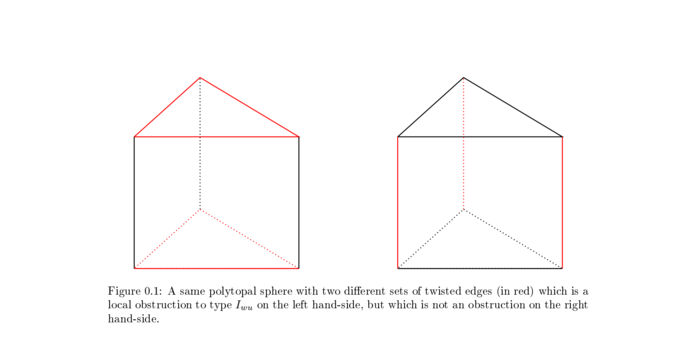
Phase tropical surfaces can appear as a limit of a 1-parameter family of smooth complex algebraic surfaces. A phase tropical surface admits a stratified fibration over a smooth tropical surface. We study the real structures compatible with this fibration and give a description in terms of tropical cohomology. As an application, we deduce combinatorial criteria for the type of a real structure of a phase tropical surface.
Phase tropical surfaces can appear as a limit of a 1-parameter family of smooth complex algebraic surfaces. A phase tropical surface admits a stratified fibration over a smooth tropical surface. We study the real structures compatible with this fibration and give a description in terms of tropical cohomology. As an application, we deduce combinatorial criteria for the type of a real structure of a phase tropical surface.
Phase tropical surfaces can appear as a limit of a 1-parameter family of smooth complex algebraic surfaces. A phase tropical surface admits a stratified fibration over a smooth tropical surface. We study the real structures compatible with this fibration and give a description in terms of tropical cohomology. As an application, we deduce combinatorial criteria for the type of a real structure of a phase tropical surface.
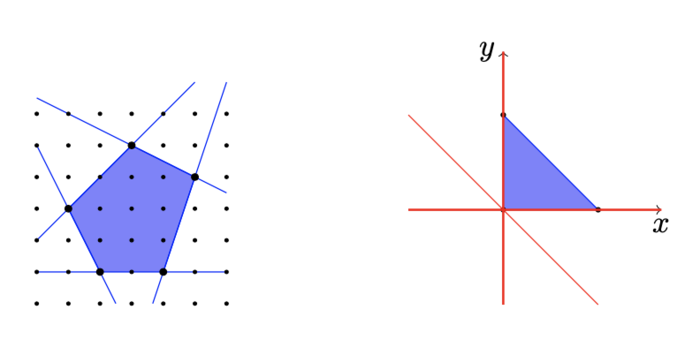
In 1962 Ehrhart proved that the number of lattice points in integer dilates of a lattice polytope is given by a polynomial — the Ehrhart polynomial of the polytope. Since then Ehrhart theory has developed into a very active area of research at the intersection of combinatorics, geometry and algebra.
The Ehrhart polynomial encodes important information about the polytope such as its volume and the dimension. An important tool to study Ehrhart polynomials is the h*-polynomial, a linear transform of the Ehrhart polynomial which is given by the numerator of the generating series. By a famous theorem of Stanley the coefficients of the h*-polynomial are always nonnegative integers. In this talk, we discuss generalizations of this result to weighted lattice point enumeration in rational polytopes where the weight function is given by a polynomial. In particular, we show that Stanley’s Nonnegativity Theorem continues to hold if the weight is a sum of products of linear forms that a nonnegative over the polytope. This is joint work with Esme Bajo, Robert Davis, Jesús De Loera, Alexey Garber, Sofía Garzón Mora and Josephine Yu.
In 1962 Ehrhart proved that the number of lattice points in integer dilates of a lattice polytope is given by a polynomial — the Ehrhart polynomial of the polytope. Since then Ehrhart theory has developed into a very active area of research at the intersection of combinatorics, geometry and algebra.
The Ehrhart polynomial encodes important information about the polytope such as its volume and the dimension. An important tool to study Ehrhart polynomials is the h*-polynomial, a linear transform of the Ehrhart polynomial which is given by the numerator of the generating series. By a famous theorem of Stanley the coefficients of the h*-polynomial are always nonnegative integers. In this talk, we discuss generalizations of this result to weighted lattice point enumeration in rational polytopes where the weight function is given by a polynomial. In particular, we show that Stanley’s Nonnegativity Theorem continues to hold if the weight is a sum of products of linear forms that a nonnegative over the polytope. This is joint work with Esme Bajo, Robert Davis, Jesús De Loera, Alexey Garber, Sofía Garzón Mora and Josephine Yu.