In this talk, I’ll show a principled way to modify treatment rules so they’re "economical" with respect to a given cost function. The approach borrows tools from optimal transport literature (imagine shifting probability mass with price tags attached) to minimize total reassignment + misalignment costs. A small dose of randomness (entropy) acts like a subsidy for randomness/exploration. A fast variant of the Sinkhorn algorithm lets us compute the new policy quickly and see exactly how it changes with parameters. For evaluation, I’ll introduce a one-step estimator that’s doubly robust, eliminates the leading source of bias compared with plug-in or AIPW estimators, and provides more trustworthy uncertainty quantification even when parts of the model are misspecified. I’ll close with examples on synthetic and real-world data.
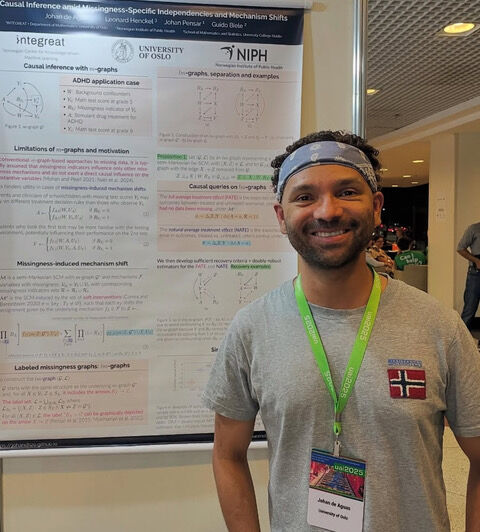
Johan de Aguas: Optimal Transport for Policy Modification in Causal Inference
Postdoctoral fellow at Integreat - The Norwegian Centre for Knowledge-driven Machine Learning. His research interests lie in the intersection of causal inference, machine learning, and semiparametric statistics.
Published Sep. 30, 2025 3:45 PM
- Last modified Sep. 30, 2025 3:45 PM