The Standardized Precipitation Index (SPI) serves as an essential tool for assessing drought conditions, primarily based on normalized accumulated precipitation data. Longer historical records of precipitation provide more precise parameter estimates of marginal distribution; however, they frequently exhibit nonstationary influences, including anthropogenic climate change and multidecadal natural variability. Most methods either disregard this nonstationarity or address it through quasi-stationary reference intervals. This study introduces a nonstationary SPI framework utilizing Generalized Additive Models (GAMs) to accurately represent the spatiotemporal variability associated with drought phenomena. In particular, GAMs are employed to estimate the parameters of the Gamma distribution in a space-time setting, while dual extreme tail flexible models are integrated to accurately reflect the probabilistic risk associated with extreme drought occurrences. Future drought and extreme wet events are calculated corresponding to different return periods in terms of return levels. The results demonstrate that the nonstationary SPI model maintains stability and accurately reproduces recognized nonstationary drought patterns, while also providing new insights into the evolving dynamics of drought. This approach represents a significant advancement in drought modelling amidst changing climatic conditions.
Touqeer Ahmad: Spatio-temporal Modeling for Drought Classification and Prediction
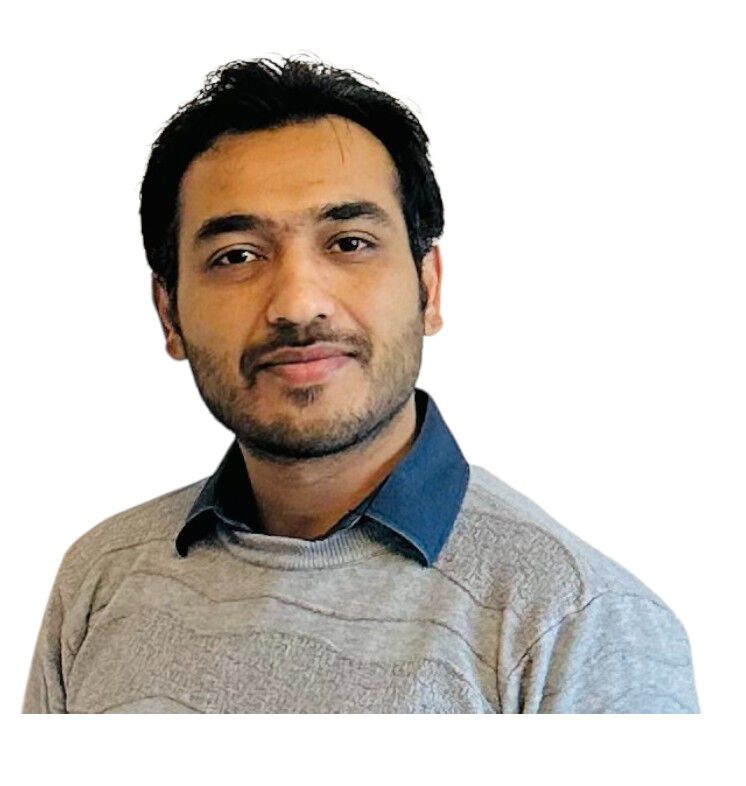
Touqeer Ahmad recently joined the Department of Mathematics at UiO as a postdoctoral research fellow under the DSTrain–MSCA program. His project will focus on the stochastic modelling of natural processes. Before that, he was a postdoctoral research fellow at the Institut Denis Poisson, Université d’Orléans, France, from May 2025 to October 2025. There, he worked on the missing data problem in high-dimensional environmental time series as part of the JUNON project. Prior to that, he also held a postdoctoral position at ENSAI, France, from May 2023 to April 2025, where he worked on machine learning and data mining of extreme values in massive data under a prestigious Région Bretagne research grant. He earned a PhD in statistics with the Doctor Europaeus Label in June 2023 from the Department of Statistical Sciences at the University of Padova, Italy. His doctoral research focused on the modeling of discrete extreme values.