Abstract
Studying stellar magnetic fields is of particular interest for two main reasons: they directly influence the habitability of planets, including Earth through solar activity, and they provide valuable insights into the magnetic evolution of our own Sun.
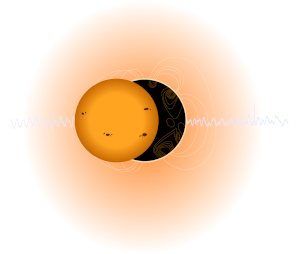
One way to investigate stellar magnetism is through starspots. Far from being mere dark dust on stellar surfaces, these features are large regions created by the emergence of magnetic field tubes. These dark spots produce variations in stellar brightness, which can be observed through photometric light curves and used to characterize magnetic activity. However, interpreting these light curves remains challenging due to strong degeneracies in those kinds of data: different configurations of starspots can produce similar brightness variations, making it difficult to uniquely constrain their physical properties.
In this work, we introduce a new method bases of the Fourier domain that overcomes some of these limitations and extract information about starspot properties from photometric observations. We also establish connections between these observations and global 3D magnetohydrodynamic simulations to better understand the link between starspots properties and intern magnetism.