Join the disputation
The PhD defence and trial lecture will be 100% in-person. The room opens for participation just before the disputation starts, and closes for new participants approximately 15 minutes after the defence has begun.
Join the trial lecture - 25th of October at 10:15 (Aud. 209, Svein Rosselands Hus)
"Stellar tracks in the HR diagram: from the Hayashi track to giant and white dwarf phases"
Conferral summary
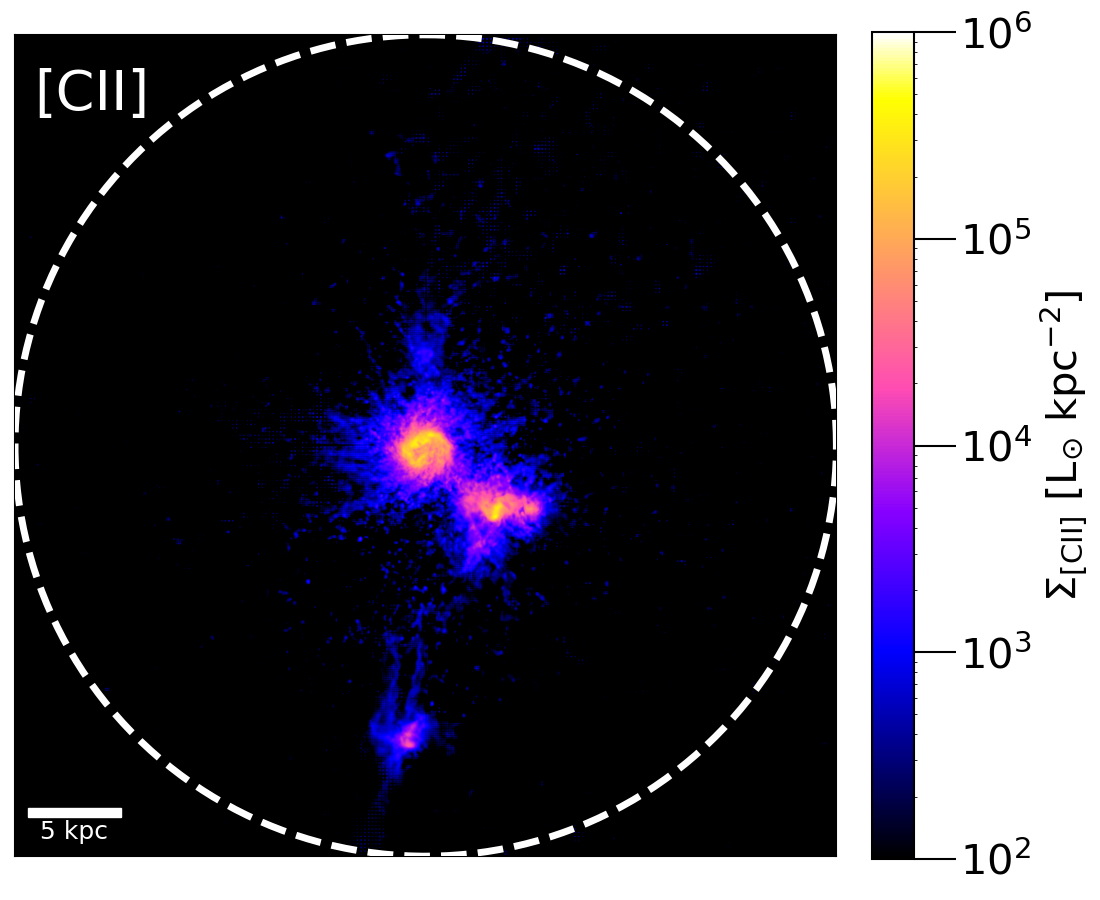
This PhD research investigates the circum-galactic medium around galaxies, which is crucial for understanding galaxy evolution but hard to observe. Using simulations and modelling, mock observations were developed for the upcoming Atacama Large Aperture Submillimeter Telescope (AtLAST). This will detect faint signals from the early Universe, which are inaccessible to current astronomical facilities.
Main research findings:
My PhD thesis investigates the gas halo around galaxies, known as the circum-galactic medium (CGM), crucial for understanding galaxy evolution but challenging to observe due to its faint, diffuse and extended nature. I utilized cutting-edge simulations to probe this gas across cosmic time and created mock observations for the upcoming Atacama Large Aperture Submillimeter Telescope (AtLAST).
Starting with the early Universe, my findings indicate that AtLAST could detect faint emission lines from the CGM that are currently beyond the reach of telescopes like ALMA. I also explored how sub-millimetre emission line ratios can reveal physical properties of the gas in distant galaxies. Additionally, I mentored a Master's student to enhance our models considering early galaxies' chemical variances, yielding more accurate predictions.
Lastly, I modelled the thermal Sunyaev-Zel'dovich effect in the CGM, which reflects internal halo pressures linked to galaxy evolution. I discovered AtLAST could detect this effect in individual galaxy groups, unlike current facillities which can only achieve this via stacking of hundreds of thousand observations.
My work demonstrates AtLAST's potential to significantly advance our understanding of galaxy evolution from the early Universe to the present day. My work demonstrates AtLAST's potential to significantly advance our understanding of galaxy evolution from the early Universe to the present day.