Join the disputation
The PhD defence and trial lecture will be 100% in-person. The room opens for participation just before the disputation starts, and closes for new participants approximately 15 minutes after the defence has begun.
Join the trial lecture - 19th of September at 10:15 (Aud. 209, Svein Rosselands Hus)
"How does the Aurora Borealis work?"
Conferral summary
I arbeidet med å utvide vår forståelse av universets utvikling og stjernedannelse, har vi laget en ny og forbedret modell av den infrarøde himmelen. Dette inkluderer en ny modell av zodiakallyset som er reflektert sollys og varmestråling fra støvkorn i solsystemet. I tillegg har vi utviklet programvare som hjelper astrofysikere og kosmologer verden rundt med å fjerne zodiakallys fra astrofysisk data.
Main research findings:
The cosmic infrared background (CIB) is the accumulated light from all stars and galaxies in the Universe. This light forms an isotropic background signal, which we can observe with telescopes to learn more about the history and evolution of the Universe. Unfortunately, this signal is difficult to measure due to other light from our Galaxy and Solar System. These "other" lights are often referred to as foregrounds and cloud our view of the CIB.
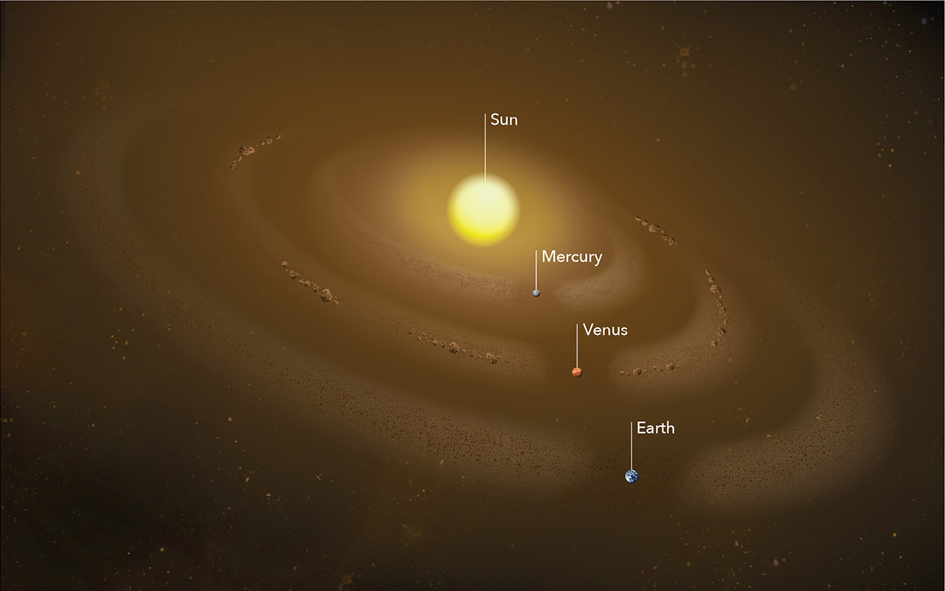
In this work, we focus on modeling and removing the zodiacal light foreground from infrared data so that we can measure the CIB. Zodiacal light is reflected sunlight and heat emission from small grains of dust that fill the interplanetary medium in the Solar System. We have made a new zodiacal light model, which does a better job at cleaning up the data from NASAs COBE/DIRBE experiment. Additionally, we have developed a new and open-source Python package called ZodiPy. The primary purpose of ZodiPy is to assist the astrophysics and cosmology communities with analyzing astrophysical data, making it easier to produce zodiacal light forecasts for future experiments. The package has already been used by astronomers and cosmologists worldwide, most notably by the NASA Roman telescope.