Join the disputation 
The PhD defence and trial lecture will be hybrid. The room opens for participation just before the disputation starts, and closes for new participants approximately 15 minutes after the defence has begun.
Join the trial lecture - 19th of June at 10:15 (Aud. 209, Svein Rosselands Hus)
"Could pulsars be the progenitors of fast radio bursts?"
Conferral summary
Dette arbeidet har brukt en nedenfra-og-opp-metodikk til å fremme vår forståelse av mørk materie på flere fronter. Vi har forbedret den numeriske behandlingen av såkalt ultralett mørk materie (FDM), funnet en ny nedre grense for dens masse og har kommet opp med en ny modell. Dette er den første i sitt slag for FDMs bølgeeffekter i kosmiske filamenter – motorveiene i universets mørke ryggrad.
Main research findings:
Since the advent of observational evidence for the mysterious, gravitationally interacting substance dubbed dark matter (DM) about a century ago, physicists have worked relentlessly to uncover its microphysical nature. Impressive theoretical frameworks have been developed, and increasingly sophisticated detectors constructed—yet, no direct detection has been achieved. Astrophysics offers a complementary perspective: rather than asking what dark matter is, we ask how it behaves.
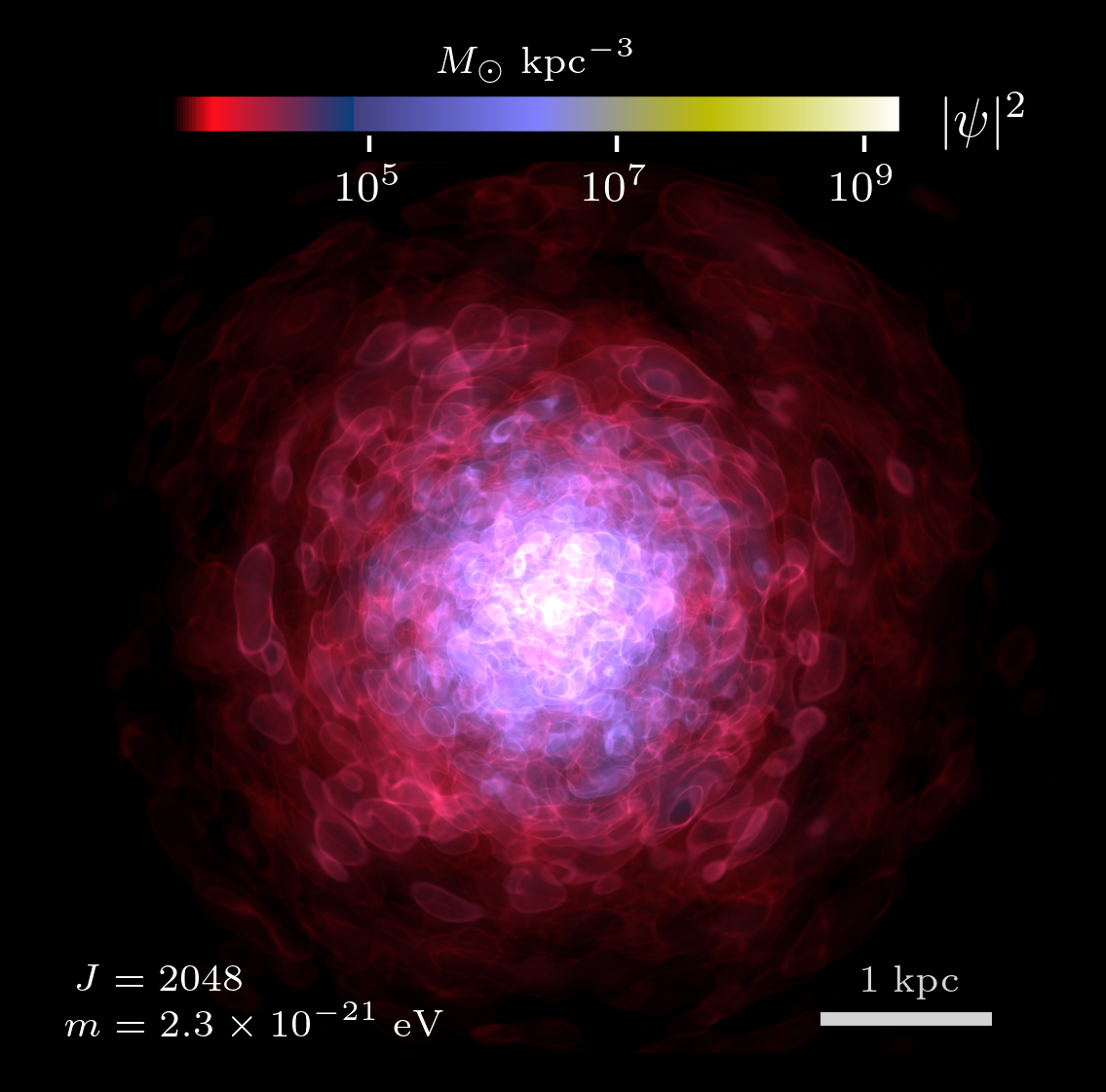
In this thesis, I focus on ultralight (or “fuzzy”) dark matter—a class of models that posits the DM particle to be roughly a hundred billion billion billion times lighter than a proton. So light, in fact, that its dynamics resemble those of a wave rather than a classical particle, giving rise to a distinct set of phenomena in a “fuzzy” universe.
To this end, I decompose FDM’s dynamics and phenomena into their elementary building blocks. Lower-dimensional considerations allow me to compare and further develop numerical solution strategies. By reconstructing all possible FDM wave states within the dwarf galaxy Leo II, I derive a robust mass constraint that updates four-decade-old folk wisdom. Finally, by assembling a population of simplified yet fuzzy cosmic filaments, one at a time, I statistically reproduce results of fully-fledged simulations at significantly lower cost.