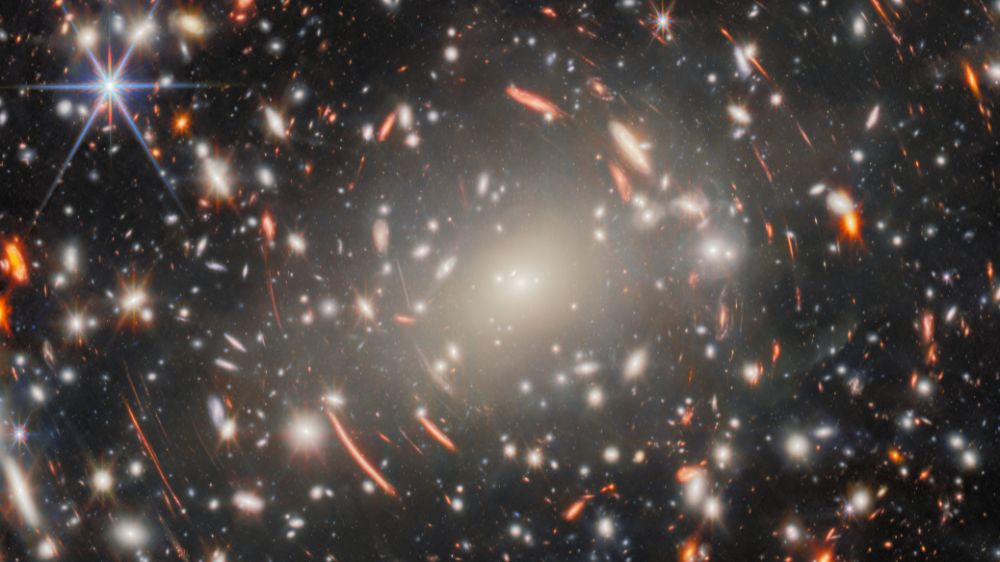
The dark matter puzzle
The problem of missing mass in the Universe, at the scale of galaxies, large-scale structures, and its global content, is a multi-faceted enigma. In the cold dark matter scenario, one of the main candidates for the exotic particles, is the neutralino, the most stable of the super-symmetric particles. However, supersymmetry does not appear as expected in the Large Hadron Collider experiments at CERN.
Many other models have blossomed in recent years, I will describe some alternatives such as axions, sterile neutrinos, or modified gravity.
The Rosseland Lecturer 2026
This year’s Rosseland Lecture will be held by Professor Françoise Combes, Emeritus Professor at Collège de France, chair of “Galaxies and cosmology”, and president of the French Academy of Sciences for 2025-2026.
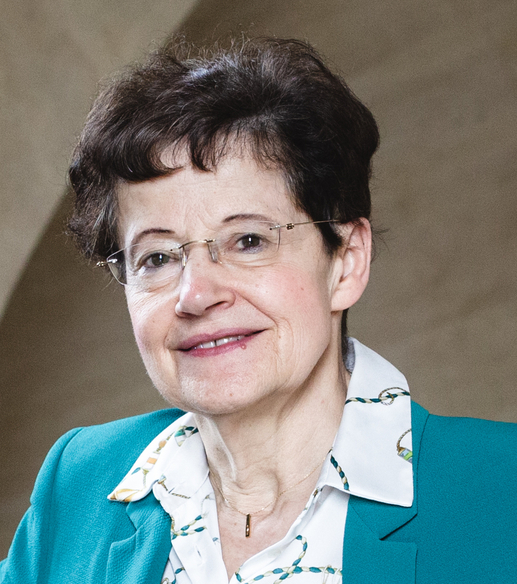
Combes works at the Paris Observatory on the formation and evolution of galaxies, their dynamics and their co-evolution with supermassive black holes, as well as on models of dark matter.
She has received several awards, including the CNRS Gold Medal (2020), the international L'Oreal-Unesco award for Women in Science (2021), and the Gothenburg Lise Meitner Award from the Gothenburg Physics Centre (2017).
Combes was elected member of the European Academy (2009) and international member of the National Academy of Sciences (USA, 2023).
The Rosseland Lecture 2026 will be held on Friday the 8th of May at 15:15 in the Science Library in Vilhelm Bjerknes’ hus at Blindern, University of Oslo.
Coffee and cakes will be served from 14:45. Welcome!
The Rosseland Lecture
The Rosseland Lecture is held annually by the Institute of Theoretical Astrophysics, University of Oslo, in memory of Norway’s foremost astrophysicist, and founder of our institute, Professor Svein Rosseland (1894 – 1985). The Rosseland Lecturers are internationally renowned, outstanding astrophysicists. The Rosseland Lectures hold a semi-popular level and are open for all.
The lecture will be streamed on YouTube channel of the Science Library.