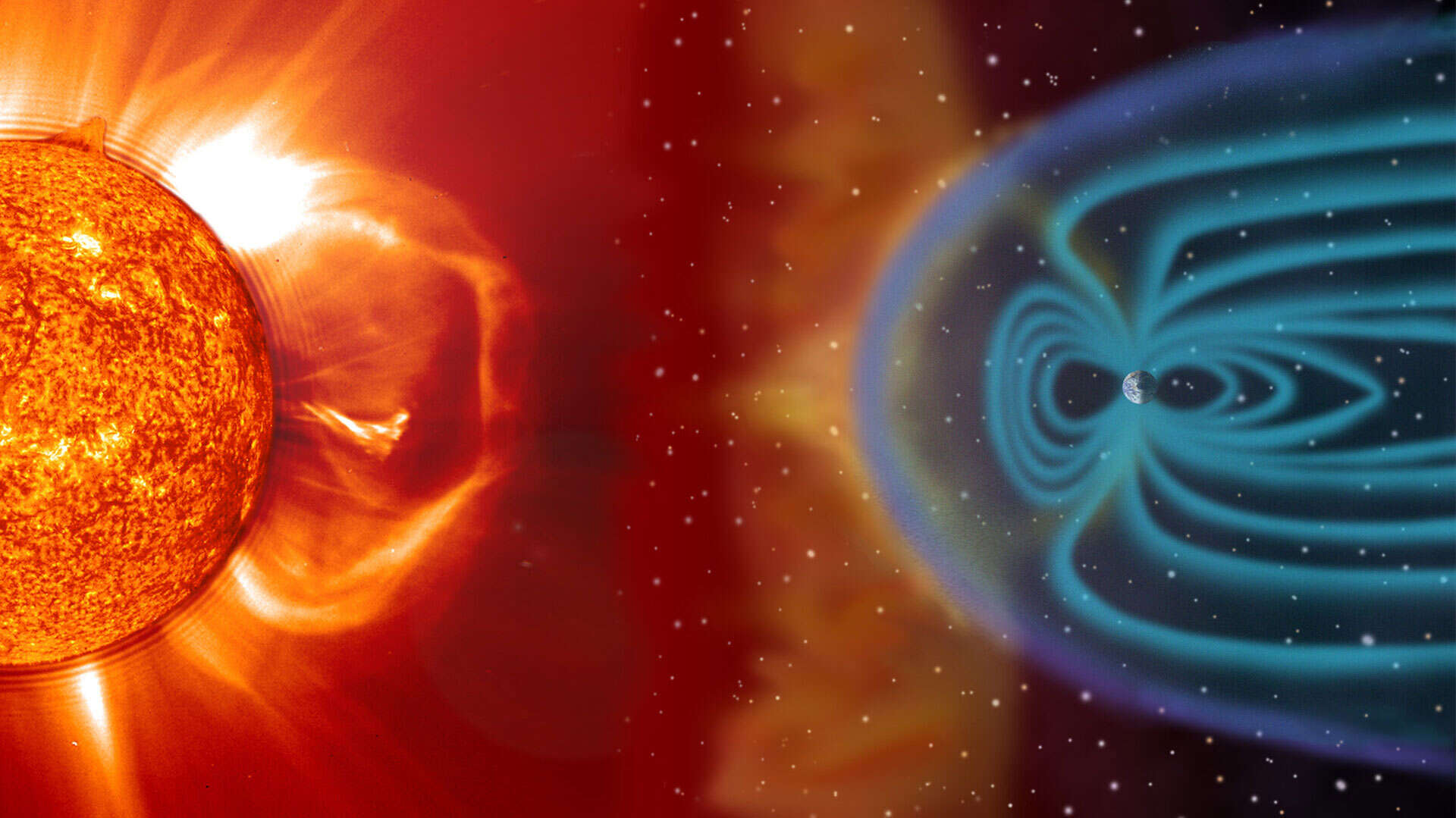

The space weather environment of exoplanets is determined by their host stars' rotation rate and magnetic activity. Solar-type stars form with a wide range of rotation rates, but by approximately 0.5–1 Gyr, angular momentum loss through stellar winds has brought them into the Skumanich era, where their rotation rates become increasingly similar and follow the same spin-down relation. Consequently, the early rotational history of the Sun, and its effect on space weather, cannot be reconstructed directly from its present-day rotation rate.
In my work, I have used large-scale magnetohydrodynamic simulations constrained by magnetic field maps reconstructed using Zeeman–Doppler imaging to explore how observed multipolar and often misaligned stellar magnetic fields shape the space weather environments of young, solar-type stars. By extending the wind simulations to include the interaction between stellar wind and planetary magnetospheres, we can quantify the space weather conditions experienced by exoplanets and model the effect of stellar wind pressure and planetary magnetic shielding on atmospheric erosion. Star-planet interactions generate radio emission from exoplanets, which may soon be observable and could offer insight into stellar wind conditions in exoplanetary systems, as well as an opportunity to constrain exoplanetary magnetic field strengths.
At PHAB, I aim to build on this work by coupling stellar wind models with models of planetary upper atmospheres, incorporating energetic particle transport, to better understand how stellar activity drives atmospheric escape and the long-term evolution of exoplanetary atmospheres.