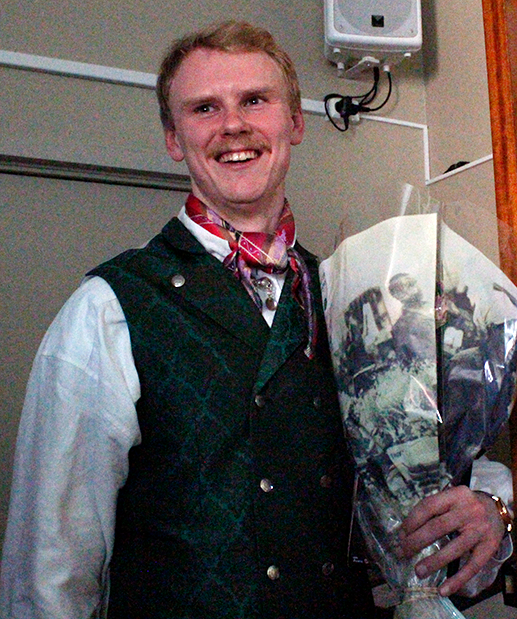
During his PhD at the Institute of Theoretical Astrophysics (ITA) and the Rosseland Centre for Solar Physics (RoCS), Elias Roland Udnæs investigated how energy moves through and heats the solar atmosphere.
Exploring the Sun’s dynamic atmosphere
Elias’ research focused on the chromosphere, a layer of the Sun’s atmosphere above its visible surface. It is a difficult region to study because it is both extremely thin and highly active.
– The main question is how to understand the chromosphere, Elias explains. It is very dynamic—there is a great deal of movement in the gas and a lot of energy involved—even though it is very ‘thin’. Very roughly speaking, the gas in the chromosphere is a million times less dense than Earth’s atmosphere.
Modern telescopes reveal the Sun in far greater detail than was previously possible. However, this does not necessarily make it easier to understand what is happening.
– Earlier, it was common to use very simplified models of the chromosphere, he says. Now we know that it is almost impossible to accurately describe what is happening when looking at observations from a modern telescope, precisely because we see so much detail. There are no simple structures.
This makes seemingly straightforward questions difficult to answer.
– Questions such as ‘What is the temperature at this exact point?’ or ‘Where does all this energy come from?’ are very hard to answer,” Elias says.
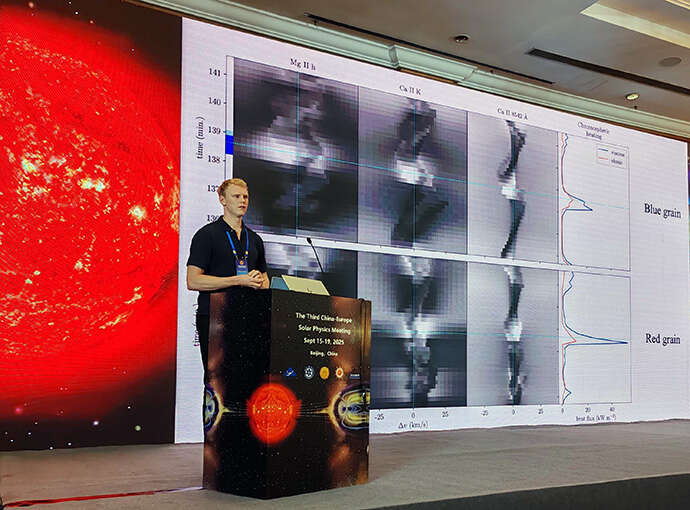
To investigate these questions, he used large amounts of data from realistic computer simulations of the solar atmosphere.
I used simulations to model the heating and transport of energy throughout the solar atmosphere.
– We compare a point in an observation with the most similar point in a simulation, and then use that point in the simulation to describe the observation.
In addition to working with simulations, Elias developed a tool that helps researchers connect observations from solar telescopes with computer models
By finding similar features in both, researchers can use the simulations to gain more information about what they see on the Sun.
Contributing to a larger picture
Research on the solar chromosphere rarely produces simple or definitive answers. Instead, progress often comes through improved methods, more realistic models and better ways of interpreting observations.
Often, research leads to the rather satisfying conclusion that we need more research before we can reach definitive answers.
Elias’ work developed tools and methods for comparing telescope observations with numerical simulations. These can help researchers investigate how energy is transferred through the chromosphere and interpret the increasingly detailed observations provided by modern solar telescopes.
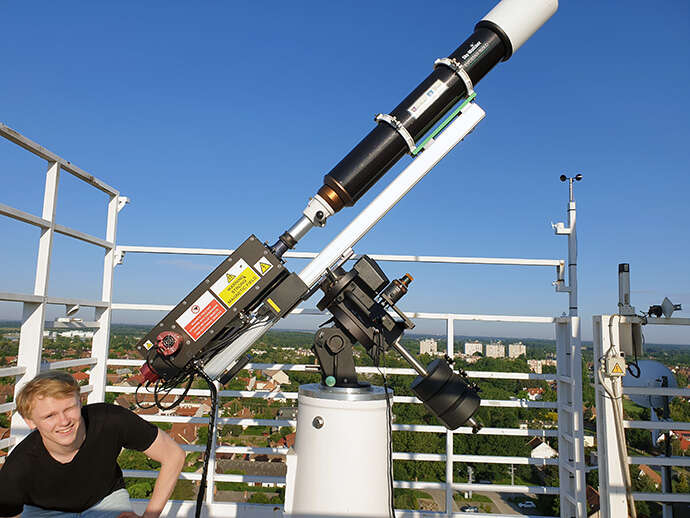
A collaborative research environment
For Elias, the research environment at ITA was an important part of the PhD experience. He highlights the support he received from his supervisor, postdoctoral researchers and fellow PhD students.
I have been extremely lucky to borrow the time of a great supervisor who has been very patient with me and allowed me to make independent decisions in my research.
The informal conversations with colleagues were equally valuable—both the scientific discussions and the everyday exchanges in the office.
– I have had more discussions between those four walls than outside of them, he says about office 210, which he shared with other PhD students.
These discussions made the office both a productive place to develop ideas and an enjoyable place to work.
The value of asking questions
One of the most important lessons Elias takes with him from his PhD is the importance of talking to others about difficult problems.
– I learned how important it is to discuss your problems with your peers, and how much I could learn from my PhD colleagues.
His advice to new PhD students is simple:
– Don’t expect to understand complicated theory on the first try. It is okay to ask the same question several times.
A new chapter in industry
After completing his PhD, Elias started a position as a project engineer at Kongsberg Gruppen. Although his work has moved from solar physics to industry, he sees clear value in the skills he developed during his doctorate.
– Analytical skills and programming are very important in my current job, he says.
My PhD training gave me the tools and mindset to solve most problems independently, which I find very useful.
At the same time, the role has introduced him to a more team-based way of working.
– However, it is not all independent work, as we also work quite a bit in teams. That differs somewhat from my own PhD, he says. It has been great and exciting so far.
The move marks a new chapter after several years of studying the Sun, its atmosphere and the physical processes that shape it.
Read more
Bachelor in Physics & Astronomy at UiO– an overview of the undergraduate curriculum that gave Elias his foundation.
Master in Astrophysics at UiO – the master Mats Ola completed before joining RoCS.
PhD at the Faculty of Mathematics and Natural Sciences– a quick guide to the doctoral opportunities.
Rosseland Centre for Solar Physics (RoCS) where Elias did his PhD.