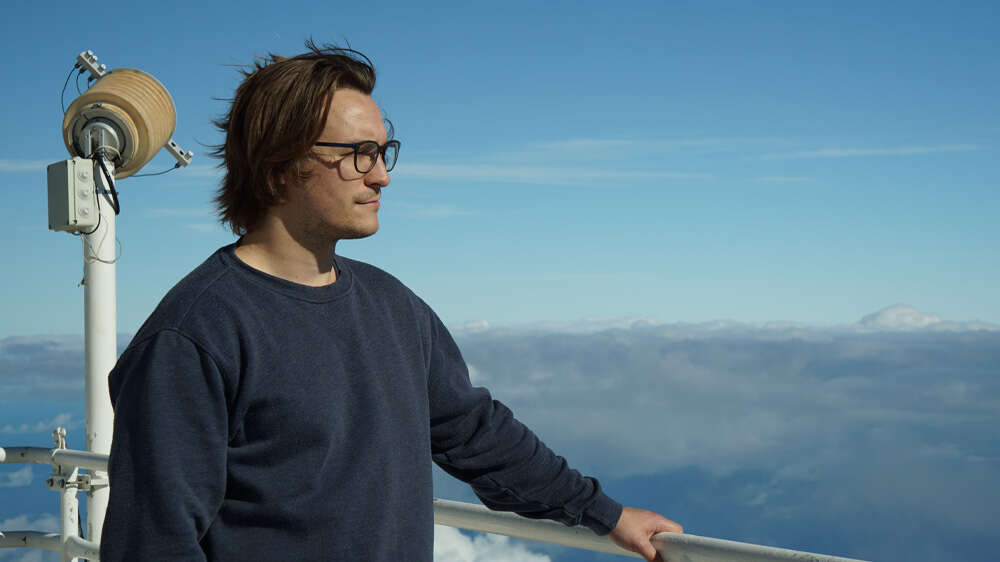
Dr. Mats Ola Sand has spent the last few years at ITA and the Rosseland Centre for Solar Physics (RoCS) unravelling how the Sun’s magnetic field powers some of these spectacular phenomena.
His work blends high‑resolution observations with state‑of‑the‑art simulations, and the insights he has gained are already illuminating new pathways both in solar physics and beyond.
Magnetic reconnection in action
My research explores how the Sun launches jets of hot plasma into its atmosphere.
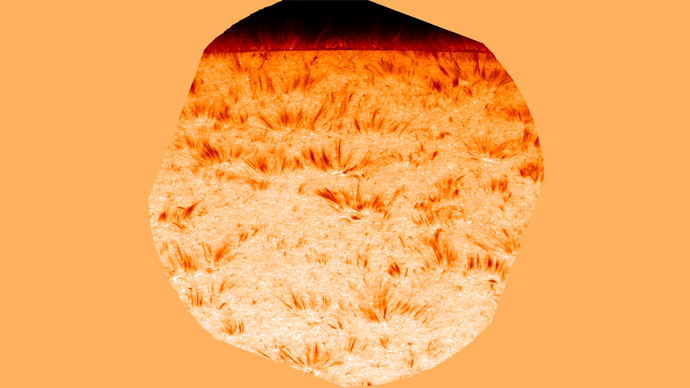
Focusing on magnetic reconnection – the rapid rearrangement of magnetic field lines that releases stored magnetic energy – he has examined small‑scale events near the solar surface. These appear as bright spots called Ellerman bombs, and linked them to thin, towering plasma jets known as spicules.
By combining coordinated ground‑based telescopes with space‑based instruments, he has also followed a UV burst – a burst of emission in Si IV that traces reconnection – connected to a surge. As such, he followed the full life cycle from a magnetic reconnection event connected to a surge in close proximity.
New mechanisms, unexpected longevity
The discoveries have been striking.
I identified a coupling mechanism between shocks and reconnection that hadn’t been documented in the solar atmosphere before.
This coupling provides a fresh angle on how energy can be transferred across different solar layers. He also obtained the first clear observational evidence that the reconnection seen in Ellerman bombs directly powers spicules – a link long predicted by theory but never firmly pinned down in data.
Perhaps most surprising was an unusually persistent UV burst. “It lasted at least three and a half hours, compared to the typical ten to thirty minutes,” he notes. This long‑lived tracer allowed him to capture a complete reconnection episode, following plasma expelled in opposite directions and the repeated birth of tiny magnetic structures that theoretical models had only hinted at.
The ITA / RoCS research environment
Mats Ola's successes would not have been possible without the collaborative spirit of ITA and RoCS.
The environment here is excellent, with colleagues who are genuinely generous with their time and expertise,” he says.
Access to both high‑resolution observations and cutting‑edge simulations, combined with a supervisor who encourages independent ideas, has turned challenges into opportunities and fostered both confidence and independence.
Learning from dead ends
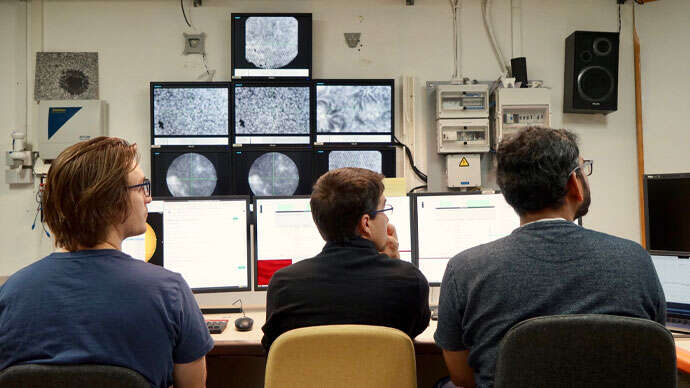
The PhD journey is never a straight line. “The most important lesson for me was learning to treat dead ends as part of the work rather than evidence that something was wrong,” Mats Ola reflects. Many ideas fizzled out, but those moments forced a deeper understanding of the data and models. Persistence, he learned, “eventually moves things forward,” and the slow periods became the crucible for his growth.
Advice for new PhD students
When asked what newcomers should keep in mind, Mats Ola stresses balance and foresight. “Exercise regularly. For me, it was by far the most effective way to manage stress and maintain perspective during difficult periods.” Patience, he adds, is key: “Don’t interpret every setback as evidence that you’re failing.” And he offers a practical tip for the future:
“Build your code and documentation as if someone else will need to use them – because eventually that someone will be your future self, wondering what on Earth you were thinking six months earlier!”
Looking ahead
The final chapter of the PhD is already opening a new one. “The plan is to move into data science and stay in Oslo.” Detecting rare signals amidst dominant backgrounds, constructing structured analytical pipelines, and teasing out hidden patterns are skills that translate seamlessly to industry challenges. “Oslo is and has always been home, so I intend to stay,” Mats Ola concludes - ready to apply his solar expertise to the data‑driven world beyond academia.
Read more
- Bachelor in Physics & Astronomy at UiO – an overview of the undergraduate curriculum that gave Mats Ola his foundation.
- Master in Astrophysics at UiO – the master Mats Ola completed before joining RoCS.
- PhD at the Faculty of Mathematics and Natural Sciences – a quick guide to the doctoral opportunities that attracted both Mats Ola and his fellow PhD fellows.
- Rosseland Centre for Solar Physics (RoCS) – home of the solar‑jet project, description of the BIFROST simulation code and the high‑resolution observation suite.