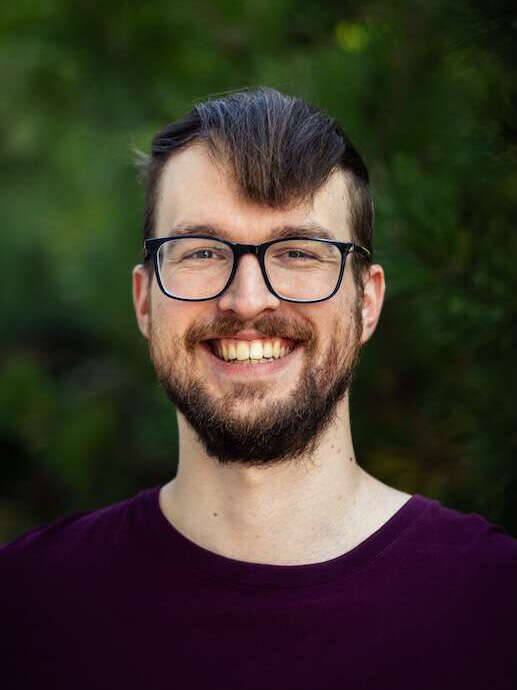
Sascha Ornig has spent the past few years at ITA and the Rosseland Centre for Solar Physics (RoCS), studying solar flares and investigating how their most intense brightenings form and evolve in the Sun’s atmosphere.
Focusing on white‑light solar flares
The light from the Sun can be described as a smooth background, called the continuum, with countless spectral lines superimposed. Much of solar physics has traditionally focused on these spectral lines because they are easier to observe and analyse.
Sascha’s thesis turns attention to the continuum itself.
My thesis is centered around solar flares, which are among the most energetic and violent events in the solar system. Some of their emissions pose challenges to our understanding of flare energetics, and I try to address these questions through simulations and observations of these strong brightenings on the Sun.
White‑light enhancements – brightening in the visible continuum – are particularly important.
– A large amount of the total energy released in flares ends up in the continuum, up to 90%, he says. It is therefore important to understand how these continuum enhancements form and how they affect the general solar environment.
What happens during a flare?
Solar flares are driven by magnetic energy stored in the Sun’s atmosphere. During a flare, this energy is rapidly converted into other forms.
– Energy stored in the Sun’s magnetic field is converted into other forms, such as heating of the plasma and acceleration of particles, including electrons and protons, to very high speeds, Sascha explains.
The accelerated particles, together with other phenomena such as waves in the solar atmosphere, create large intensity enhancements throughout the atmosphere..
– White light, or the visible continuum, generally contains information about the lowermost layer of the atmosphere, the photosphere, but it can also include contributions from higher layers, he says. With observations and simulations in the optical continuum, we can investigate the influence of flares on the lower atmosphere and infer the mechanisms behind these enhancements.
Combining observations and simulations
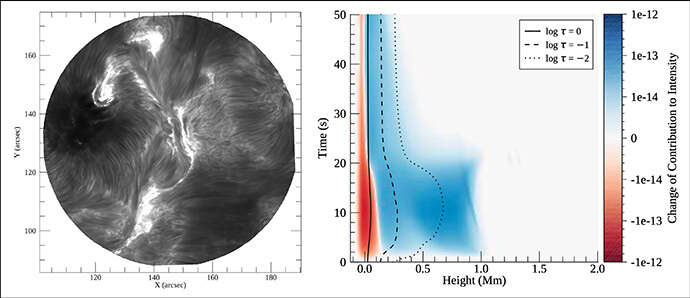
Like many projects in solar physics, Sascha’s research relies on both detailed observations and numerical modelling.
– From observations, we can only infer certain properties, such as temperature or plasma density, based on intensity measurements, he explains. Simulations, on the other hand, readily provide this information.
Realistic flare simulations are demanding. They require enormous computational resources and must therefore be simplified.
– Our models are still limited in complexity because of the enormous computational power required to run them, he says.
Comparing our simulations with the conditions we infer from observations helps us adjust our models to better reflect the actual conditions on the Sun.
– This, in turn, provides answers to physics questions that we cannot answer through observations alone, Sascha explains.
Finding the limits of current observations
Not all important scientific results are clear, positive detections. For Sascha, one of the key outcomes of the PhD was a negative result that points the way forward.
In my eyes, my most important result was a negative result.
- We tried to infer the mechanisms behind the continuum enhancements using high‑resolution observations from the Swedish Solar Telescope. However, we found that the current setup does not provide the information we need in the way we had intended,” Sascha says.
Rather than being a setback, the result reveals what future instruments and observing strategies need to be able to do.
– This helps us identify observational needs for the future, he explains.
The surprising power of accelerated particles
In current flare physics, it is widely believed that both accelerated particles and additional mechanisms, such as waves in the solar atmosphere, are needed to explain the observed intensity enhancements.
– I was surprised to discover how close we can get to observed intensity increases by just using accelerated particles, Sascha says.
Waves are harder to model realistically, but he is optimistic about what will be possible once this challenge is met.
– I think once that challenge is overcome, we will be on a great path to realistically model solar flares in their entirety.
A supportive research environment
The research environment at ITA and RoCS has been central to his PhD experience, both scientifically and personally.
– It is such a familiar and friendly environment that encourages you to step out of your comfort zone and do things that make you grow personally and professionally.
He highlights how colleagues and leaders have encouraged him to take on responsibilities he would not have imagined at the outset.
– I would never have imagined taking on any important roles in, for example, the institute leader meetings, he notes. But the encouragement and the friendly responses to everything I did were incredibly empowering.
– I am glad to have taken the path I have, but I am sure that I could not have done it without my colleagues here.
Learning to believe in one’s abilities
Beyond the scientific insights, the PhD has also brought important personal lessons.
This is a cliché response, but the most valuable lesson I have learned here is to believe in yourself and your abilities.
– We all tend to downplay ourselves and fear receiving critical responses to what we do, but a teaspoon of self‑confidence can go a long way in helping you develop personally and professionally. You will likely also be rewarded with much positive feedback.
Looking ahead to a new role
Despite a challenging job market, Sascha had secured a new position before his defence.
– Even though the job market is difficult to navigate at the moment, I was fortunate enough to have secured a new job before my PhD defense, he says.
I am very much looking forward to making use of my abilities in an entirely new setting, and I am happy to see one of my former colleagues there again.
The move marks the start of a new chapter, taking the skills and experience gained from studying solar flares and white‑light enhancements into a new professional arena beyond the PhD.