The Earth and the Moon
Welcome to the Earth and the Moon. You are now fifteen meters away from the Sun.
The Planetfield is a unique light model of our solar system, at the correct relative scale, where both distances and planet sizes are reduced by a factor of ten billion. Read more about the model.
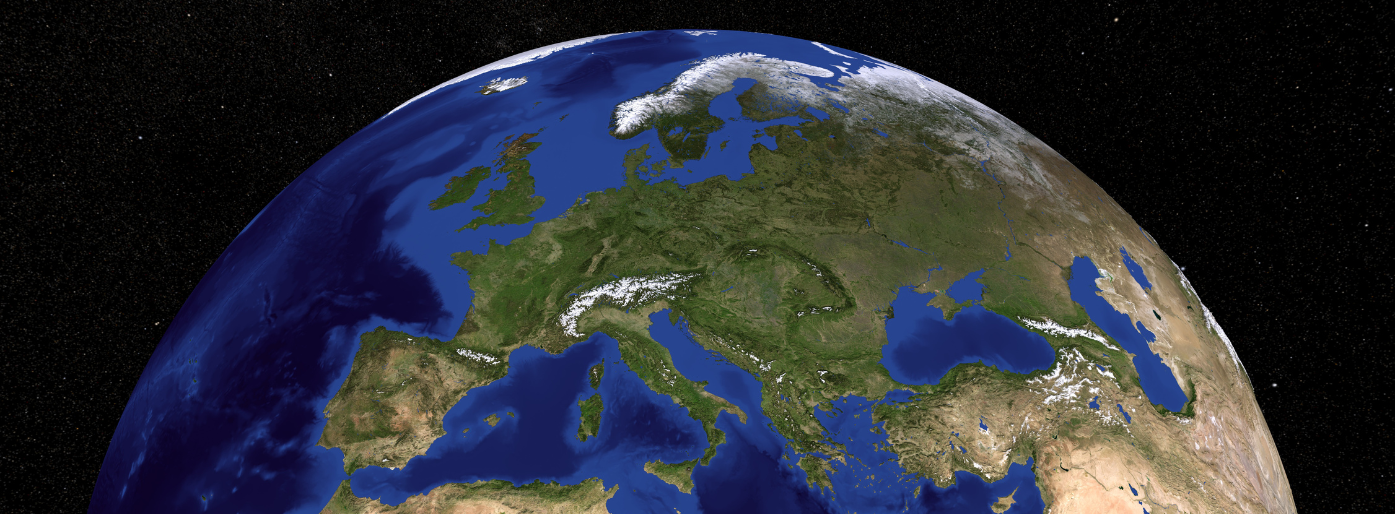
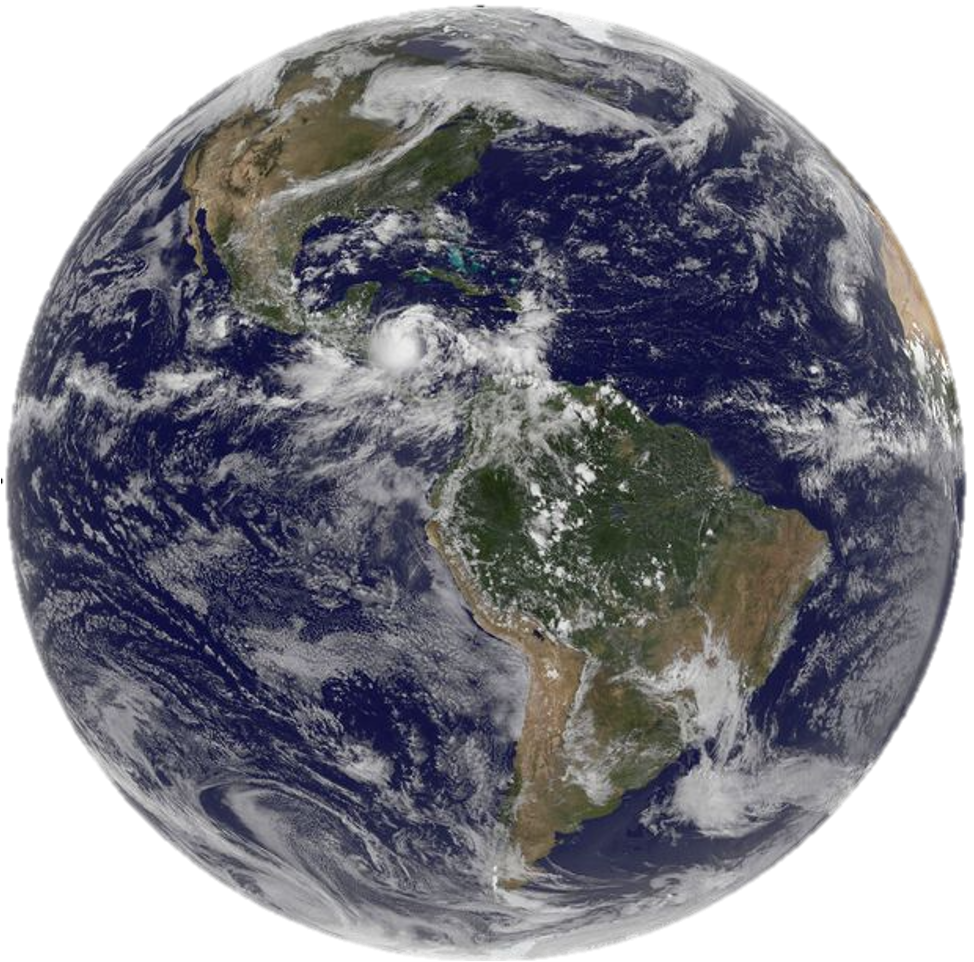
In this scale, the Earth, our home, is a glowing blue sphere with a diameter of 1.3 mm. The Earth has an atmosphere that consists largely of nitrogen (78%), oxygen (21%), and smaller amounts of other gases such as argon (1%) and carbon dioxide (0.04%). We are fortunate in our location out here in space. If the Earth were a bit closer to the Sun, like Venus, it would be too hot for life to arise. If we were farther away, for example where Mars is, the water on Earth would be frozen, with no possibility for life. We are right in the region astronomers call the habitable zone.
The Earth’s axis of rotation is tilted by 23.5° relative to the plane of its orbit. This tilt is the origin of our seasons, not the varying distance to the Sun. Here in the north, we are actually closest to the Sun in winter. The tilt determines both the Sun’s height above the horizon during the day and the length of the day, and thus how much heating the air, the sea, and the ground receive. In summer, the days are longer, and the Sun is higher in the sky.
The Earth is a so-called rocky planet. On the outside, we have the crust, which consists of rock and minerals. Deeper down, the amount of metals increases, until we reach an inner core of nickel and iron. The Earth moves in orbit around the Sun at a speed of 30 km/s, or more than 100 000 km/h. In the model, this means that the tiny glowing sphere moves more than 1 cm per hour, or almost the length of an A4 sheet of paper per day. Consider that you are standing here calmly reading while this is happening: in reality, you are racing through space at a dizzying speed. This motion means that after six months the Earth will be 15 m from the Sun on the opposite side of the model.
Roughly four centimeters from the Earth, you can see a small glowing sphere: our nearest neighbour, the Moon. In the model, it is only 0.35 mm mm in diameter. This perspective is important. Those four centimeters represent the farthest distance humans have ever travelled in space. Let that sink in while you think about our plans for crewed missions to Mars, 6–7 m away. If you place yourself one meter away from the two glowing spheres, you will see the Earth and the Moon as you would if you were actually ten million kilometers out in space.
Facts about the Earth
| Diameter | 12 756 km |
|---|---|
| Distance from the Sun | About 147–152 millions of kms |
| Rotation period | 23 h 56 min |
Orbital period around the Sun | 365.24 days |
| Surface temperature | –88 to 58 ºC |
The Moon
The Moon is an inhabited celestial body without an atmosphere, covered with crater upon crater from meteor impacts. Large parts of the surface are characterised by darker, flat, plain-like areas called seas (or mare in Latin). In earlier times, astronomers believed these were actual oceans. Later it was established that these areas were formed after intense volcanic activity, which caused lava to flow across the surface, creating darker plains.
The Moon is made of rock and metals, and its composition is very similar to what we find in the Earth’s crust. This has led to the most widely accepted hypothesis for the Moon’s origin: a possible collision between the Earth and another body, Theia. Theia is assumed to have been about the size of Mars and no longer exists. When Theia collided with the nascent Earth, it was completely destroyed. The remains of Theia, plus part of Earth’s outer layers, ended up in a ring around the Earth and gradually clumped together to form today’s Moon. This explains why its composition resembles that of Earth’s crust.
The Moon has been visited by a total of 12 astronauts, from 1969 to 1972. NASA has initiated a new lunar program (Artemis) that aims to land humans on the Moon during 2028.
The Moon takes 27 days to complete one orbit around the Earth. It takes just as long to rotate about its own axis, which is why we can always see only one side of the Moon. Since the Earth is simultaneously moving around the Sun, the lunar phases repeat with a period of 29 days. Think about this: while the small glowing sphere has completed one orbit around the larger blue sphere, both have moved a full 7 meters through the model.
Facts about the Moon
| Diameter | 3475 km (0,27 x Earths) |
|---|---|
| Distance from the Earth | 363 300–405 500 km |
| Rotation period | 27,3 days |
| Orbital period around the Earth | 27,3 days |
| Surface temperature | –233 to 123 ºC |
