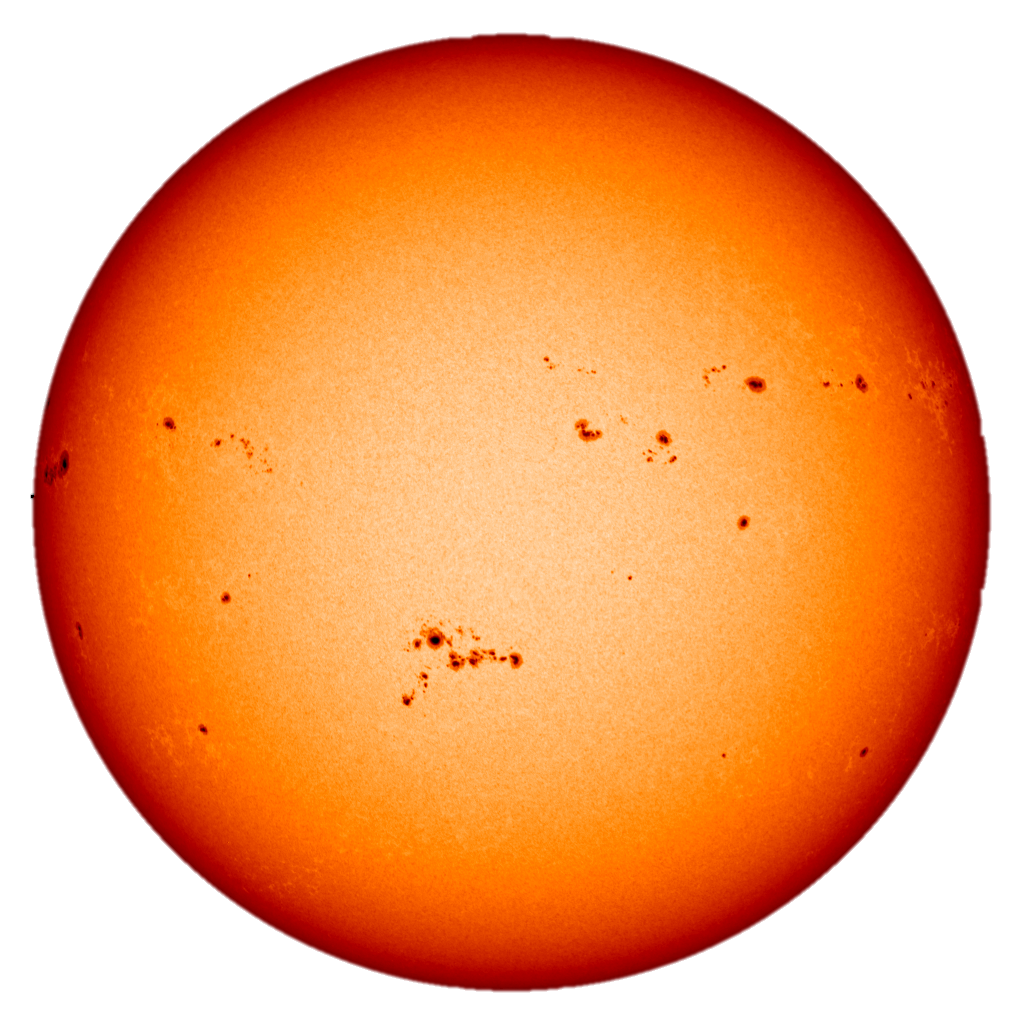
The Sun
You are now standing in front of a glowing sphere with a diameter of 14 cm, representing the Sun, our life-giving star.
The Planetfield is a unique light model of our solar system, at the correct relative scale, where both distances and planet sizes are reduced by a factor of ten billion. Read more about the model.

The sphere represents the Sun, shown in ultraviolet light (wavelength 30 nm, as opposed to visible light at about 400–700 nm). In reality, this glowing ball has a temperature of about 6000°C at its “surface”.
The Sun consists of hydrogen and helium (respectively 73% and 25%), plus many other elements in smaller amounts. It is hot because nuclear reactions (fusion) take place in its interior, where hydrogen nuclei collide and merge into helium nuclei. This happens under high pressure and at a temperature of around 15 million degrees. For each helium nucleus that is formed, an energy surplus is produced that heats the Sun and makes it glow intensely. The high temperature causes the electrons to be stripped from the atomic nuclei; this state of matter is called plasma.
The Sun, our nearest star, was born when a huge cloud of hydrogen and helium gas contracted under its own gravity. This happened about 4.6 billion years ago. The universe contains innumerable such gas clouds that are constantly forming new stars. The Sun is highly active, with large flows in the plasma, strongly varying magnetic fields, and eruptions (solar storms) that eject matter out into space. Particles from such eruptions also reach the Earth and are the cause of the northern lights. The Sun has enough hydrogen to sustain its current fusion process for about five billion more years. After that, it will swell into a red giant star, shed its outer layers, and end up as a small white dwarf star.
Facts about the Sun
| Diameter | 1.4 millions of km (109 x Earths) |
|---|---|
| Distance from the Earth | About 147–152 millions of km |
| Rotation period | 25.4 Earth-days |
| Surface temperature | Around 5500 ºC |
| Core temperature | Around 15 millioner ºC |
| Power output | 385 million billion billion Watts |