Background
.png)
Colorectal cancer (CRC) symptoms are unspecific often emerging when the disease is no longer curable. Screening reduces CRC mortality, but current screening tests need improvement to be more accurate and less costly and invasive. CRC is one of the cancer types with strongest association with lifestyle, and there is reason to believe that this association is partly mediated trough the bacteria in the gut, - the microbiota.
We are investigating interactions between CRC, lifestyle and microbiota to better guide prevention of CRC and increase the biomarker performance.
Project aims
The overall aim of the CRCbiome study is to discover gut microbiota biomarkers for colorectal cancer screening.
Design and infrastructure
The CRCbiome study have recruited participants enrolled in the Bowel Cancer Screening in Norway (BCSN) study - a pilot for the national colorectal cancer screening program. Near 3000 screening participants with a positive Fecal immunochemical test (FIT) was invited to participate in our study. Before the colonoscopy, the study participants were asked to fill in a lifestyle- and demographics questionnaire and a validated food frequency questionnaire, developed at the University of Oslo. Neoplastic lesions detected as part of the screening examination was removed during colonoscopy. Two and twelve months after the colonoscopy, the participants were asked for a new FIT test. With this it is possible to investigate whether the microbiome changes after the removal of any precursors to cancer.
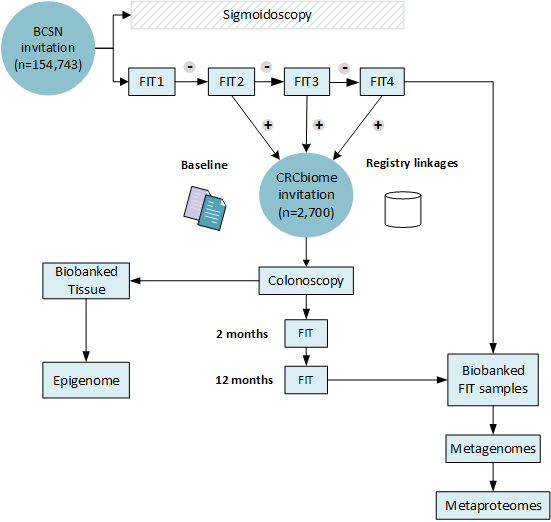
Project status
The CRCbiome project began in 2017 and is dedicated to understanding the complex relationship between the gut microbiome and colorectal cancer (CRC). To date, we have recruited 1,640 participants and completed quality control of their questionnaire data, and DNA from fecal samples has been extracted and sequenced. In 2025, we will expand the CRCbiome cohort with approximately 2,000 additional metagenomes derived from biobanked FIT samples.
Our research covers several areas:
Bioinformatics development: advancing tools and analytical pipelines for comprehensive microbiome analysis, including bacteria, viruses, and fungi.
Microbiome determinants: studying how factors such as lifestyle, diet, prescription drug use, and biology shape the gut microbiome.
Biomarker discovery: identifying microbial or molecular markers that could improve CRC detection and prevention.
Integrative multi-omics: combining metagenomic, metatranscriptomic, metaproteomic, epigenomic, clinical, and lifestyle data to obtain a more comprehensive understanding of colorectal cancer (CRC) development.
By studying the gut microbiome from many angles, the CRCbiome project hopes to contribute to earlier diagnosis, better prevention, and more personalized care for people at risk of colorectal cancer.
Who are we?
The project is lead by Prof. Trine Rounge at BiLS, Bioinformatics in Life Science, Department of Pharmacy, UiO and Dr. Paula Berstad at the Cancer Registry of Norway, National Institute of Public Health (NIPH). Einar Birkeland began as a postdoc in March 2020 and has since transitioned to a researcher role within the project. With a background in molecular biology and applied bioinformatics, Einar holds a PhD from the University of Bergen. He specializes in metagenome analyses. Cecilie Bucher-Johannessen started her PhD in March 2020. Her research examines sex differences in gut microbiota and colorectal cancer, as well as the role of Phascolarctobacterium. She is defended her thesis on the 13th of june 2025. Ane Sørlie Kværner became a postdoc in August 2019. She holds a degree in clinical nutrition and a PhD in clinical nutrition from the University of Oslo's Faculty of Medicine. Ane's work focuses on lifestyle and diet analyses within the project. Ekaterina Avershina joined the project as a researcher in May 2022, and has broad background in bioinformatics and molecular biology. Maja Jacobsen also started in May 2022, serving as the project coordinator and lab engineer. Elin Sandertun Røed joined the project as a PhD student in September 2024. Her research will focus on the relationship between prescription drug data, the microbiome, and colorectal cancer. In August 2025, Blanca Candelas Galavis began her PhD, focusing on multi-omics analyses of microbiomes.
Alumni
Paula Istvan joined the project as an affiliated postdoc in November 2020. Her research focused on analyzing the gut virome from participants' fecal samples (the FIT virome).
.jpg?alt=body)
The CRCbiome core group
How to get access to data
All research projects that includes information from CRCbiome must comply with the EU’s General Data Protection Regulation (GDPR). This means that the processing must have approval from the Regional Committee for Medical Research in Norway (REC). Furthermore the processing needs legal basis according to GDPR Article 6 and 9. The applicant must have considered the need for a Data Protection Impact Assessment (DPIA) according to GDPR article 35. The applicant must prove that these requirements have been met before the data can be made available. Disclosure of information to countries outside the EU requires that the conditions in GDPR are met. To apply for access to data from the CRCbiome study the applicant must fill out this form: Data access application form. For more information, or submission of the application form, email: t.b.rounge@farmasi.uio.no
Collaboration
Giske Ursin, Director, Cancer Registry of Norway, Norwegian Institute of Public Health
Kristin Ranheim Randel, Head of The Colorectal cancer Screening Section, Cancer Registry of Norway, Norwegian Institute of Public Health
Geir Hoff, Researcher
Edoardo Botteri, Researcher, Cancer Registry of Norway, Norwegian Institute of Public Health
Torbjørn Rognes, Professor, University of Oslo
Eivind Hovig, Professor, University of Oslo and Oslo university Hospital
Hanne Cecilie Winther-Larsen, Professor, University of Oslo
Anette Hjartåker, Professor, University of Oslo
Ida Robertsen, Professor, University of Oslo
Hege Salvesen Blix, Professor, University of Oslo, Researcher, Norwegian Institute of Public Health
Ingvild Odsbu, Researcher, University of Oslo and Norwegian Institute of Public Health
Ole Herman Ambur, Associate Professor, Oslo and Akershus University College of Applied Sciences.
Robert Lyle, Core Facility Leader/Senior Scientist, Norwegian Sequencing Centre.
Richard Landberg, Professor, Chalmers University of Technology, Gothenburg, Sweden.
Willem de Vos, Professor, University of Helsinki and Professor Wageningen University
Scott Bultman, Associate Professor, University of North Carolina at Chapel Hill
Vahid Bemanian, Senior engineer/researcher, Akershus University Hospital
Pekka Ellonen, Technology lab at FIMM, Helsinki, Finland
Per Hoffman, CCO at Life & Brain GmbH and Head of Research Platform Genomics, University Hospital Bonn, Germany
Mingyang Song, Ass. Prof, Harvard T.H. Chan School of Public Health.
Øyvind Holme, Researcher, Hospital of Southern Norway
Siv Kjølsrud Bøhn, Associate professor, Norwegian University of Life Sciences
Alessio Naccarati, Senior Researcher, Italian institute for Genomic Medicine