
The PhD defence and trial lecture will be streamed. The chair of the defence will moderate the disputation.
Ex auditorio questions: the chair of the defence will invite the audience physically present in the auditorium to ask ex auditorio questions.
→ Live streaming of trial lecture and disputation
→ Request for thesis copy (available until the disputation starts)
Trial lecture
Time and place: September 12, 2025; 10:15 AM, -
Lille Fysiske auditorium (V232) - Fysikkbygningen
Title: "The tetra-neutron: Theory and experiment"
Main research findings
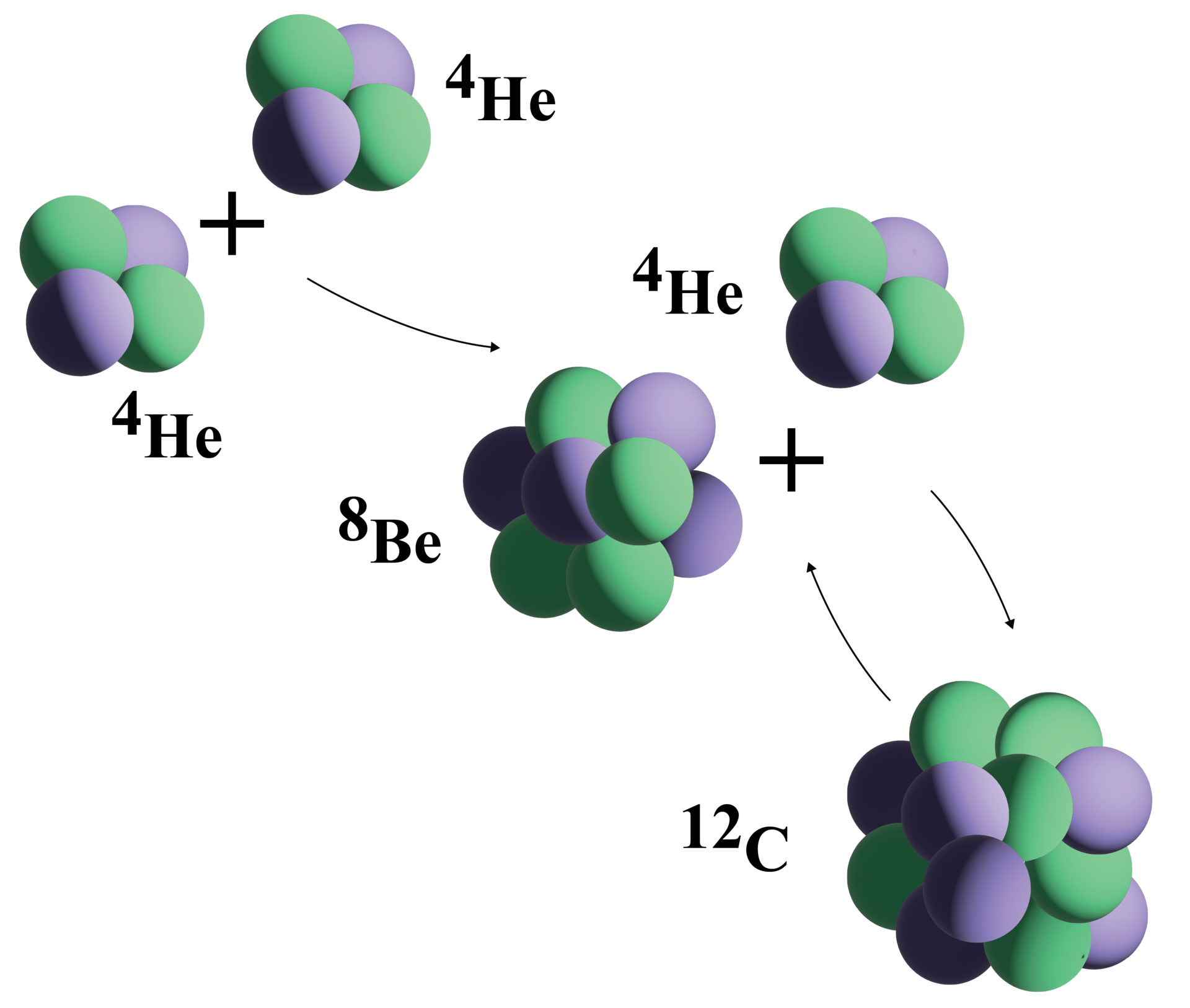
The triple-α process is a fundamental cornerstone of stellar nucleosynthesis, facilitating the production of 12C, a vital building block for life. Through the triple-α process, three helium nuclei can fuse to ultimately produce a stable 12C nuclide. At medium stellar temperatures between 0.1–2.0 GK, the Hoyle state in 12C mediates the triple-α reaction, making a comprehensive understanding of its properties essential for accurately modeling the stellar production of 12C, as well as the subsequent stellar nucleosynthesis. Numerous measurements of the decay modes of the Hoyle state have been conducted since its discovery, yielding a relatively well-constrained value of for it’s radiative branching ratio, describing the probability of producing 12C through the triple-α process. However, a recent measurement published by Kibédi et al. [Phys. Rev. Lett. 125, 182701 (2020)] reported a highly discrepant value of Γrad/Γ = 6.2(6) × 10−4 for the radiative branching ratio from the Hoyle state. Given the astrophysical significance of the Hoyle state, resolving this conflict is crucial. This study seeks to address this discrepancy through a new measurement of the γ-decay branching ratio of the Hoyle state, together with a comprehensive reanalysis of the data published by Kibédi et al. [Phys. Rev. Lett. 125, 182701 (2020)].
Hovedfunn (Norwegian)
Gjennom trippel-alfaprosessen kan tre heliumkjerner smelte sammen for å danne en stabil 12C-nuklide. Ved medium høye temperaturer i en stjerne, mellom 0.1–2.0 GK, spiller Hoyle-tilstanden i 12C en avgjørende rolle i å fasilitere trippel-alfaprosessen. En grundig forståelse av denne tilstandens egenskaper er derfor helt essensielt for å modellere produksjonen av 12C i stjerner, samt de påfølgende nukleosynteseprosessene. Mange målinger av henfallsmodusene til Hoyle-tilstanden har blitt utført siden dens oppdagelse, og disse har resultert i en relativt godt avgrenset verdi for det radiative greinforholdet på Γrad/Γ = 4.16(11) × 10−4, som beskriver sannsynligheten for å produsere 12C gjennom trippel-alfaprosessen. Imidlertid rapporterte en nylig måling gjennomført av Kibédi et al. [Phys. Rev. Lett. 125, 182701 (2020)] en betydelig avvikende verdi på Γrad/Γ = 6.2(6) × 10−4 for det radiative greinforholdet fra Hoyle-tilstanden. Gitt den viktige astrofysiske betydningen av Hoyle-tilstanden, er det helt avgjørende å løse denne konflikten. Denne studien har som mål å adressere denne diskrepansen ved å utføre en ny måling av γ-henfallsgrensforholdet til Hoyle-tilstanden, samt gjennomføre en omfattende ny analyse av dataene fra Kibédi et al. [Phys. Rev. Lett. 125, 182701 (2020)].
Adjudication Committee
- Professor Hans Fynbo, Department of Physics and Astronomy, Aarhus University, Denmark
- Professor Angela Bracco, Department of Physics, University of Milan, Italy
- Associate Professor Maria Vetleseter Bøe, Department of Physics, University of Oslo, Norway
Supervisors
-
Professor Sunniva Siem, Department of Physics, University of Oslo, Norway
-
Associate professor Kevin Ching Wei Li, Department of Physics, University of Oslo, Norway
-
Professor II Tomas Kvalheim Eriksen, Department of Physics, University of Oslo, Norway
Chair of defence
Professor Andreas Görgen, Department of Physics, University of Oslo, Norway
Contact information to Department: Line Trosterud Resvold