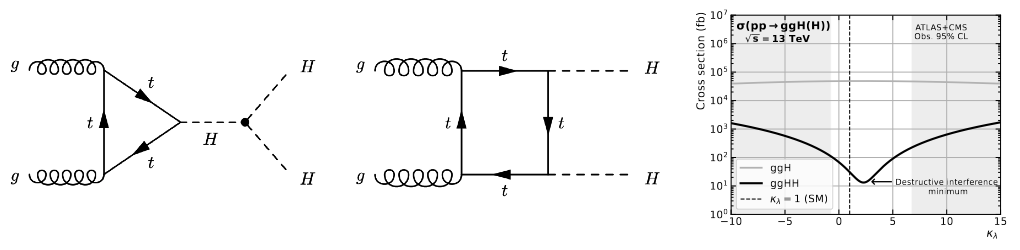
Understanding the shape of the Higgs potential is one of the central open questions in particle physics. The observation and measurement of Higgs boson pair (di-Higgs) production at the Large Hadron Collider and the High Luminosity LHC (HL-LHC, starting in 2030) provide the only direct means in the foreseeable future of probing the Higgs self-interaction predicted by the Standard model, but the process is extremely rare and, therefore, challenging to measure at the Large Hadron Collider (LHC) at CERN. Precisely because the process is so rare, this is also fruitful ground for searching for physics beyond the Standard Model.
The goal of this project is to contribute to the search for di-Higgs production in the combined ATLAS data of Run 2 (2015-18) and Run 3 (2022-26). Previous (and ongoing) master projects at the University of Oslo have studied (are studying) the use of increasingly advanced Machine-Learning (ML) techniques for separating the rare di-Higgs signal from the plentiful Standard Model background. Several studies of projections of the results one can expect with the full HL-LHC dataset of 3000/fb have been carried out as well.
Although the Higgs bosons in a di-Higgs event can decay in many different ways, this project will focus on the specialty of the Oslo group: one Higgs boson decays to two photons (H→γγ) and the other decays via Z0Z0, W+W- or τ+τ- to one or more detectable leptons.
Depending on the progress of the previous group of students, one of two avenues of research will be pursued. One is to investigate the inclusion of lower-level information in the list of input features that neural networks are to be trained on, in order to improve the signal sensitivity. For example, there are several pre-selections of candidates based on hard cuts of composite features of the reconstructed events, but the composite features play no further role in the signal-background discrimination.
The second research direction is to implement a neural network-based simulation-based statistical inference (NSBI). The current baseline analysis is based on one or a small number of invariant di-photon mass spectra of the events classified as signal candidates by the ML algorithm, with various discrete levels of averaged signal purity. By avoiding this step in the statistical inference, greater sensitivity may be achieved. Also, various existing methods of interpolating the inference between different values of λ (for example, parameterized neural networks) do not necessarily take into account subtle correlations between observables.
Milestones:
M1: Survey the published ATLAS and CMS results and the relevant UiO theses on the subject. Decide on the research direction to pursue.
M2: Gain access to the ATLAS software, documentation, and relevant ATLAS Run 2 and 3 data (in the form of ROOT “ntuples”) and corresponding simulated ntuples for signal and backgrounds.
M3: Start writing thesis. Deliver 5-10 pages with first draft of Introduction and/or Theory chapters.
M4: Install necessary ML software, if not already done for M2, and reproduce the latest existing results.
M5: If required, produce new ntuples with an extended feature set.
M6: Implement changes to the workflow in order to pursue one of the research directions.
M7: Report preliminary “expected” results to the relevant ATLAS di-Higgs working group, and take into account feedback.
M8: If a go-ahead is given, unblind the real data (until this point only the background-rich data may be compared to the simulated data).
M9: Complete first draft of thesis, one month before submission deadline.
M10: Submit thesis.
Courses relevant from the bachelor's degree:
Recommended courses for theoretical curriculum in the master's programme:
(Mandatory for the project)
(Other relevant courses)