
Permafrost Science enters the art gallery
Permafrost stores significant amounts of carbon globally and is a crucial ecosystem in the context of climate change. However, changes in this subsurface layer in the Far North are difficult to observe directly. It can be hard to understand the link between permafrost and climate, as they are two distinct concepts, and why they are important.
The artist Taylor Alaina Liebenstein Smith addressed how the concept of thawing permafrost could be visualized to a broader audience in her exhibition “A Feeling of Longing That Freezes and Thaws”, at Atelier Nord in Grunerløkka, Oslo.
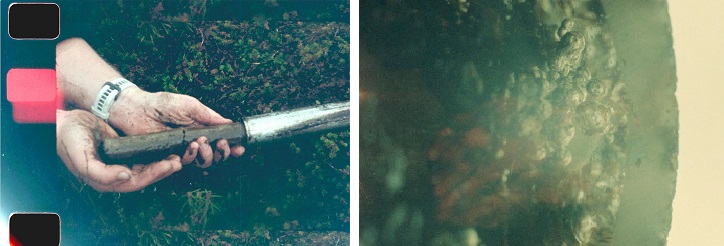
The exhibition featured permafrost samples projected using 35mm slide projectors, magic lanterns, a 16mm film, and cooling elements, all related to ongoing thawing processes in Finnmark. It also included sculptures, a sound installation, and conversations between the artist and scientists.

Fruitful collaboration
The exhibition at Atelier Nord was a result of a collaboration between the artist completing her MFA at the Academy of Fine Arts, Oslo National Academy of the Arts Taylor Alaina Liebenstein Smith, and researchers from the University of Oslo:
Mats Rouven Ippach and Anfisa Pismeniuk, both PhD students from the Dept. of Geoscience and the CBA Centre. Additionally, Eira Carlsen, a PhD student, Professor Alexander Eiler, both from the Dept. of Biosciences, and dancer and choreographer Tim Winter participated in this collaborative project.
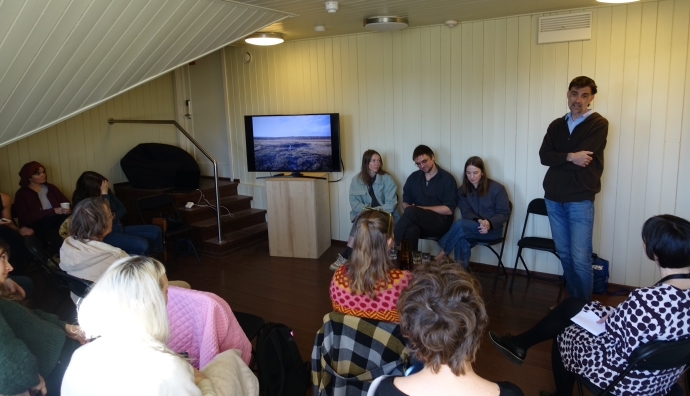
The exhibition at Atelier Nord attracted over 450 visitors during the three weeks in March (March 7 – March 23, 2025).
During the closing weekend, Saturday, March 22, there was a panel talk and conversation titled “Perceiving Permafrost,” where participants had the opportunity to discuss the intersection of art and science in this particular exhibition.
The researchers began by presenting their scientific approaches and interests in investigating the ongoing thawing of permafrost and its impacts on climate. Additionally, Sebastian Westermann, a professor in the Department of Geosciences and a specialist in permafrost, contributed to the conversation.
The rest of the debate focused on perceptions and understanding of permafrost beyond the realms of science and art, and included a dialogue between the artist, the researchers, and the audience. The conversation was fruitful, with questions from the audience that developed into a back-and-forth discussion between the panel and the attendees.
Why Permafrost?
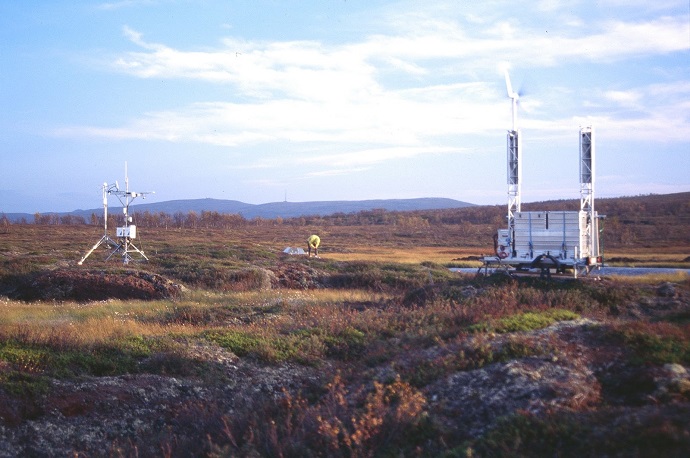
For many years at the field sites in Finnmark, peatlands with permafrost have been present in Norway. The thawing permafrost is resulting in changes to the landscape. Discussions with people living in these areas suggest that peat mounds have been disappearing for several years.
Aerial imagery from the last few decades confirms the rapid degradation of the peat plateaus. Their transformation from frozen carbon storages to dynamic wetland systems is indeed visible on the surface, both to those explicitly looking for it and to those directly affected by the changes.
It’s not only people living in permafrost areas who are affected by this climate-induced thawing; permafrost thaw can have global implications.
References and additional information:
Find more information about the exhibition/Atelier Nord, the artist and the research centre CBA at the links below:
Atelier Nord: “A Feeling of Longing That Freezes and Thaws”
About the artist: Taylor Alaina Liebenstein Smith
About the research centre CBA: Centre for Biogeochemistry in the Anthropocene