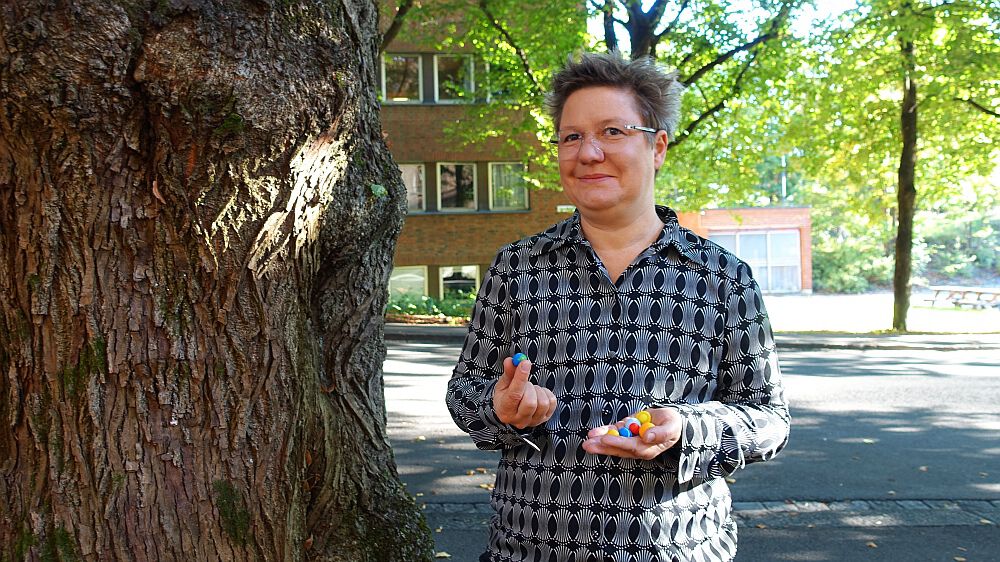
The Research Council of Norway (NFR) has announced that three research projects in space research will receive funding. Among them is Stephanie Werner, a professor of planetology at the University of Oslo (UiO).
Werner is also the director of the Center for Planetary Habitability (PHAB), one of UiO's centers for excellence in research. She will now receive support for the project 'Galactic Recipe for Exo-Planets.'
Will explore the formation of exoplanets
An exoplanet is a planet outside our solar system that orbits another star. They vary in size, composition, and distance from their respective stars. Some may have conditions similar to those on Earth, making them interesting for research, especially regarding the potential for life.
With the funding, it is possible to study the processes and conditions necessary for the formation of exoplanets. Is there a recipe for this? Today, we are aware of countless exoplanets, while the physical properties of host stars and planets can vary significantly.
– One goal of the 'Galactic Recipe for Exo-Planets (GREP)' project is to gain more knowledge about the formation of exoplanets. Conditions that we know play a role include the composition of the host star and factors that influence the formation of exoplanets, such as temperature and dynamic processes, explains Stephanie Werner.

– The composition of a star can vary much and is fundamental to the internal structure and physical properties of an Earth-like exoplanet that consists of rock. This relationship between a host star and exoplanets is something we want to gain more knowledge about.
Of nearly 5,000 known exoplanets, only 5% exhibit potentially Earth-like characteristics in terms of mass and distance from the star they orbit, writes PHAB, which conducts research on Earth-like exoplanets or exo-Earths.
New ESA Space Telescope: PLATO
The project will utilize the European Space Agency's new space telescope PLAnetary Transits and Oscillations of stars (PLATO), which is set to be launched into space in the autumn of 2026. The space telescope will search for Sun-like stars and Earth-like exoplanets that are composed of rock.
– One goal of the GREP project is to predict and reproduce the architecture of the new exoplanetary systems that are discovered, as well as the characteristics of the exoplanets. Another goal we have is to test current competing planet formation models against observations from the space telescope, concludes Werner.
Funding for space research from NFR
This thematic funding from the Research Council of Norway (NFR) for space research is awarded to projects aimed at enhancing fundamental knowledge about space and Earth, as well as fostering the development of a new generation of space researchers. It is a priority that the projects include recruitment positions.
For more information about the funding see NFR