
The conferment of the honorary doctorate took place on 2 July 2026 during the closing ceremony of The 3rd Asian Conference on Permafrost (ACOP 2026), which was held in Ulaanbaatar from 28 June to 2 July 2026. In the hall there were around 350 participants from 25 countries, including seven researchers from the University of Oslo working in cryosphere and permafrost research.
The honorary doctorate was presented to Sebastian Westermann by the President of the Academy, Prof. Demberel Sodnomsambuu, Mongolian Academy of Sciences.
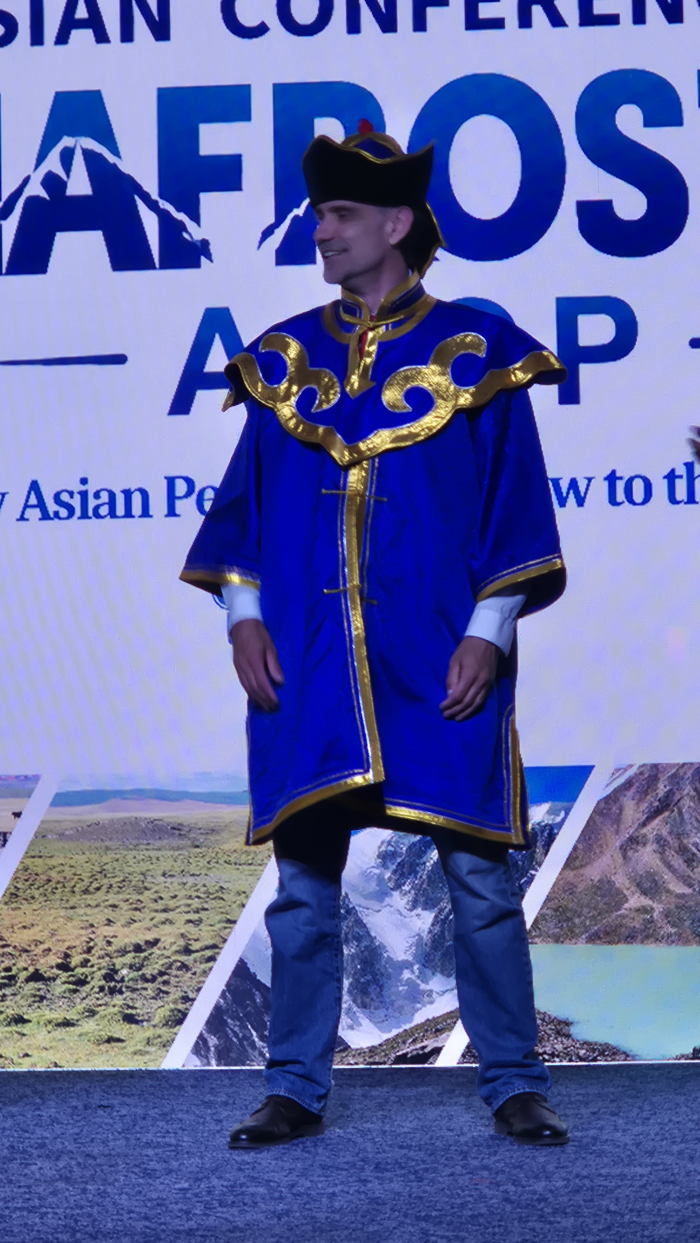
This is the third Asian conference on Permafrost. The Asian continent, the largest in the world, has the most extensive permafrost areas on the planet. Various types of permafrost are found here. Read more about the conference here: 3rd Asian Conference on Permafrost (ACOP 2026)
Long research career in the cryosphere
Throughout a long research career, Sebastian Westermann has worked on developing models for permafrost and studied how climate change affects the cryosphere, the frozen part of the Earth’s surface where water exists in solid form. The cryosphere includes, among other things, snow, glaciers, permafrost, as well as seasonal frost, among others. He is also involved in research on the carbon balance in permafrost regions in a changing climate.
On several occasions he has carried out extensive fieldwork in field campains in Mongolia, as well as in Norway, Svalbard and Canada, with a particular focus on permafrost.
Westermann is a professor at the Section for Geography and Hydrology (GeoHyd) at the Department of Geosciences. He is also participating in the Centre for Biogeochemistry in the Anthropocene (CBA), which studies the interactions and feedback between climate, the carbon cycle and ecosystems in northern latitudes.