The trial lecture will be held in Auditorium 1 in The Geology Building, and the PhD defence will be in the Auditorium 3 in the ZEB-building. In some cases, it will be possible to attend the trial lecture and dissertation digitally, in that case a link to Zoom will be posted.
Trial lecture
Thursday 31 October, 10:15-11:00, Aud 1, The Geology Building:
Identifying climate controls on alluvial successions in the stratigraphic record
Conferral summary (in Norwegian)
Alluviale riftbassenger er områder der jordskorpen sprekker opp og det dannes daler der elver og elvevifter avsetter sedimenter. Slike avsetninger er potensjelt bra reservoarer for naturressurser og CO2-lagring. I sin doktorgrad har Camilla Würtzen undersøkt hvordan bassengene utvikles under påvirkning av tektonisk aktivitet og klima, gjennom studier av Perm-Trias suksesjonen under Horda Platformen i Nordsjøen og Qahlah formasjonen (fra Kritt) i Oman. En kombinert analyse av seismiske data, brønndata, spektral dekomponering, og feltarbeid gir en mer komplett modell for sedimentfordeling og utvikling av bassengene, og gir viktig innsikt for ressursutnyttelse og CO2-lagring.
Main research findings
Popular scientific article about Würtzen's dissertation:
Alluvial Rift Basin Fill - Development dynamics, controlling factors, and reservoir architecture
Alluvial Rift Basin Fill - Development dynamics, controlling factors, and reservoir architecture
Alluvial rift basins - places where the Earth’s crust stretches to form valleys filled with river and fan deposits - shape the continental landscape and are commonly sites for reservoirs hosting natural resources. This PhD research examines how these basins evolve and how factors like faulting and climate affect their nature.
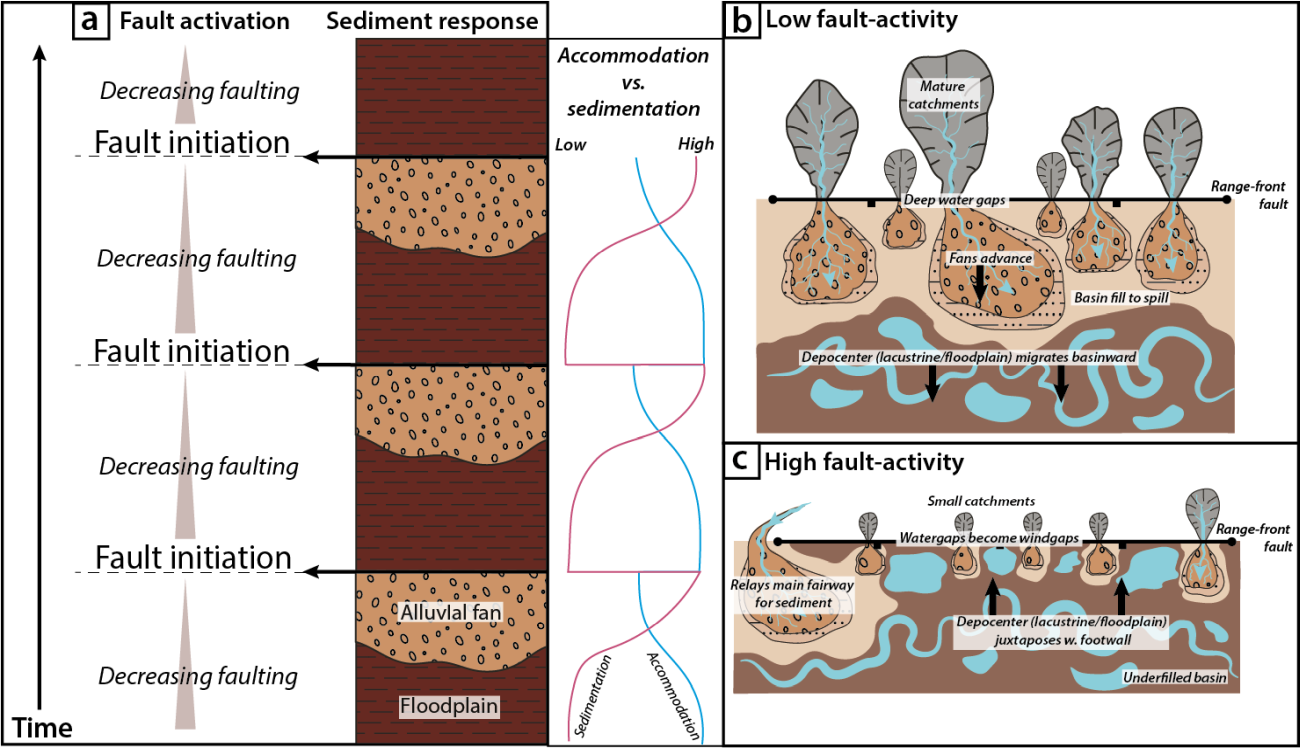
Two cases were studied in the work by Camilla Würtzen: the subsurface Permian-Triassic Horda Platform Basin in the North Sea and the exposed Upper Cretaceous Fanja Basin in Oman. In the North Sea, seismic mapping, well data and spectral decomposition were combined to infer sediment distribution and depocenter development over time in response to shifting climate and fault activity. Fieldwork in Oman revealed how faults and changing sediment sources influenced the structure of alluvial deposits in the Qahlah Formation.
By integrating these two case studies, a more complete model of how alluvial rift basin stratigraphy and architecture develop was established. This research not only improves our understanding of Earth’s geological history but also provides valuable insights for industries exploring these basins for resources and CO2 storage.
This doctoral work is part of the Norwegian Carbon Capture and Storage (NCCS) research cooperation, hosted by SINTEF, aiming to safely store CO2 underground and reduce greenhouse gas emissions.
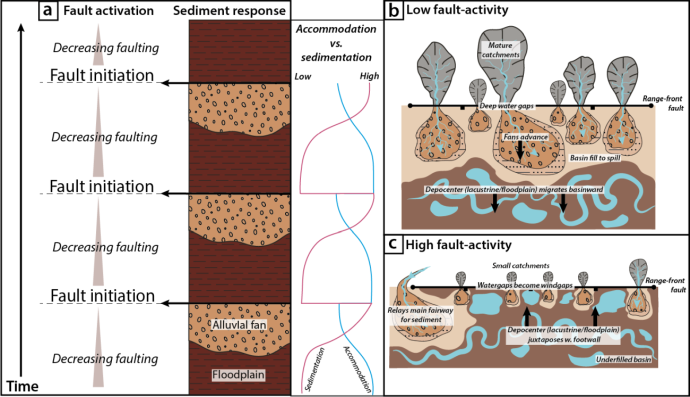
Photo and other information:
Press photo: Camilla Würtzen, portrait; 1200px. Photo: Private
Other photo material: Figure with description and credit as specified in the article above, size 1300px.