
The PhD defence and trial lecture will be held in Auditorium 3 in The ZEB-building. In some cases, it will be possible to attend the trial lecture and dissertation digitally, in that case a link to Zoom will be posted.
Trial lecture
Monday 27 October, 10:15-11:00, Aud 3, ZEB-bygningen:
The Subglacial Bedform Continuum: morphology, formation, and preservation in the context of Fennoscandian Ice Sheet history
Conferral summary (in Norwegian)
Rogenmorener finnes i områder som var dekket av innlandsisen i Skandinavia under istidene, samt områder som har vært dekket av store isbreer. I sin avhandling bruker Thomas Barnes kunstig intelligens og romlig analyse til å kartlegge formen på og hvor det finnes Rogenmorener i Norge. Denne informasjonen brukes til å lage en rekonstruksjon av hvordan landskapet ble formet mens det var dekket av kilometertykk is under istidene. Avhandlingen gir ny kunnskap om hvordan samspillet mellom is, vann og landskapet danner spesielle landformer som f.eks. Rogenmorener. Dette gir oss et nytt bilde av hvordan innlandsisen har satt sitt preg på det norske landskapet.
Main research findings
Popular scientific article about Barnes’s dissertation:
Subglacial geomorphology of Norway: ribbed moraines, the bedform continuum and localised geomorphological reconstruction of the Fennoscandian deglaciation
Ribbed moraines are landforms that are found in regions covered by former ice sheets. Ribbed moraines form as elongated hills, oriented roughly perpendicular to ice flow. Throughout Fennoscandia, they have been previously only manually mapped, thus, current maps are incomplete. Furthermore, their conditions and processes of formation continue to be poorly understood, under-researched and heavily debated. Understanding the spatial extent of ribbed moraines and their formation conditions is valuable for reconstructing ice sheets. In particular, updating our knowledge of ribbed moraines is important for understanding the centre of ice sheets where they form, as most research focuses on ice-edge features, this knowledge can be applied to present ice sheets.
To investigate ribbed moraines’ distribution and formation, Thomas Barnes has in his doctoral work automatically mapped ribbed moraines in Norway using machine learning to produce a nationwide dataset. Across this dataset, formation conditions were compared from ice-, landscape- and water-focused data. This analysis refreshes Norwegian maps of ribbed moraines and identifies that ribbed moraines need: flat topography, patchy hydrology and slow-flowing ice; to form.
Using these findings to understand ice conditions, Thomas presents a reconstruction of the Fennoscandian Ice Sheet around Femundsmarka National Park, Eastern Central Norway and Finnmark, North Norway.
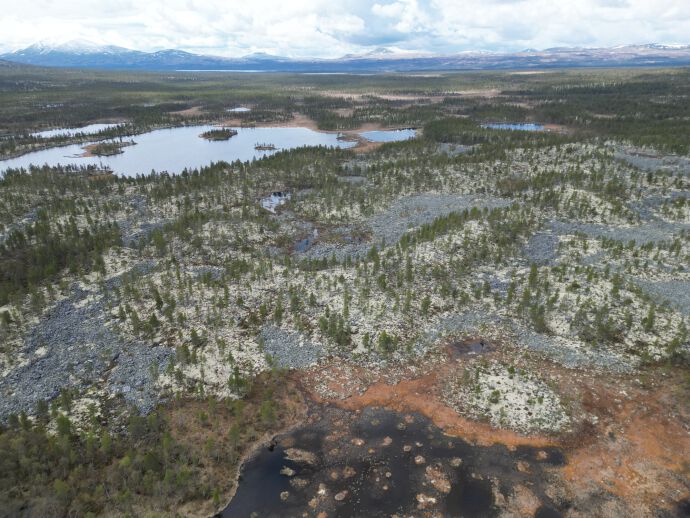
Photo and other information:
Press photo: Thomas Barnes, portrait; 900px. Photo: Private

Other photo material: Photo with description and credit as specified in the article above, size 2000px.
