The PhD defence and trial lecture will be held in Auditorium 1 in The Geology Building. In some cases, it will be possible to attend the trial lecture and dissertation digitally, in that case a link to Zoom will be posted.
Trial lecture
Wednesday 17 December, 10:15-11:00, Aud 1, The Geology Building:
Quantification of spatiotemporally noisy environmental variables in situ considering both theoretical and practical perspectives
Conferral summary (in Norwegian)
Droner kan måle klimagasser i luften, og kan være nyttige for forskning på og overvåkning av metanutslipp fra ulike kilder. Avhandlingen til Alouette van Hove viser at droner kan måle metanutslipp mer presist ved hjelp av probabilistisk inferens, noe som ble testet i felt med husdyrflokker i Kenya. I simulerte eksperimenter ble dronene lært opp av kunstig intelligens til å velge flyruter som gir mest informasjon, og dermed forbedre utslippsestimatene. Studien viser at slike adaptive strategier for datainnsamling med droner kan gi mer nøyaktige og effektive målinger enn både forhåndsplanlagte og kortsiktige ruter.
Main research findings
Popular scientific article about van Hoves’s dissertation:
Navigating emission plumes: Inferring sources from drone observations via intelligent path planning
Drones offer an effective platform for executing targeted flight missions and collecting atmospheric data on greenhouse gas concentrations. These measurements enable the estimation of emission rates from diverse sources. This thesis introduces a modular framework that integrates probabilistic inference and adaptive drone-based sampling to improve the quantification of greenhouse gas emissions, with a focus on methane. By combining Bayesian inversion techniques with reinforcement learning, the proposed approach achieves robust estimation of emission rates and source locations from inherently noisy atmospheric observations.
The framework developed by Alouette van Hove was validated through both real-world field campaigns---such as monitoring methane emissions from livestock herds in Kenya---and controlled synthetic experiments. Results demonstrated that Bayesian methods can outperform traditional mass balance techniques, especially for weak emission sources (~100 g CH4 h-1) and under turbulent atmospheric conditions. Furthermore, reinforcement learning agents trained to optimize drone flight paths for maximal information gain consistently surpassed preplanned and myopic strategies in source estimation accuracy.
These advances establish a foundation for operational emission monitoring systems capable of supporting climate policy, regulatory compliance, Earth system monitoring, and targeted emission mitigation.
Photo and other information:
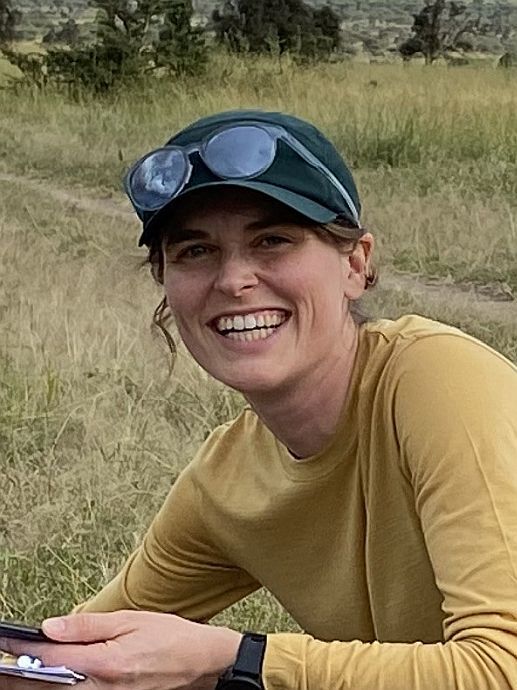
Press photo: Alouette van Hove, portrait; 1500px. Photo: Vibeke Lind/NIBIO
