The PhD defence and trial lecture will be held in Auditorium 1 in The Geology Building. In some cases, it will be possible to attend the trial lecture and dissertation digitally, in that case a link to Zoom will be posted.
Join via Zoom (webinar)
Trial lecture
Friday 31 January, 10:15-11:00, Aud 1, The Geology Building:
Bioremediation methods for contaminated soils.
Conferral summary (in Norwegian)
I brannslukningsskum (AFFF) inngår perfluorerte stoffer (PFAS-er) som er svært stabile og som forurenser miljøet. I denne ph.d.-studien blir det undersøkt hvordan ulik mengde vann i jord ved Oslo lufthavn, Gardermoen påvirker oppførselen til PFOS og PFAS. Ved lav vannmetning ble det ikke observert utlekking av PFOS og andre langkjedede PFAS, en høyere metningsgrad gav høy utlekking av flere PFAS, men ikke PFOS, mens forsøk med fullstendig vannmettet jord fremdeles ikke bidro til å fjerne alle PFAS-ene. Feltskalaforsøk med jordvasking viste at AFFF-forurenset jord ikke ble fullstendig fri for PFAS, men resultatene varierte mye basert på hvor mye og hvilken type brannslukningsskum som hadde vært brukt.
Main research findings
Popular scientific article about Høisæter’s dissertation:
Fate and transport of per- and polyfluorinated alkyl substances (PFAS) from the use of aqueous film forming firefighting foam (AFFF) in unsaturated soils
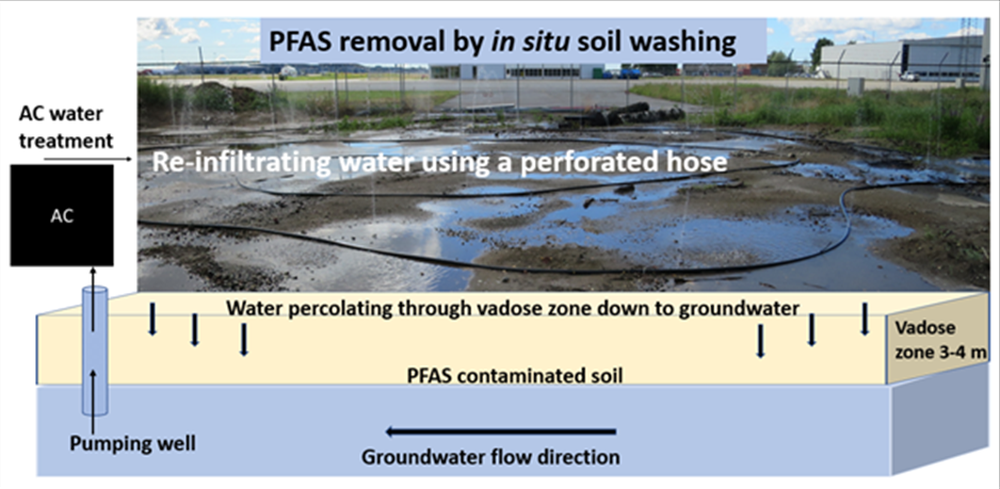
Fire extinguishing foam (AFFF) contains PFAS substances which are very stable, can accumulate in the environment and contaminate soil and groundwater. In this study, a high retention of PFOS was observed in unsaturated soil in the source zone at a fire training field at Gardermoen, after high exposure to infiltration that simulated several years of snowmelt or pulses of intense autumn rainfall. The studies showed that chemical and physical properties in unsaturated soil other than organic carbon, such as air/water interface retention, affect the mobility of PFOS and other PFAS in unsaturated soil contaminated by PFAS from use of AFFF. Lower water saturation of soil resulted in higher retention of PFOS and other long-chain PFAS while a high degree of saturation resulted in high leaching of several PFAS, except for PFOS. Fully saturated water flow did not remove all PFAS from the AFFF contaminated soil.
Field experiments with soil washing to remove PFAS from soil contaminated by AFFF, showed a clear variation in removal efficiency observed in different soil samples from different locations. This can possibly be linked to historical AFFF exposure and the weathering of the PFAS contamination at individual locations. Our studies indicate that a complex mixture of PFAS compounds from historical use of AFFF remains in soil and will have a major impact on the long-term environmental risk at these sites. Reducing infiltration of water at AFFF contaminated sites will limit risk of PFAS leaking into the environment considerably.
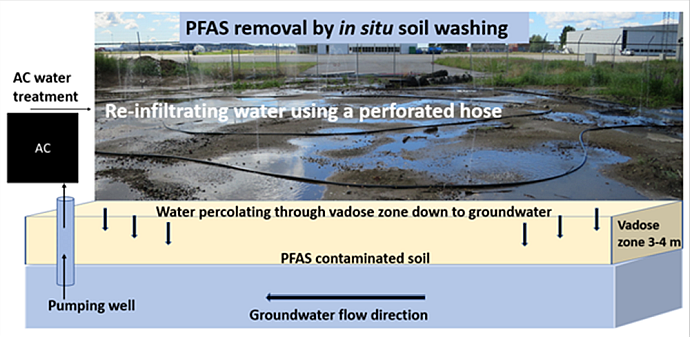
Photo and other information:
Press photo: Åse Høisæter, portrait; 800px. Photo: Private

Other photo material: Figure with description and credit as specified in the article above, size 1000px.