Trial lecture
Friday 4 September, 10:15-11:00, Aud 1, The Geology Building:
Upscaling CO₂ Mineral Trapping Capacities: Key Processes and Parameters at the CO₂–Rock Reaction Front
Conferral summary (in Norwegian)
Trygg og sikker geologisk lagring av carbon (CCS) krever gode reservoarer, og den vulkanske bergarten basalt har vist gode egenskaper som reservoarbergart. I sin avhandling har Marija Plahter Rosenqvist gjort en detaljert studie av reservoaregenskapene til de vulkanske avsetningene i den nordatlantiske vulkanske provinsen (NAIP) med studier fra Færøyene og offshore Norge. Funn viser hvordan sprekker og porer i km-til mikrometer-skala i basalt er viktige for bergartens evne til å lagre CO2 i undergrunnen.
Main research findings
Popular scientific article about Rosenqvist’s dissertation:
Multiscale flow pathways in basalts of the North Atlantic Igneous Province
Implications for CO2 storage
Global warming caused by greenhouse gas emissions from human activities is likely to negatively affect the climate, ecosystems, and human health unless action is taken. CCS technology with capturing CO2 and injecting it into basalt offers a safe storage option, as the gas reacts with the rock and mineralises into carbonate. However, we still don’t fully understand how fluids move through basalt reservoirs and which pore structures CO2 can react with and precipitate carbonates.
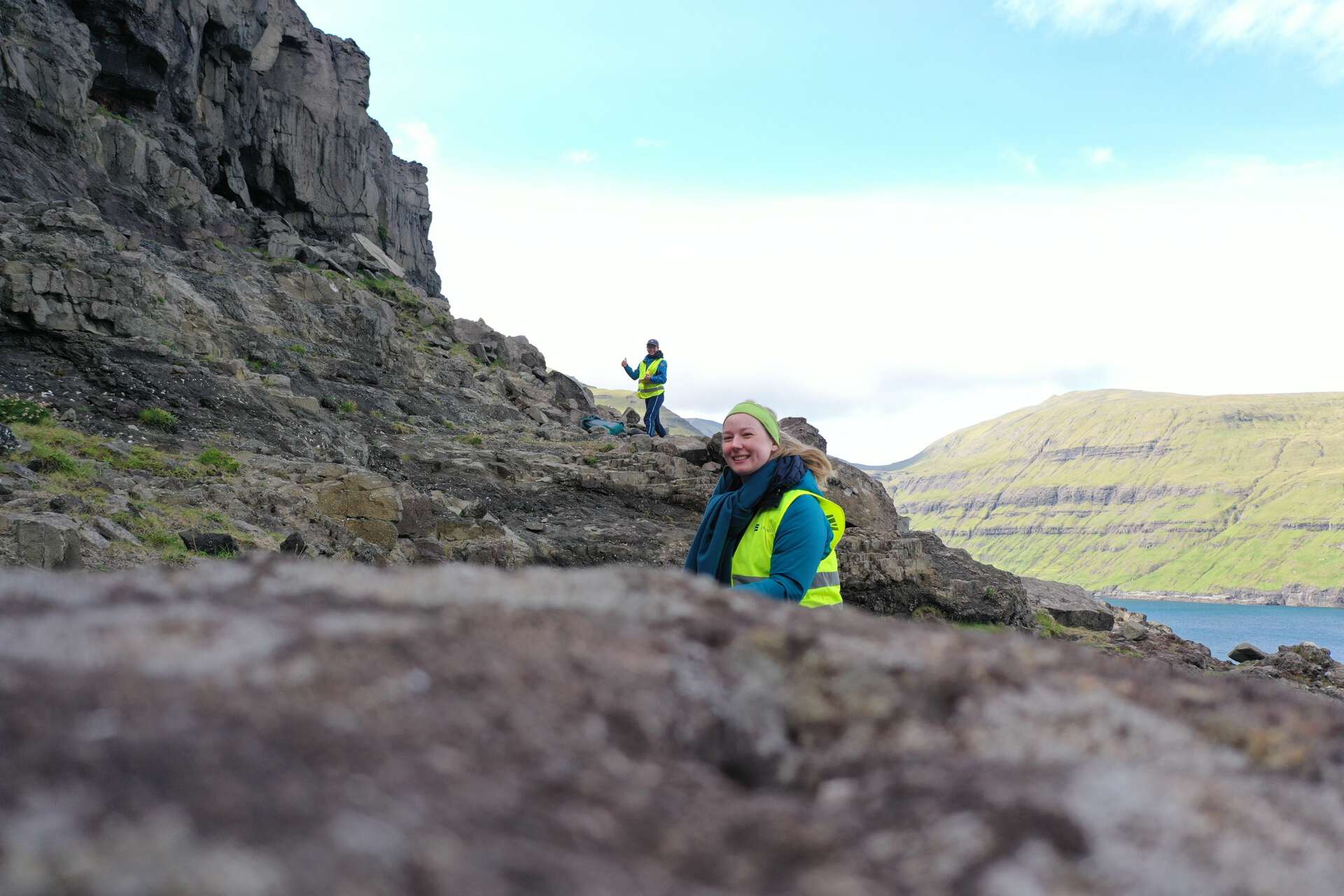
In her PhD thesis Marija Plahter Rosenqvist offers a multiscale characterisation of potential fluid-flow pathways in basaltic sequences of the North Atlantic Igneous Province (NAIP) in the North-east Atlantic Ocean. Studies on the Faroe Islands suggest that lava flows with relatively thick, porous crusts make for likely good reservoirs. In basalts from the Skoll High offshore Norway, carbonate occurs in macroscale pores and in the microporous volume of the basalt rock, where it has replaced primary basalt minerals.
The research also documents significant porosity below the resolution of normal core-scale micro-computed tomography (resolution ca. >50 μm). This emphasises that the large reactive potential of basalts does not depend solely on macroporosity and the results presented may be used to evaluate the potential for CO2 storage in the NAIP in the North Atlantic Sea.

Photo and other information:
Press photo: Marija Plahter Rosenqvist, portrait; 2000px. Photo: Private

Other photo material: Photo with description and credit as specified in the article above, size 2500px.