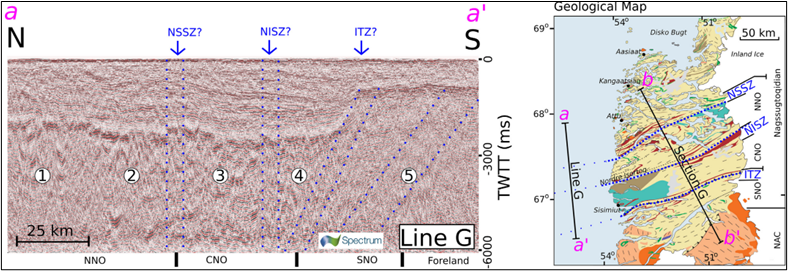
We offer a Master's thesis on the interpretation of geophysical data in the Davis Strait between western Greenland and Canada, where the nature of the crust is controversial and microcontinents have been proposed (e.g. Longley et al., 2024).
The work aims to map major Palaeoproterozoic thrust systems and associated fold and fault structures that may be associated with the Nagssugtoqidian orogen in western Greenland and its temporal correlate in northeastern Canada, the Torgat orogen (van Gool et al., 2005).
The project will also focus on investigating the influence of these thrusts in controlling subsequent rift-related structures in overlying Paleozoic-Cenozoic sedimentary rocks (e.g. Peace et al., 2018). The student will use seismic reflection data from TGS and various geophysical datasets where available (e.g., gravimetric, magnetic, bathymetric, and borehole data).
Through this thesis, the student will acquire critical skills in structural interpretation of seismic reflection data using Petrel, scientific writing, assessment and discussion of scientific uncertainty, ethics in science, communication techniques to present and disseminate scientific results, a professional network of international experts in various fields of geoscience, and participation in international research projects (ArcTec, OrBiT).
The work will include interaction with Assoc. Prof. Alexander Peace at McMaster University (Canada).
The proposed work can prepare for a career in the energy industry (hydrogen, carbon capture and storage, hydrocarbons and offshore mining), government surveys (e.g. NGU, SoDir) and academia. The career aspirations of the selected student will be discussed before the start of the project and the objectives and activities of the project will be tailored to the student's needs.
Please express your interest to Jean-Baptiste Koehl (jeanbaptiste.koehl@gmail.com) to discuss availability.