Job Description:
This master project is aimed at 3D seismic mapping, fieldwork and rock mechanics analysis of samples. The work is based on collaboration between the CO2 storage teams at UiO and Equinor. The candidate will work with a PhD Research Fellow and in a team of structural geologists at the University of Oslo and Equinor.
Some work will be carried out at Equinor's offices (Fornebu), and laboratory work may be carried out at Equinor's laboratory in Bergen. Some fieldwork in western Norway (near Førde) is central to the project.
Project description:
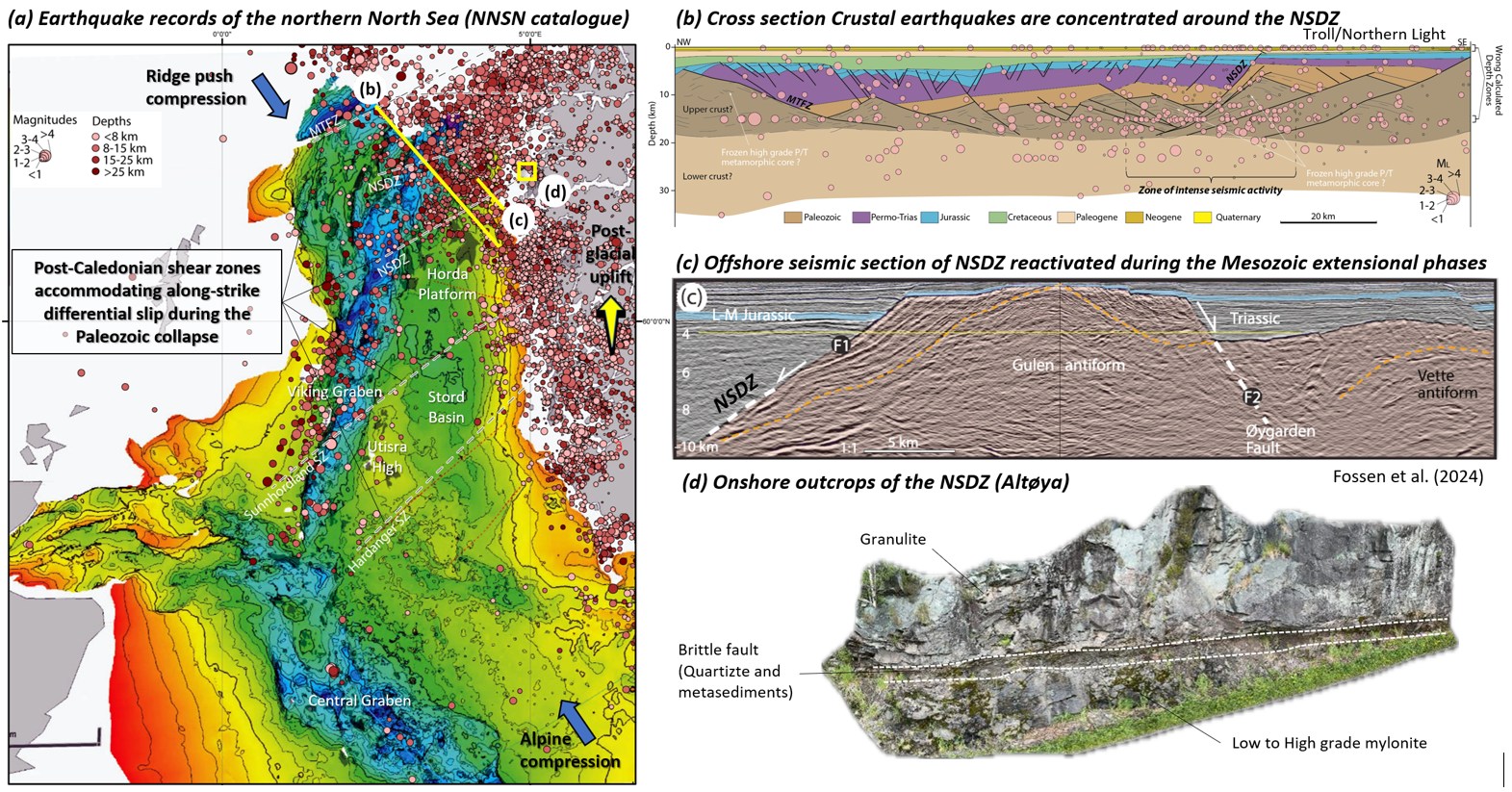
Rifting in the North Sea is driven by inherited mechanical comportments that control a range of fault orientations and geometries in the crust (basement) as well as in the overlying sediments. Conspicuous seismogenic zones observed today suggest that present in situ stress regimes vary from the basement to the sedimentary cover.
Depending on stress orientations and basement rheology, faults may be close to reactivation. Although the seismic hazard in the North Sea is relatively low, seismic activity could provide open normal faults with fluid migration.
The project will analyse the mechanical behaviour of a specific crustal fault zone in the northern North Sea, based on 3D seismic interpretation together with rock mechanics analysis of a shear zone from onshore outcrops.
The study will consider stress levels and mechanical properties of the rocks and may include geomechanical modelling.
The aim is to improve our understanding of the mechanical response of the lithosphere within the North Sea Rift, which will enhance our ability to assess the risks associated with CO2 storage operations.