Drones can be equipped with instruments to sample the atmosphere, for example to obtain methane concentration observations. By combining these observations with atmospheric transport models—for instance large-eddy simulations (LES)—through Bayesian inference, predictions can be made of the emission rate of a methane source. In a previous study, we used point concentration samples to estimate methane emissions of a cattle herd. Collecting such observations raises the question: where should the drone fly to obtain the most informative observations for the Bayesian inference process? Active learning offers a way to answer this question by predicting the information gain of a potential future measurement.
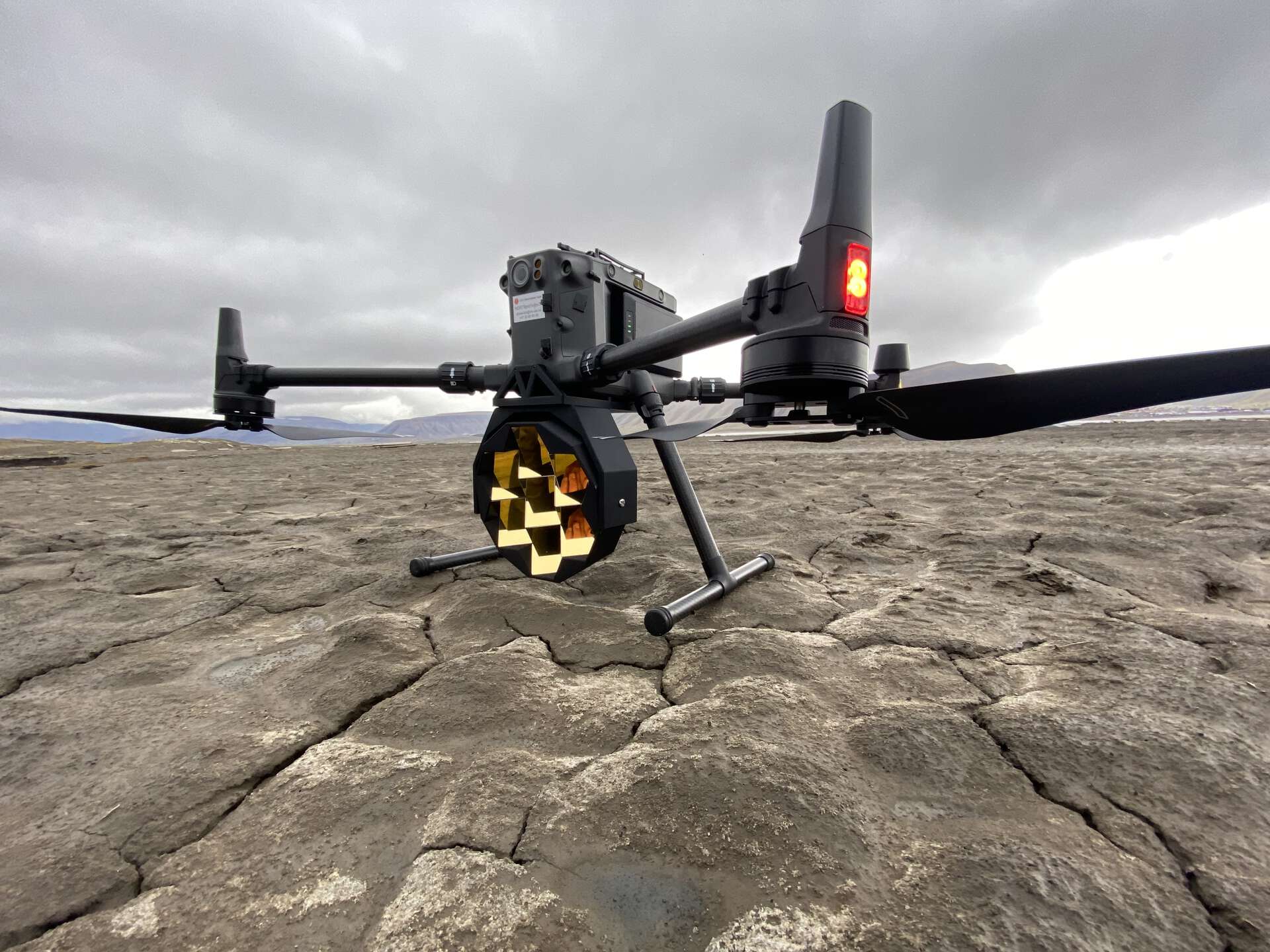
This MSc thesis applies this approach to a new sensing setup: an open-path laser methane sensor, where the laser instrument stands on the ground and the drone carries a mirror (see photo) that reflects the signal back, providing path-integrated methane concentrations along the beam. The study will be conducted using synthetic data, optionally complemented by test data from a previous campaign on Svalbard, and the student will have the opportunity to carry out further real-world experiments with the setup as well. There is considerable room here to develop and compare strategies for guiding the drone's flight path. Machine learning model development can become a central part of the thesis for a student interested in that direction.
The exact focus of the MSc thesis is flexible and can be tailored together with the supervisors—for example, toward developing and testing the open-path laser sensing and inference setup itself, toward atmospheric transport modeling using LES, or toward flight-path optimization using active learning or reinforcement learning.