Background
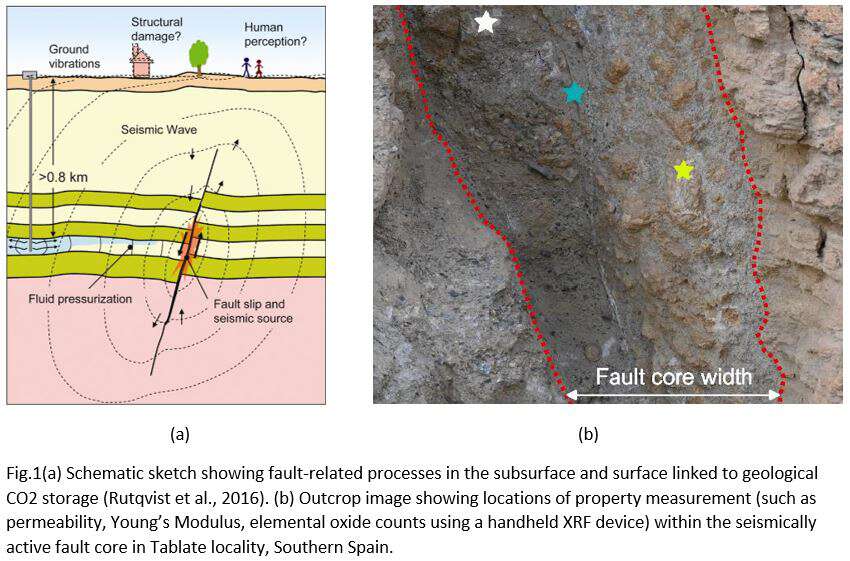
Reliable prediction of fault-controlled fluid flow is critical for the safe development of geological CO₂ storage projects. Current workflows of fault seal analysis use empirical proxies such as Shale Gouge Ratio (SGR) and Clay Smear Potential, which simplify complex geological heterogeneity into single predictive parameters. However, recent field observations suggest that the spatial organisation of the fault core elements (like fault gouge, fault breccia, smears, lens) exhibiting distinct properties may exert a stronger control on fluid flow than the bulk composition alone.
The key challenge to address through this thesis is to determine which geological features in the fault core are important for reliable prediction of subsurface fluid flow.
Objectives
The thesis will quantify how structural heterogeneity within the fault core influences uncertainties in flow predictions. The candidate will assess the significance of fault core architecture such as the spatial organisation of fault core elements, permeability contrasts and anisotropy on the multiphase CO2-brine systems relevant to CO2 storage.
If interested, the candidate may also develop deep learning algorithms from previously available open-source literature to automate fault core characterisation from outcrop images.
Methodology
The thesis will utilize results from outcrop characterisation containing detailed geometry and petrophysical properties of fault core from Southern Spain. The candidate will develop a workflow using Python to generate several statistically constrained digital realisations or digital fault core architectures preserving outcrop-based geological characteristics. Numerical simulations along with sensitivity analysis will quantify the effect of variable fault core architecture on fluid-flow in CO2-brine systems.
Expected impact
The thesis will deliver open-source workflow that ranks the geological controls influencing fault-controlled fluid-flow. It will serve as an important guideline to identify the minimum geological fault characterisation required for reliable understanding of fluid flow during CO2 storage. The insights from the thesis will contribute to the development of strategies that will refine existing fault seal analysis workflows supporting safer and more efficient geological CO2 storage.
The candidate will have the opportunity to collaborate with partners in the ongoing gigaCCS and CO2SafeQuest projects.
Reference:
- Alaei, Behzad and Braathen, Alvar, Automating fault interpretation in outcrop images: A First Deep Learning Approach and Insights. Available at SSRN: https://ssrn.com/abstract=5958695 or http://dx.doi.org/10.2139/ssrn.5958695
- Berg, S. S., & Øian, E. (2007). Hierarchical approach for simulating fluid flow in normal fault zones. Petroleum Geoscience, 13(1), 25-35.
- Fredman, N., Tveranger, J., Semshaug, S., Braathen, A., & Sverdrup, E. (2007). Sensitivity of fluid flow to fault core architecture and petrophysical properties of fault rocks in siliciclastic reservoirs: a synthetic fault model study. Petroleum Geoscience, 13(4), 305-320.
- Rinaldi, A. P., Jeanne, P., Rutqvist, J., Cappa, F., & Guglielmi, Y. (2014). Effects of fault‐zone architecture on earthquake magnitude and gas leakage related to CO2 injection in a multi‐layered sedimentary system. Greenhouse Gases: Science and Technology, 4(1), 99-120.
- Rizzo, R. E., Inskip, N. F., Fazeli, H., Betlem, P., Bisdom, K., Kampman, N., ... & Busch, A. (2024). Modelling geological CO2 leakage: Integrating fracture permeability and fault zone outcrop analysis. International Journal of Greenhouse Gas Control, 133, 104105.
- Rutqvist, J., Rinaldi, A. P., Cappa, F., Jeanne, P., Mazzoldi, A., Urpi, L., Guglielmi Y. & Vilarrasa, V. (2016). Fault activation and induced seismicity in geological carbon storage–Lessons learned from recent modeling studies. Journal of Rock Mechanics and Geotechnical Engineering, 8(6), 789-804.
- Torabi, A., Jiménez-Millán, J., Jiménez-Espinosa, R., García-Tortosa, F. J., Abad, I., & Ellingsen, T. S. (2020). Effect of mineral processes and deformation on the petrophysical properties of soft rocks during active faulting. Minerals, 10(5), 444.
- International Energy Agency Greenhouse Gas R&D Programme (IEAGHG). (2024). Geological Storage of CO₂: Seal Integrity Review (Report No. 2024-06). https://doi.org/10.62849/2024-06