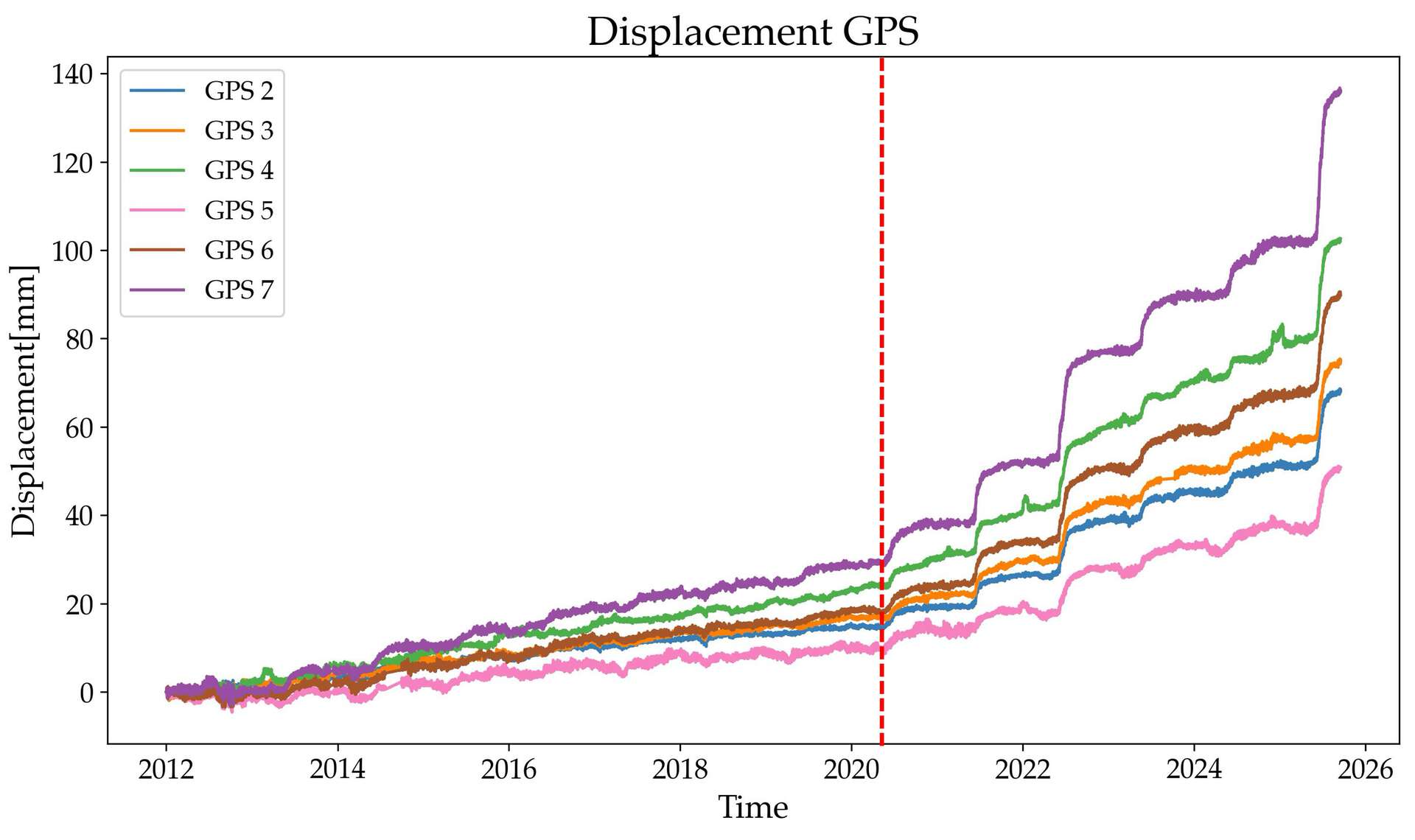
Creep is a fascinating phenomenon in geomechanics, observed in a variety of geological settings. A well-known example is the creeping segment of the San Andreas Fault, which deforms steadily at about 30 mm/yr. Unlike the neighbouring locked segments, a creeping fault progressively releases the energy of tectonic loading, and the creeping segment has therefore remained comparatively quiet in terms of seismic activity.
Closer to home, Norway hosts several examples of creeping rock slopes. The most prominent is the unstable rock mass at Åknes in Stranda kommune, where roughly 50 million cubic metres of rock standing above Sunnylvsfjorden threaten to fail and generate a catastrophic tsunami. As on the San Andreas Fault, deformation rates at Åknes are on the order of tens of millimetres per year. Here, however, the shear zone lies at a depth of only 15–30 metres and is accessible to direct in situ monitoring. Since 2017, Norges vassdrags- og energidirektorat (NVE) has installed several state-of-the-art monitoring boreholes that continuously record fluid pressure and displacement at different depths and locations within the rockslide.
In this project, the student will work with this exceptional natural laboratory, combining data analysis and/or modelling to interpret the displacement, fluid pressure, and temperature time series recorded at Åknes. The aim is to address questions about the dynamics of the slope, such as how rainfall, temperature, and snowmelt influence the sequences of creep bursts observed each year. The project will also include a comparison with other monitored creeping rock slopes in Norway, in partnership with NVE.
This Master’s project will be integrated into a cross-disciplinary research team at the Njord Centre, where you will participate in weekly meetings with NVE and other researchers from the group working on related topics. The overarching goal is to better understand the geomechanical processes causing the measured variations in creep velocity and to better anticipate the risk of catastrophic failure.
Do not hesitate to contact Fabian (fabian.barras@mn.uio.no) if you need further information on the project.