Why are stromatolites interesting?
Stromatolites are defined as "organo-sedimentary structures” formed by the incidental induction of mineral precipitation within or on microbial biofilms with, or without, trapping and binding of ambient sediments (Hohl and Viehmann, 2021). In other words, stromatolites are the oldest known remnants of prokaryotic microorganisms that harboured the shallow photic zone of the oceanic environment during the Palaeoarchaean times (Allwood et al., 2009).
Here we would emphasize the Archaean sedimentary record in terms of benthic versus planktonic microbiota concerning nutrient supply/exchanges in the ancient oceans. The Archaean featured "non-uniformitarian" conditions, such as a reducing atmosphere, intense sea-floor weathering, early acidic oceans, mostly submerged continents, abundant greenhouse gases, and intense UV radiation (Hohl and Viehmann, 2021; Catling and Zahnle, 2020).
Cyanobacteria are remarkable "survivors," as they endured with conditions such as shorter length of day (~12-16 hours), lower sun’s luminosity (77% of modern day) and intense greenhouse state (6% modern day level; Alcott et al. 2024). Therefore, it remains important to decode the earliest biogeochemical processes through the stromatolite archive across the Archaean.

Why study Archaean stromatolites from South Africa and India?
The oldest confirmed stromatolites are extensively studied in the Pilbara Craton's Archean record, specifically the Dresser Formation (3.49 Ga) and Strelley Pool Formation (3.43 Ga; Hohl and Viehmann, 2021).
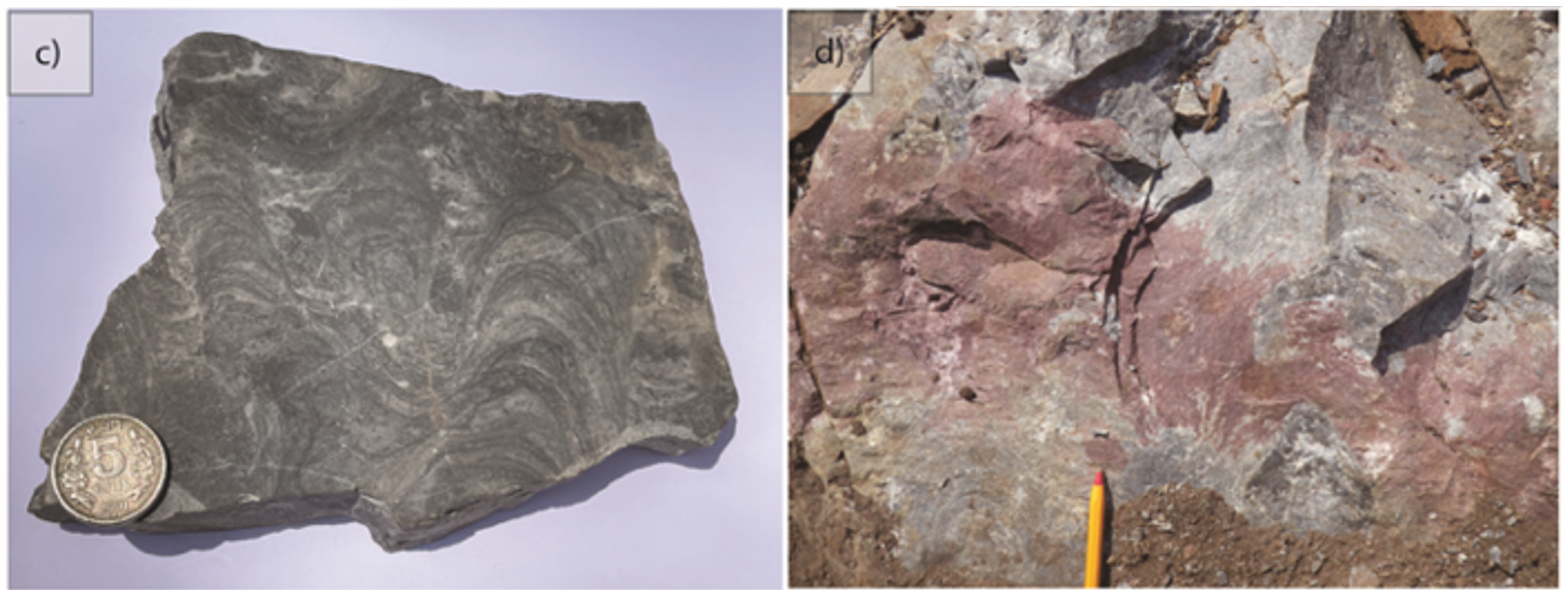
In Africa, stromatolites from the Nondweni Greenstone Belt, South Africa (~3.41 Ga, Fig. 1a-b) represent some of the oldest yet are poorly investigated (Wilson and Versfeld, 1994). Similarly, stromatolites from the Singhbhum Craton in India (~2.7 Ga) are well-preserved but understudied (Jodder et al., 2025, Fig. 1c-d). The abovementioned stromatolites exhibit notable morphological similarities and growth patterns (laminae), akin to those in the Dresser Formation, Pilbara Craton. Our focus will be on exploring early Earth biogeochemical processes influencing the growth of cyanobacterial bioherms in these stromatolites.
High-resolution imaging techniques will be utilized to document these cyanobacterial remnants, offering insights into past and present environmental dynamics and interactions with the bio-geosphere. Such studies are crucial for understanding the co-evolution of Earth and life, shedding light on stromatolites' adaptability and significance in Earth's geological and biological history.
Methodology
Field and drone-based mapping will be combined with portable XRF study and subsequent collection of ~ 15-20 cm drill core samples from the best-preserved outcrops.
Petrographic and Raman analyses will be conducted at the UiO to identify individual mineral phases within the stromatolites. Polished thin sections will be analysed using TIMA imaging, along with trace element analyses of the organic rich stromatolitic domains using LA-MC-ICP-MS analysis.
To unravel nanometre textural details, orientations and mineralogical compositions, we will apply high resolution imaging of selected thin sections at the European Synchrotron Radiation Facility, Grenoble, France.
High resolution Synchrotron based study of South African and Indian stromatolites
To achieve high-resolution imaging of ancient microbialites, CT scans will be attempted. We plan to use PPC-SRμCT for imaging microbialite structures within a dense siliceous matrix. ESRF BM05 is requested due to its high energy and suitable propagation distance for phase retrieval, providing enough contrast to visualize the preserved microbialites. Six shifts are requested to image two complete cores at resolutions of 3µm and 0.7µm. Beamline BM05 high-energy source and local expertise make it ideal for this type of experiment.
The experiment will occur in two sessions spaced apart to enable volume reconstruction, region of interest (ROI) identification, and sample preparation for nantomography. Note the timing for the synchrotron analyses are already discussed with collaborators and beamline scientists at ESRF.
References:
- Alcott, L. J., Walton, C., Planavsky, N. J., Shorttle, O., & Mills, B. J. (2024). Crustal carbonate build-up as a driver for Earth’s oxygenation. Nature Geoscience, 17(5), 458-464.
- Allwood, A. C., Walter, M. R., Kamber, B. S., Marshall, C. P., & Burch, I. W. 2006. Stromatolite reef from the Early Archaean era of Australia. Nature. 441: 714–718.
- Catling, D. C., & Zahnle, K. J. (2020). The archean atmosphere. Science advances, 6(9), eaax1420.
- Hohl, S. V., & Viehmann, S. (2021). Stromatolites as geochemical archives to reconstruct microbial habitats through deep time: Potential and pitfalls of novel radiogenic and stable isotope systems. Earth-Science Reviews, 218, 103683.
- Allwood, A.C., Grotzinger, J.P., Knoll, A.H., Burch, I.W., Anderson, M.S., Coleman, M.L., Kanik, I., 2009. Controls on development and diversity of early Archean stromatolites. PNAS 106, 9548–9555.
- Jodder, J., Hofmann, A., Elburg, M. A., Ngobeli, R., & Torsvik, T. H. (2025). Reply to comment on “Debunking the myth of a single Iron Ore Group in the Singhbhum Craton, India”. Precambrian Research, 427, 107884.
- Wilson, A.H., Versfeld, J.A., 1994. The early Archaean Nondweni greenstone belt, southern Kaapvaal Craton, South Africa; Part II, characteristics of the volcanic rocks and constraints on magma genesis. Precambrian Research 67, 277–320.