Iron (Fe) is one of the most abundant rock-forming elements, constituting about 5% of the Earth's crust and being the fourth most abundant element. It is the most-used metal and has been mined and utilized for many applications for more than 3500 years.
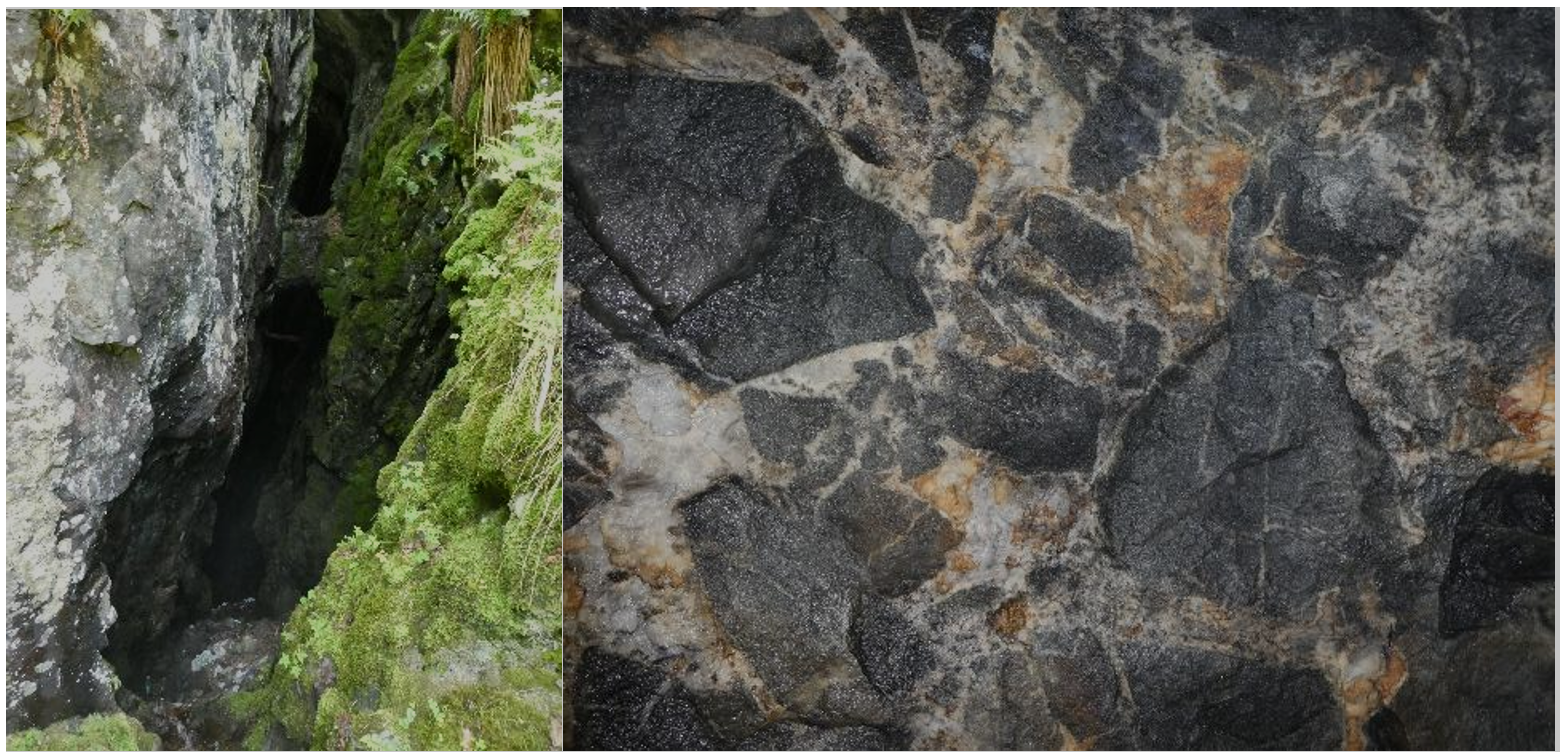
The Fe-oxide mines on Langøy island near Kragerø were worked, with interruptions, from about 1620 until 1966, with a total production of about 1 million t of magnetite ore. The mineralisation occurs in a 1.1 km long, magnetite-mineralized zone at the northern contact of a gabbro intrusion. The ore precipitated in a vein-like breccia zone hosted by metagabbro and albitite. The gabbro has a crystallization age of 1149 ± 7 Ma. The albitite is a metasomatic alteration product of intensely Na-metasomatised gabbro, which was affected at about 1090–1084 Ma. The metasomatic Na-bearing fluids responsible for the widespread alteration caused Fe depletion and the transformation of gabbro into albitite. However, it remains unclear whether the hydrothermal Langøy magnetite mineralisation represents the precipitation of metasomatically, locally remobilized Fe, or whether the fluids forming the Langøy Fe mineralisation were derived from other crustal sources. This uncertainty arises primarily from the lack of constraints on (1) the timing of magnetite mineralisation and (2) the nature and pressure–temperature conditions of the metasomatic fluids in the area.
Aims of the study
This study has two main objectives.
- The first is to identify datable minerals associated with the Langøy magnetite and to date them using U–Pb geochronology.
- The second is to characterise the fluids responsible for the mineralisation by studying the mineral assemblage and fluid inclusions in the gangue minerals quartz and calcite using microthermometry.
These data will be used to reconstruct the timing of mineralisation and the nature of the fluids involved. The results will be placed in a regional context by integrating existing data on Na-metasomatism, in order to elucidate the origin and mutual relationships between the Langøy mineralisation and the regional Na-metasomatism. Ultimately, the results will help to better constrain the source of Fe and improve our understanding of the genesis of metasomatic Fe-oxide deposits in general.
Research questions to be addressed
- What is the mineralogical assemblage and mineralisation sequence of the Langøy magnetite mineralisation?
- What were the composition and temperature of the hydrothermal fluid responsible for the Fe-oxide mineralisation?
- What were the approximate P–T conditions of ore precipitation?
- What is the age of the mineralisation (using U–Pb/Pb–Pb dating of magnetite), and what is its temporal relationship to the regional Na-metasomatism?
- What can be inferred about the source of Fe responsible for the Langøy mineralisation?
Implementation / Methodology
Fieldwork and sampling will be carried out during a one-week campaign on Langøy. Where possible, historical samples from the NHM collection will also be used. Rock and mineral samples will be prepared as thin sections and epoxy mounts. For bulk chemistry, rock samples will be sent to external commercial laboratories. The identification and quantification of minerals, their assemblages, and crystallization sequences will be conducted using optical microscopy, scanning electron microscopy, and electron microprobe analysis at UiO.
To identify datable minerals, ore samples will be crushed and subjected to heavy mineral separation. The recovered heavy minerals will be assembled, mounted, and analysed for their U–Pb content to determine their suitability for U–Pb geochronology. U–Pb/Pb–Pb dating of U-bearing phases will be performed at the Department of Geosciences at Blindern.
For fluid inclusion characterisation and microthermometry, calcite and quartz crystals related to the mineralisation will be prepared as doubly polished sections. Microthermometric measurements will be performed at the University of Tromsø. If solid phases are identified in the fluid inclusions, Raman spectroscopy will be carried out at the IFE in Oslo.
The study will also include a literature review of existing publications relevant to the area and topic.
What will the student learn?
The student will learn how to sample and map both underground mine workings and surface outcrops, and will become familiar with the identification, characterisation, and quantification of minerals using optical microscopy, scanning electron microscopy, electron microprobe analysis, fluid inclusion studies and microthermometry, as well as Raman spectroscopy. The student will be introduced to TIMS-based mineral age dating and will gain a comprehensive understanding of metasomatic processes and the chemistry of hydrothermal fluids.