The Norwegian Geotechnical Institute (NGI) is an applied research institution with many projects supporting the green energy transition in the offshore energy sector and a high focus on offshore wind energy and CO2 storage. In collaboration with UiO, we offer students the possibility to do a MSc project at NGI on topics closely linked to our ongoing research projects.
We are currently starting up research activities within the new gigaCCS research centre (https://www.ngi.no/aktuelt/Nytt-forskningssenter-gigaCCS/), where NGI together with UiO will focus on reducing the uncertainty-related to the deformation in the subsurface during CO2 injection and providing better containment risk assessments. In addition, we have ongoing activities related to the RecyclShale project. We have recently been awarded a new project, CO2SAFEQUEST, focusing on fault zone properties, integrating structural geology and geomechanics to better understand leakage risk along faults.
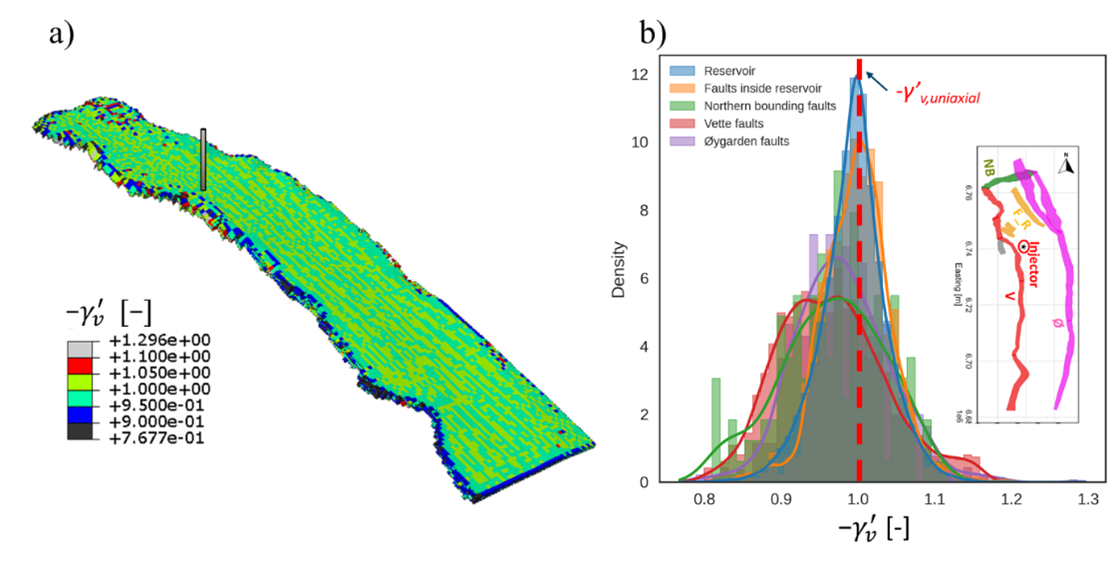
One or two thesis topics will be available for students who like to learn more about the integration of geology and geomechanics for a carbon-neutral energy solution. The thesis may be focused on analyses of available data from CO2 storage projects in the North Sea (e.g., the Horda Platform area) to simulate associated geomechanical behaviours, as demonstrated in Figure 1.
The results will be discussed in relation to the geology of the area and the containment risk for a CO2 storage project. A second option is to focus on fault zone characterisation by establishing a new data set using experimental methods and outcrop sampling. NGI will assist in defining an appropriate dataset and experimental methods for fault zone material. This will include standard and advanced laboratory data from core samples, well logs, geological and geomechanical models, and provide tools and methods for analysis. An interest in statistics and programming suitable for detailed data analysis will be beneficial to the thesis. A detailed description of the thesis will be planned with the student.
The student will learn:
- Get a unique experience in data analysis and uncertainty quantification
- In-depth knowledge of geomechanical data and laboratory methods
- Understanding the geomechanical risk related to faults
- Independent research, academic writing and presentation skills