Background
Dissolved Fe and Mn are found in acid and anaerobic ground water, but they have traditionally not been considered a health concern, but more a problem connected with discoloration and taste. Manganese is often hard to remove and may stay in solution to cause impacts on taste and staining of laundry. Furthermore, there is new evidence that high manganese in drinking water may have an adverse impact on learning capacity in young children, although there remain many uncertainties.
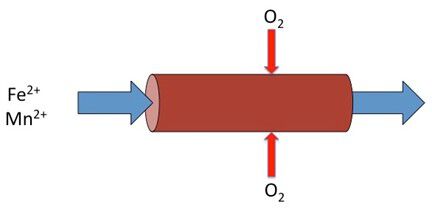
For groundwater, subsurface iron and manganese removal by oxidation is a good alternative to traditional water works treatment methods. Today there are several techniques to remove Fe & Mn from groundwater and several water works in Europe are using in situ methods.
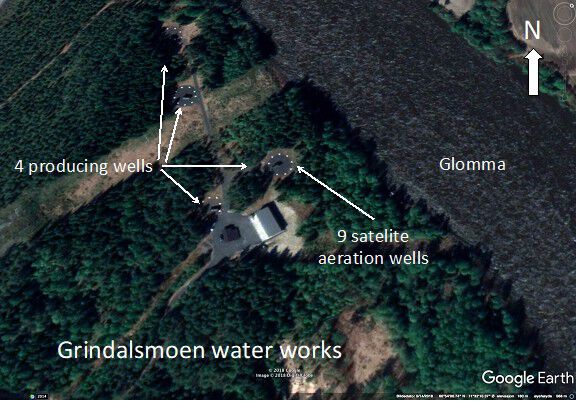
In Norway, one such technique, the Vyredox method is used in Grindalsmoen water works at Elverum. However, the exact mechanism involved is not clear. It is generally believed to be a combined sorption and oxidation process, where iron-oxide/hydroxide precipitates on mineral grain surfaces, and further promote sorption of Fe++, Mn++ and other heavy metals.
Especially manganese oxidation may also be biologically mediated. A recent MSc thesis studied the microbiological society involved in iron and manganese oxidation at Grindalsmoen (Svenni 2025).
Aims
This master thesis aims at a better understanding of the kinetics and mechanisms involved in subsurface oxidation removal of iron, manganese and other heavy metals from groundwater. This knowledge may furthermore be used to enhance removal technology.
The MSc study will apply laboratory studies as well as reactive transport calculations. This will give the student good experience with methods commonly used in environmental geology and geochemistry.
The lab studies will be carried out in flow through column with the actual sand material from Grindalsmoen. The experiments will be run both non-biotic as well as biotic with relevant microbial composition.
Requirements:
- Basic knowledge of chemistry
- Basic programming skills