Background and aim of the research:
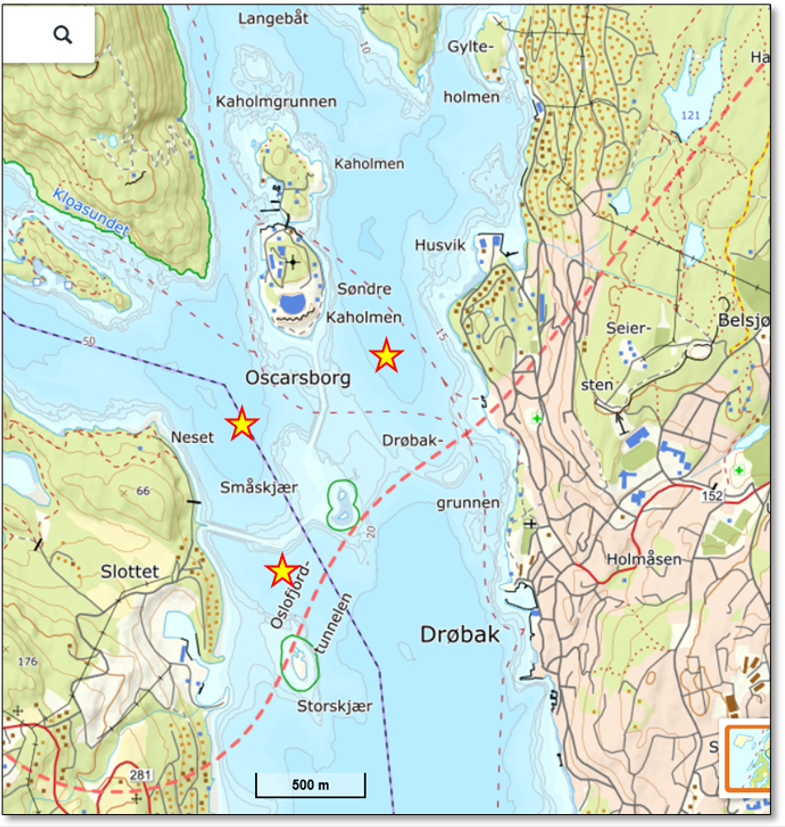
Offshore Drøbak there is a 1500m long and up to 25m high underwater wall from the skerries of Hurum via Småskjær to the islet of Søndre Kaholmen on which the Oscarsborg fortress is located. The wall was built in 1874-79 as a defence construction to prevent large vessels from sailing into the inner Oslofjord on the west side of the Oscarsborg fortress. Two small openings in the upper parts of the wall, one near Hurum, and another south of Søndre Kaholmen, allow small boats to pass.
For many decades, the inner Oslofjord environment has been negatively impacted by intense human activities, resulting in physical disturbance, chemical and organic pollution, eutrophication, and related low oxygen conditions at the sea bottom. An ongoing discussion about how to improve water circulation and bottom water oxygen conditions in the inner Oslofjord recently focused on the impact an opening of the Drøbakjeté might have on the circulation patterns.
The master thesis will focus on multiproxy studies (micropaleontological, sedimentological and geochemical parameter analyses) of marine sediment cores located in the vicinity of the Drøbakjeté (ideally N and S of the construction). Based on sediment accumulation rates, organic carbon and trace metal concentrations in dated cores, environmental changes over the last century and their spatial variability in the area can be determined. The study of fossil benthic foraminiferal assemblages will allow to assess the impact of the wall construction on the benthic soft bottom environment and ecosystem over time and space.
Research methodologies:
The study will be based on the analyses of short sediment cores collected in the vicinity of the Drøbakjeté, Oslofjord. The project will focus on analysing pollutants, organic carbon content, and fossil benthic foraminiferal assemblages of dated sediment cores.
Learning outcomes:
The master's student will be involved in marine fieldwork and laboratory work. The student is asked to produce her/his data and to describe and summarize the results scientifically. The student should be able to determine local environmental and ecological status changes over time, define reference conditions, and link and compare the results to existing studies.
The project is suitable for one to two students with a geological or biological background and an interest in the marine environment. We are very happy to adapt project ideas to individual interests or wishes.