Cars have over the last decades become more environmentally friendly by reducing NOx emissions, particulates and certain organic contaminants from fossil fuel, and more recently zero-emission electric cars have replaced fossil-fuel cars leading to less CO2 emissions. At the same time, the average car has become heavier, and more powerful, and tire dimensions have increased. This has likely resulted in more road tears and increased transport of microplastics from tires. A transition to spike-free tires may have had the opposite effect with less road tear.
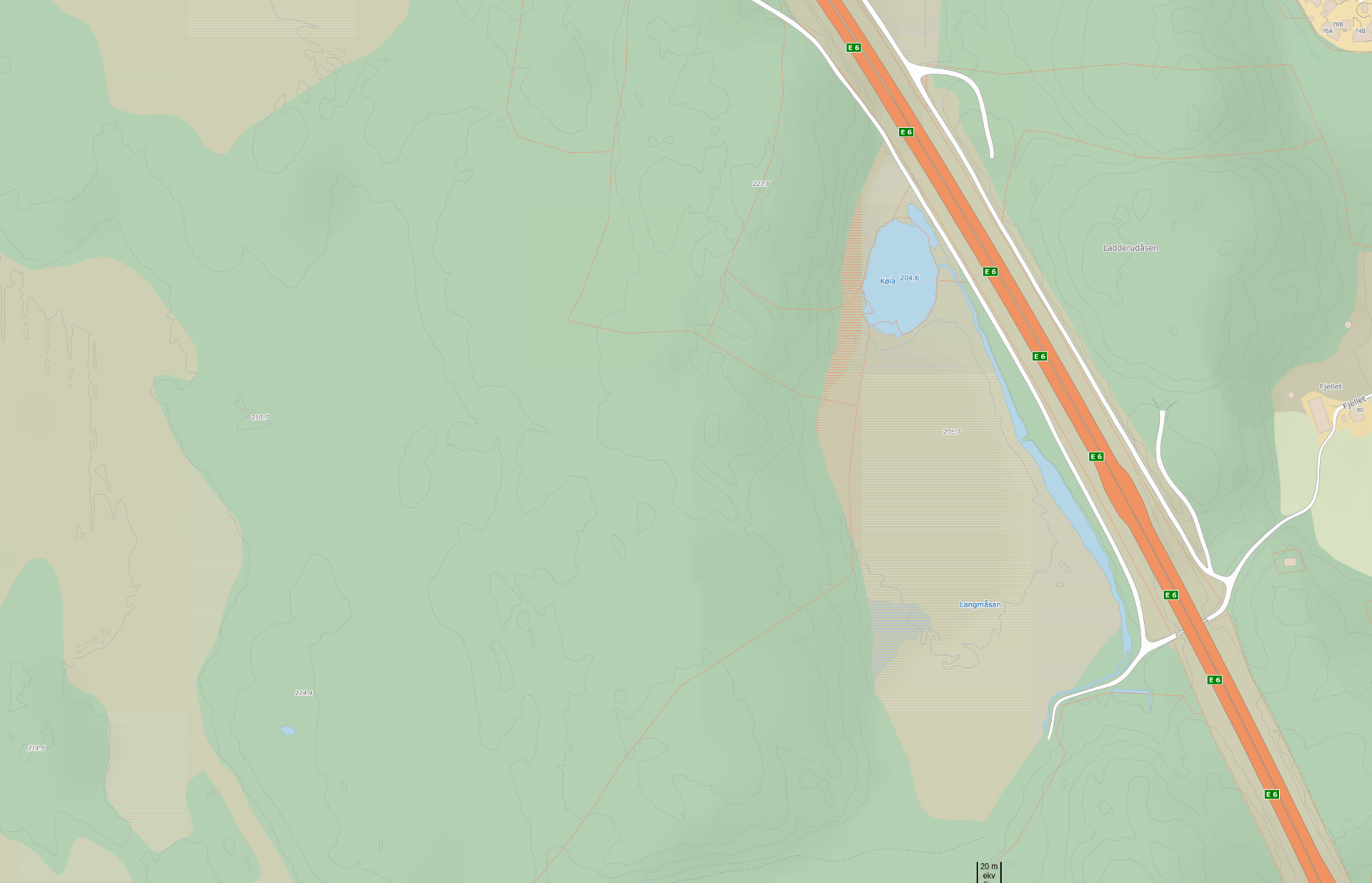
We will investigate sediment cores from smaller lakes approximately to E6 in Eidsvoll municipality (Fig. 1). E6 is a major highway with more than 10,000 cars passing every day. It was first constructed at the current location in the 1980s, built as a 2-line road, and later expanded to a 4-line road in 2010. The traffic has been steadily increasing and the latest number we have seen is 18,000 cars/day on average over a year.
We hypothesise that contaminants (dust, certain organic molecules, plastics) accumulate in nature approximately to the major roads and that the amount that accumulates decreases sharply with distance from the road. The mire and lake environments may therefore provide a historical record of contamination from road traffic, and provide trends in the accumulation of contaminants as the various factors affecting contamination change with time.
This master thesis aims at:
- Obtaining temporal trends in the amount of road dust, certain targeted organic contaminants, and microplastics over the last ~50 years (including the time before road construction at this site).
- Identifying major shifts in the transport of contaminants corresponding to technological leaps (e.g., particle filters, catalysts, etc).
- Obtaining spatial trends in the accumulation of the contaminants by sampling at different distances from the road.
- To try to identify anthropogenic organic compounds among the organic mire components.
- Providing a rough estimate of the total flux of contaminants from the road traffic at this site.
Methods:
The MSc study will apply both field and laboratory work as well as contaminant transport calculations. This will give the student good experience with methods commonly used in environmental geology and geochemistry.
Requirements:
- Decent background in organic or inorganic chemistry
- Students who want to work with this thesis are required to take GEO5900 – Chemical processes in soil and groundwater (spring 2025)