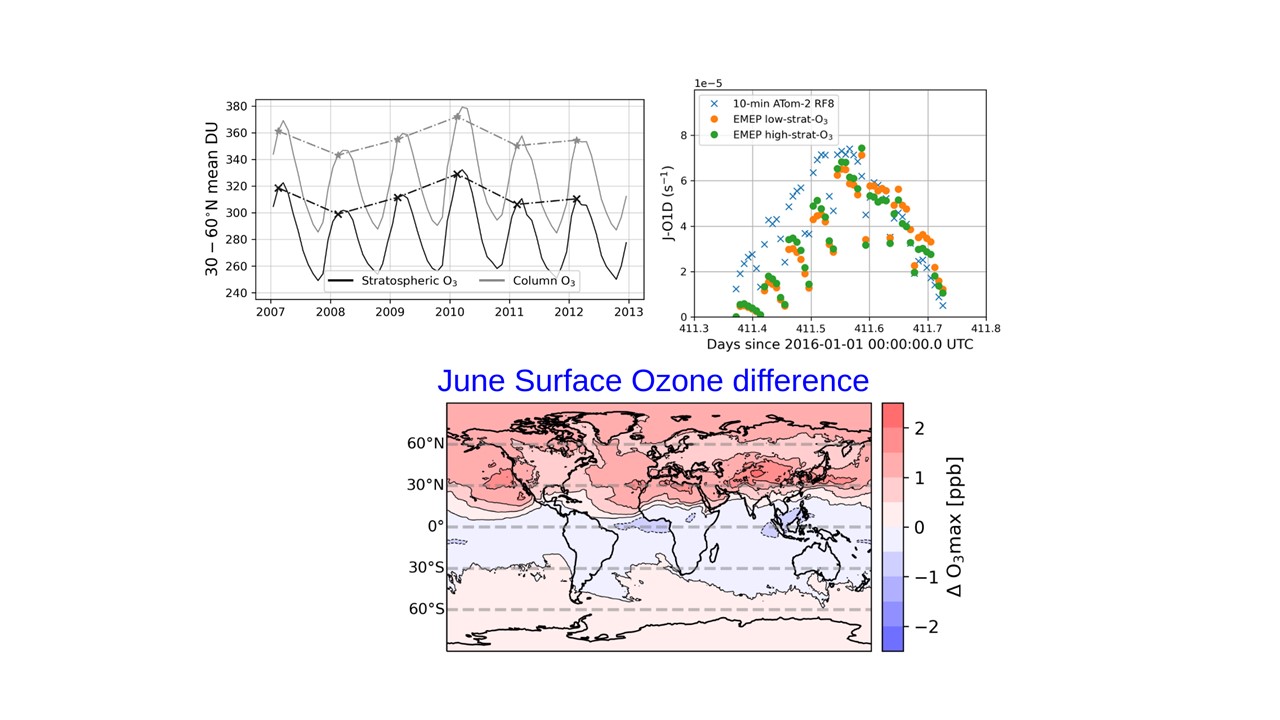
Recent work (https://doi.org/10.5194/gmd-16-7433-2023) identified variability in tropospheric photochemically active species such as ozone and hydroxyl, attributable to long-term (Quasi-Biennial Oscillation, El Niño-Southern Oscillation) and short-term (tropopause folding event) variability in the overhead stratospheric and upper tropospheric ozone column.
The overhead ozone column acts as a filter for UV radiation, affecting key tropospheric photolysis reaction rates (J values). The latter is responsible for driving the reactions that lead to the removal of key greenhouse gases and air pollutants. The photochemical coupling between dynamically driven stratospheric variability and tropospheric chemistry is a largely new and understudied topic.
Modelling tools:
- Mechanistic global 3D Eulerian EMEP chemical transport model simulations 1D tropospheric box model simulations using BoxChem.
Observational data:
- Atmospheric Tomography Mission (ATom) aerial campaign measurements over the Pacific Ocean (https://daac.ornl.gov/ATOM/guides/ATom_merge_V2.html).
- Satellite stratospheric ozone column measurements.
- Surface photolysis rate and ozone (column) measurements across Europe.
Research aims:
- Validation of modelled tropospheric hydroxyl concentrations and photolysis rates.
- Attribution and quantification of variations in tropospheric photolysis rates resulting from dynamically driven variations in overhead stratospheric ozone.
- Quantify and understand the resulting impacts on hydroxyl (OH) and its implications for the chemical lifetimes of greenhouse gases and air pollutants.