The Atlantic Water (AW), originating from the Gulf Stream, is the primary source of heat and salt to the Arctic Ocean. This heat contributes to the melting of sea ice and, in a future ice-free Arctic, allows AW to directly heat the polar atmosphere, thereby enhancing Arctic amplification—excessive warming in the north compared to lower latitudes. Several studies have demonstrated that current Earth system models perform poorly in representing the transport and transformation of AW in the Arctic Ocean. These models are widely used in the climate science community, including for the Intergovernmental Panel on Climate Change (IPCC) assessment reports, to project future climate scenarios. This project aims to better understand some of the underlying model deficiencies.
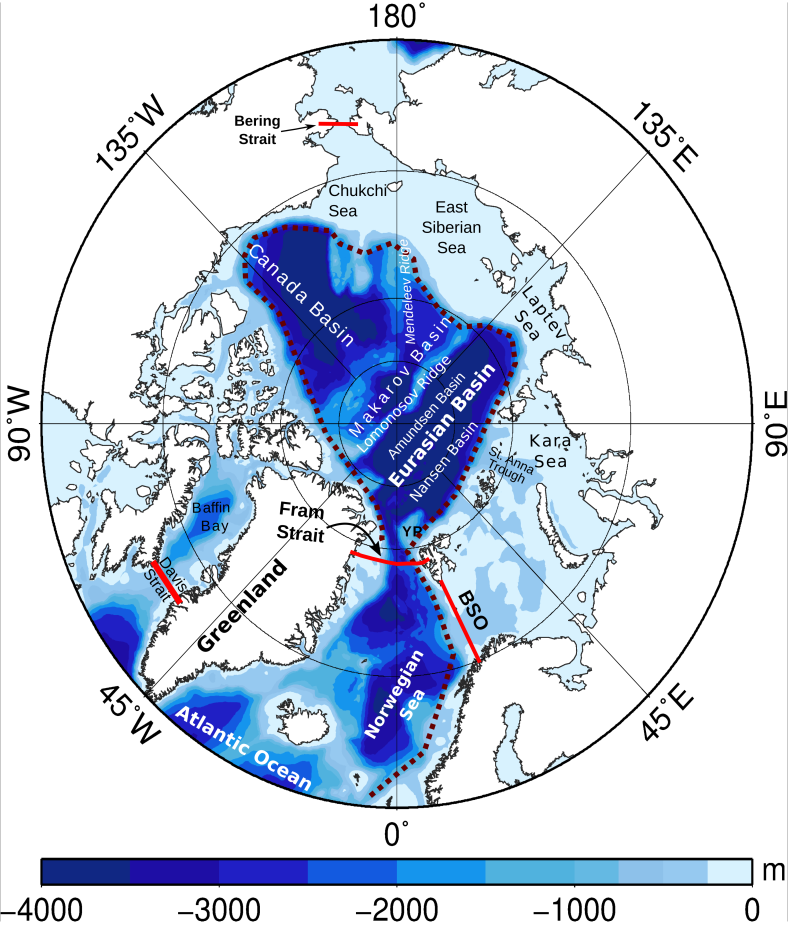
In the real ocean, AW is transported around the Arctic in the Arctic Circumpolar Boundary Current (ACBC; Figure 1). This current is strongly influenced by the continental slopes and underwater ridge systems, which create significant ‘potential vorticity’ (PV) gradients that currents find difficult to cross.
However, previous studies have indicated that in the models, the AW signature (warm and salty) disappears too quickly along the ACBC (see Figure 2 for an example). This likely implies that too much AW is being transported across the slopes and into the deep ocean basins. Whether this cross-slope transport is facilitated by currents resolved by the model grids or by mesoscale eddy transports represented through parameterisations remains an open question and forms the basis for this master’s project. A key hypothesis is that topographic PV gradients suppress cross-slope eddy transport and that this suppression is inadequately represented—as parameterisations—in most ocean climate models.
The student will study AW transport and properties (temperature and salinity) in the Norwegian Earth System Model (NorESM). Recent work has implemented a topographically-sensitive eddy parameterisation into the ocean component of NorESM; however, testing of this parameterisation has been limited.
To examine the evolution of AW in the ACBC and the role of eddy transport, the student will investigate the AW water mass in NorESM as it i) flows northward in the eastern Nordic Seas, ii) enters the Arctic Ocean via the Fram Strait and Barents Sea opening, and iii) circulates around the Arctic Ocean proper in the ACBC. The NorESM fields will be compared with observations as well as with higher-resolution ocean reanalysis products (which have themselves been constrained by observations). The analysis will also compare fields from different versions of the NorESM model to identify key dynamical aspects that NorESM (and other climate models) struggle with.
In particular, anticipating that mesoscale dynamics control much of the cross-slope transport, both in reality and in the model, the student will evaluate and compare runs with:
- Eddy-permitting vs. non-eddy-permitting grid resolutions
- Topographically-sensitive vs. flat-bottom eddy parameterisations
The project will involve handling, analysing, and plotting large model datasets. It is also envisioned that the student will learn to run the ocean component of NorESM and conduct dedicated sensitivity experiments.